Electrical Maintenance Checklist
Electrical problems often give maintenance teams warning before they become failures. A loose connection, overloaded circuit, deteriorating insulation, moisture intrusion, or overheating component may leave evidence such as abnormal temperature, discoloration, unusual noise, nuisance trips, or changing test readings.
The goal of an electrical preventive maintenance program is to identify those conditions early, correct problems before they become failures, and maintain a documented history of the equipment. The actual inspection frequency and testing requirements should be based on the equipment, manufacturer recommendations, operating conditions, criticality, applicable codes and standards, and the facility’s electrical safety program.
This checklist is a general maintenance reference and recommended starting point for commercial and industrial facilities. It is not a universal maintenance schedule. See the disclaimer below before using or adapting these recommendations.
What Is an Electrical Maintenance Checklist?
An electrical maintenance checklist is a documented set of inspection, testing, cleaning, and maintenance tasks used to monitor the condition of electrical equipment and identify problems before they result in equipment damage, downtime, or safety incidents.
Depending on the facility, an electrical maintenance program may include routine operator observations, preventive maintenance, condition-based inspections, electrical testing, infrared thermography, protective-device testing, emergency-power testing, and corrective work.
The right checklist is different for every facility. A manufacturing plant with motor control centers, production equipment, transformers, and emergency power will have different maintenance requirements than a small commercial building. Maintenance managers should build the checklist around the actual equipment in service and the risks associated with its failure.
Electrical Components Maintenance Teams Commonly Inspect
Electrical maintenance programs can cover a wide range of equipment. Common inspection and maintenance points include:
- Circuit breakers and disconnects — inspect for signs of overheating, damage, abnormal operation, and other conditions identified by the manufacturer or maintenance program. Protective-device testing should be performed when required by the equipment, maintenance program, or applicable requirements.
- Panelboards, switchboards, and switchgear — inspect for overheating, contamination, corrosion, physical damage, loose or deteriorated connections, and other abnormal conditions.
- Transformers — inspect according to transformer type and manufacturer requirements. Liquid-filled transformers may require monitoring of oil level and condition, while dry-type transformers may require inspection for contamination, overheating, and ventilation problems.
- Motor control centers (MCCs) — inspect starters, contactors, overload devices, buckets, bus connections, and other components for wear, overheating, contamination, or abnormal operation.
- Grounding and bonding systems — inspect accessible grounding and bonding connections and perform appropriate testing when required by the system design or maintenance program.
- Emergency and standby power equipment — maintain generators, automatic transfer switches, UPS systems, batteries, and associated distribution equipment according to manufacturer instructions and applicable requirements.
Routine Electrical Checks — Recommended
Focus: abnormal conditions, equipment condition, housekeeping, and early warning signs.
Routine checks are generally intended to identify obvious problems without exposing personnel to unnecessary electrical hazards. The exact frequency should be established by the facility’s maintenance program.
| Maintenance Task | What to Check |
|---|---|
| Inspect accessible electrical equipment for visible damage | Look for damaged enclosures, discoloration, corrosion, signs of overheating, water intrusion, or other abnormal conditions. Do not remove covers or open energized equipment unless the work is permitted and performed by appropriately qualified personnel using required electrical safety practices. |
| Watch for unusual electrical conditions | Report unusual buzzing, humming, burning odors, smoke, visible arcing, repeated breaker trips, flickering lights, or other changes in normal operation. Do not simply reset a protective device repeatedly without determining why it operated. |
| Check electrical room housekeeping | Keep electrical equipment areas clean, dry, accessible, and free of stored materials that could interfere with required access or working space. Follow the facility’s electrical safety program and applicable clearance requirements. |
| Review equipment indicators and alarms | Review available status indicators, alarms, monitoring systems, and building-management-system points for abnormal conditions or equipment faults. |
Periodic Electrical PM Tasks — Recommended
Focus: equipment condition, environmental conditions, protective devices, and known failure points.
These tasks should be scheduled according to the equipment manufacturer’s recommendations, facility maintenance program, equipment criticality, operating environment, and applicable requirements rather than automatically assigning every task to the same calendar interval.
| Maintenance Task | What to Check |
|---|---|
| Inspect electrical rooms and equipment for heat and ventilation problems | Check for excessive heat, blocked ventilation, failed cooling equipment, dust accumulation, or other environmental conditions that could accelerate equipment deterioration. |
| Inspect for moisture and water intrusion | Look for leaks, condensation, standing water, corrosion, or evidence of previous water intrusion around electrical equipment. Correct the source of water intrusion rather than treating the electrical equipment alone. |
| Review breaker trips and electrical alarms | Review maintenance records and alarm history for repeated breaker trips, ground-fault indications, overloads, or other recurring electrical problems. Investigate the underlying cause before returning equipment to normal service. |
| Inspect accessible electrical connections | Where maintenance procedures require it, inspect connections for evidence of looseness, overheating, corrosion, or damage. Any torque verification should follow the equipment manufacturer’s specifications and be performed by appropriately qualified personnel. |
| Inspect motor control equipment | Check starters, contactors, overload devices, and related components for abnormal wear, overheating, contamination, or operating problems. |
| Verify equipment identification and labeling | Confirm panels, disconnects, circuits, and equipment are identified accurately. Update labels when circuits or equipment are modified. |
| Record inspection results in the CMMS | Record readings, observations, deficiencies, corrective actions, parts used, and follow-up work. A good maintenance history helps identify repeat failures and changing equipment condition. |
Condition-Based Electrical Maintenance
Not every electrical maintenance task needs to be performed on a fixed calendar schedule. Condition-based maintenance can help maintenance teams focus attention on equipment showing signs of deterioration.
Depending on the equipment and maintenance program, condition monitoring may include:
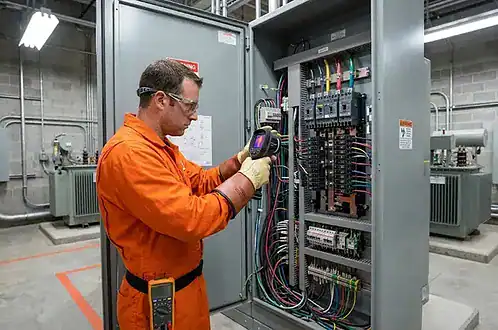
- Infrared thermography: identifying abnormal heat patterns that may indicate loose connections, overloaded circuits, deteriorating components, or other problems.
- Electrical test results: tracking applicable measurements over time and comparing results against manufacturer recommendations, established limits, or previous readings.
- Breaker and protective-device testing: verifying operation and settings where testing is required or appropriate.
- Insulation testing: evaluating insulation condition on applicable motors, cables, transformers, and other equipment using an appropriate test method.
- Power-quality monitoring: investigating voltage, current, harmonics, imbalance, or other power-quality conditions when they are relevant to the facility or equipment.
Emergency and Backup Power Maintenance
Emergency and standby power systems require their own maintenance and testing programs. Simply confirming that a generator starts is not the same as verifying the complete emergency-power system can perform its intended function.
| Equipment | Recommended Maintenance Focus |
|---|---|
| Emergency generators | Follow the generator manufacturer’s maintenance and testing requirements and the facility’s emergency-power program. Testing may include operational testing and, where required or appropriate, load testing or load-bank testing. |
| Automatic transfer switches | Inspect and test transfer operation according to manufacturer instructions and the facility’s emergency-power maintenance program. |
| UPS systems | Monitor UPS alarms, battery condition, environmental conditions, and available battery or runtime testing in accordance with the manufacturer’s recommendations. |
| Emergency and exit lighting | Inspect and test battery-backed emergency and exit lighting according to applicable life-safety requirements and the facility’s testing program. |
| Surge protective devices | Check status indicators where provided and replace failed devices according to manufacturer instructions and facility procedures. |
Lighting and Electrical Controls Maintenance
Lighting and controls are often treated as separate from electrical maintenance, but they can affect safety, equipment operation, building conditions, and energy use. Maintenance programs may include:
- Interior and exterior lighting: Check for failed fixtures, flickering, intermittent operation, damaged components, or abnormal light output.
- Emergency and security lighting: Verify required emergency, exit, exterior, parking-area, and security lighting is maintained and tested according to the applicable program.
- LED drivers and other lighting components: Inspect for overheating, intermittent operation, failure to start, or other signs of deterioration.
- Lighting controls: Verify occupancy sensors, timers, photocells, and other controls operate as intended.
Prioritize Electrical Equipment by Criticality
A maintenance manager should not treat every electrical asset as having the same consequence of failure.
Equipment supporting life-safety systems, critical production, refrigeration, process control, data infrastructure, emergency power, or other mission-critical operations may require a higher level of monitoring and a more defined preventive maintenance strategy than general-purpose equipment.
Recording equipment criticality in the CMMS allows the maintenance team to prioritize PMs, inspections, corrective work, and follow-up when resources are limited.
Electrical Testing and Inspection — Recommended Considerations
More detailed electrical testing should be planned around the equipment and the facility’s electrical maintenance program. It may include:
| Testing or Inspection | Maintenance Consideration |
|---|---|
| Infrared thermography | Use qualified personnel and appropriate procedures to identify abnormal thermal patterns in energized equipment. Thermal imaging should be performed under suitable operating conditions and interpreted by someone qualified to evaluate the results. |
| Protective-device testing | Test applicable breakers, relays, GFCIs, and other protective devices according to manufacturer requirements and the facility’s maintenance program. |
| Insulation-resistance testing | Perform appropriate insulation testing on applicable equipment when required by the maintenance program or equipment condition. Test procedures must account for equipment type and connected electronics. |
| Grounding and bonding inspection/testing | Inspect accessible grounding and bonding connections and perform appropriate testing based on the system, equipment, applicable requirements, and facility maintenance program. |
| Connection torque verification | Where required, verify connections using the equipment manufacturer’s specified torque values and appropriate procedures. This work should be performed by qualified personnel with the equipment in the required safe condition. |
| Arc-flash documentation | Review electrical system documentation, equipment labeling, and arc-flash information when equipment or system configuration changes or when required by the facility’s electrical safety program. |
Use Electrical Maintenance Data to Find Recurring Problems
A maintenance checklist is more useful when the results are captured and reviewed over time.
For example, if the same motor control center repeatedly shows elevated temperatures, a breaker trips several times, or a connection requires repeated corrective work, that history gives the maintenance team a reason to investigate the underlying problem instead of treating every occurrence as an isolated work order.
Recording inspections, meter readings, thermal findings, failures, repairs, and follow-up work in a CMMS creates a maintenance history that can help the team identify repeat failures and make better decisions about repair, replacement, and PM frequency.
Electrical Safety: Maintenance and Safe Work Practices Are Different
Electrical equipment maintenance and electrical safety are closely related, but they are not the same thing.
NFPA 70B addresses electrical equipment maintenance and provides a framework for maintaining electrical, electronic, and communication systems and equipment. NFPA currently identifies 2026 NFPA 70B as the current edition. Whether a particular edition or provision is legally required depends on the applicable jurisdiction, adopted codes, authority having jurisdiction, contractual requirements, and other circumstances.
NFPA 70E addresses electrical safety in the workplace, including safe work practices for electrical hazards, arc-flash considerations, and personal protective equipment.
OSHA also has federal workplace electrical requirements, including requirements concerning electrical safety-related work practices and training. OSHA’s rules distinguish between qualified and unqualified persons based on the work and electrical hazards involved.
For a maintenance manager, the practical distinction is important: the PM checklist defines what equipment should be inspected or maintained, while the facility’s electrical safety program determines who can perform the work and how that work must be performed.
How eWorkOrders CMMS Supports Electrical Maintenance
Electrical maintenance involves recurring inspections, test results, corrective work, equipment history, and follow-up tasks. A CMMS can help maintenance teams keep those activities organized.
eWorkOrders can be used to schedule recurring electrical PMs, assign work to qualified personnel, record inspection results, attach test documentation, track corrective work, and maintain a history for each electrical asset.
For maintenance managers, the value is not simply having a checklist. It is having a documented maintenance history that shows what was inspected, what was found, what corrective action was taken, and what still needs attention.
Frequently Asked Questions
How often should commercial electrical equipment be inspected?
There is no single inspection interval that applies to every commercial or industrial electrical system. Frequency depends on equipment type, manufacturer recommendations, condition, operating environment, criticality, maintenance history, applicable requirements, and the facility’s electrical maintenance program. A qualified electrical professional or responsible facility electrical program should establish the appropriate intervals.
What is included in an electrical preventive maintenance checklist?
An electrical PM checklist may include visual inspections, equipment condition checks, connection inspections, protective-device testing, infrared thermography, insulation testing, grounding and bonding checks, emergency-power maintenance, lighting inspections, and documentation. The actual checklist should be built around the equipment installed at the facility.
Who should perform electrical maintenance?
Some routine observations may be performed by trained facility personnel when permitted by facility procedures. Electrical testing, maintenance involving exposed electrical hazards, and work on or near energized equipment should be performed only by personnel who are appropriately qualified, trained, authorized, and equipped for the work. OSHA requires electrical safety-related work practices for employees working on or near equipment that is or may be energized.
What can happen when electrical equipment is not maintained?
Electrical equipment can develop deteriorated insulation, loose or damaged connections, contamination, overheating, worn components, and other conditions that may contribute to equipment failure, downtime, electrical hazards, or fire. Preventive and condition-based maintenance can help identify developing problems before they become larger failures.
What is infrared thermography used for in electrical maintenance?
Infrared thermography uses a thermal-imaging camera to identify abnormal temperature patterns on energized electrical equipment. Maintenance teams may use thermal inspections to identify potential hot spots associated with loose connections, overloaded circuits, component problems, or other abnormal conditions. Thermal findings should be evaluated by personnel qualified to interpret the results.
How much does electrical maintenance cost?
Electrical maintenance costs vary widely based on the facility, electrical equipment, system complexity, testing requirements, equipment condition, criticality, labor rates, and required maintenance scope. A qualified electrical contractor or testing organization can determine the appropriate scope and provide a site-specific estimate.
Does electrical maintenance include emergency power and lighting?
It can. A facility’s electrical maintenance program may include generators, automatic transfer switches, UPS systems, batteries, emergency lighting, exit lighting, surge protection, and other supporting equipment. Testing and maintenance requirements should be based on the equipment manufacturer’s instructions and applicable life-safety, electrical, and facility requirements.
Important Disclaimer: This electrical maintenance checklist is provided by eWorkOrders as a general reference and recommended starting point for commercial and industrial maintenance programs. The tasks, inspection methods, testing activities, and suggested maintenance considerations are recommendations only. They are not intended to establish a universal electrical maintenance schedule or to state that every task applies to every facility or piece of equipment.
Electrical maintenance requirements vary according to equipment type, manufacturer instructions, system design, equipment condition, operating environment, equipment criticality, facility procedures, jurisdiction, applicable laws, codes and standards, authority having jurisdiction requirements, insurance requirements, and other site-specific conditions.
Before using this checklist, facility owners, maintenance managers, and other responsible personnel should review and adapt it for the specific equipment and conditions at their facility. Appropriate tasks, inspection intervals, testing methods, and acceptance criteria should be established by qualified electrical personnel and other responsible professionals as applicable.
This checklist does not replace equipment manufacturer’s instructions, applicable federal, state, or local laws and regulations, requirements of the authority having jurisdiction, applicable electrical codes and standards, the facility’s electrical safety program, or the judgment of qualified electrical professionals. NFPA publications, including NFPA 70B and NFPA 70E, should be consulted in their current applicable editions and as adopted or required by the applicable jurisdiction or facility.
Work on or near energized electrical equipment can expose workers to serious hazards, including electric shock, electrocution, arc flash, arc blast, burns, and fire. Such work should only be performed by personnel who are appropriately qualified, trained, authorized, and equipped for the work and who follow applicable electrical safety procedures, including lockout/tagout where required. OSHA requires safety-related work practices for applicable electrical work on or near energized equipment.
eWorkOrders makes no representation that this checklist is complete or appropriate for any particular facility, equipment type, industry, jurisdiction, or electrical system. Responsibility for determining the appropriate maintenance activities, inspection frequencies, testing requirements, safety procedures, and compliance obligations remains with the facility and the qualified professionals responsible for its electrical systems.
By Janet Jaquis, Marketing Director | CMMS Software Specialist · Last updated September 9, 2026
Additional Resources
Part of the eWorkOrders Learning Center
The Ultimate Library of Maintenance Checklists
Commercial HVAC Maintenance Checklist
Maintenance Terms & Definitions Glossary
References
- National Fire Protection Association. NFPA 70B: Standard for Electrical Equipment Maintenance.
- National Fire Protection Association. NFPA 70E: Standard for Electrical Safety in the Workplace.
- Occupational Safety and Health Administration. 29 CFR 1910 — Occupational Safety and Health Standards.


