Warehouse Maintenance Checklist
A warehouse rarely fails all at once — it fails one unreported problem at a time: a rack upright nobody flagged after a forklift bump, a dock leveler that’s been sticking for weeks, a sprinkler head nobody’s looked at since it was installed. Because a warehouse is really a dozen different systems running at once — material handling equipment, racking, fire protection, electrical, and more — this checklist is organized by how often each area actually needs a look, from the daily operator walkaround to the annual structural and compliance review.
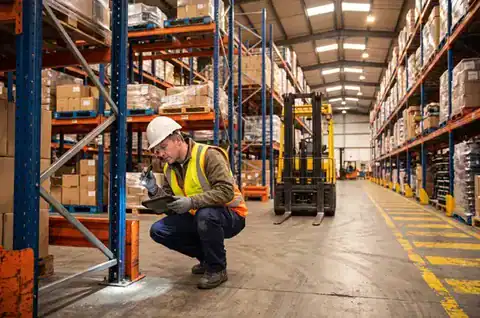
Daily (Operator & Facility Walkaround)
- Check forks, chains, and mast for bending or wear; hydraulic lines for leaks; and make sure the brakes, steering, horn, and lights all work before putting the truck into service.
Weekly
- Report and tag anything found immediately — don’t wait for the next scheduled inspection.
Monthly
- Confirm load-capacity signage is posted and legible at every bay.
Quarterly
- Document and tag any damaged bay out of service until repaired; consider a qualified rack-inspection professional for this pass.
Annual
- Federal regulation requires this at least once every three years for each operator.[1]
Note: This checklist is a general maintenance reference and recommended starting point for warehouse maintenance programs — it is not a substitute for a facility’s required fire, life-safety, or structural inspections, or for applicable regulatory requirements. Actual inspection scope and frequency should reflect the facility’s layout, equipment, storage height and commodity type, and local code requirements. See the full disclaimer below before using or adapting these recommendations.
What Is a Warehouse Maintenance Checklist?
A warehouse maintenance checklist is a documented set of inspection and upkeep tasks covering the full range of systems that keep a warehouse or distribution facility running safely — material handling equipment, storage and racking systems, building systems, and fire and life-safety systems — rather than any single piece of equipment.
That breadth is also what makes a warehouse checklist different from most of the equipment-specific checklists in this library. A forklift checklist or a conveyor belt checklist covers one asset. A warehouse checklist covers the facility those assets operate inside of, and the frequency each area needs attention varies widely — a forklift gets walked around before every shift, while a full structural racking review might happen once a year.
The specific checklist differs by facility. A high-throughput distribution center running multiple shifts puts far more wear on docks, conveyors, and racking than a lower-volume storage warehouse, and a facility storing hazardous materials or operating at height has compliance obligations a simple dry-goods warehouse doesn’t. Facility and maintenance managers should build the checklist around the actual equipment, storage systems, and applicable regulations for their operation.
Key Systems to Inspect in a Warehouse
Material Handling Equipment: Forklifts, pallet jacks, conveyors, and dock equipment.
Racking & Storage Systems: Uprights, beams, decking, anchors, and load-capacity signage.
Building Systems: HVAC, electrical panels, lighting, and plumbing.
Fire & Life-Safety Systems: Sprinklers, fire alarms, extinguishers, and emergency egress.
Loading Docks & Shipping Areas: Dock levelers, doors, seals, and bumpers.
Floors & Walking Surfaces: Aisle condition, markings, and trip hazards.
Safety Considerations for Warehouse Maintenance
Warehouse maintenance carries several hazards specific to the environment: powered-industrial-truck traffic, falls from height on mezzanines and ladders, racking collapse, and lockout/tagout exposure on conveyors and other powered equipment. A few points apply across most facilities:
Racking damage is usually gradual, not dramatic. Most rack damage comes from everyday contact — a forklift clipping an upright, a pallet set down a little too hard — not a single catastrophic event. A system that looked fine at installation can be seriously compromised a year later if routine contact damage goes unreported and uninspected.
Powered industrial truck operators must be evaluated periodically, not just trained once. Federal regulation requires an evaluation of each operator’s performance at least once every three years, in addition to initial training and any refresher training triggered by an accident, a near-miss, or an observed unsafe operation.[1]
Warehousing and distribution center operations are also a specific focus of federal workplace-safety enforcement: OSHA runs a National Emphasis Program directing inspectors toward warehouses and distribution centers, concentrating on powered-industrial-vehicle operations, material handling and storage (including racking), walking-working surfaces, and means of egress and fire protection.[2] That program was renewed in mid-2026, extending its coverage through at least 2031 — a sign that these specific hazard categories remain an active compliance priority for this industry, not a one-time initiative.
Lock out and tag out any conveyor, palletizer, or other powered equipment before performing maintenance, clearing a jam, or reaching into a pinch point, and never bypass a machine guard to speed up a repair.
Personal Protective Equipment (PPE)
The right PPE depends on the specific task and the facility’s own safety program, but most warehouse maintenance work calls for some combination of the following:
High-Visibility Clothing
A hi-vis vest is standard for anyone working on foot in or near active forklift and material-handling traffic.
Foot Protection
Steel-toed or composite-toe boots guard against crushing injuries from dropped loads, pallets, or shifting product.
Hand Protection
Cut-resistant or general-purpose work gloves suited to the task — banding material, sheet metal edges, and rack hardware are common hazards.
Fall Protection
A harness and lanyard anchored to an approved point when working from a mezzanine edge, order picker, or elevated platform without a fixed guardrail.
Common Warehouse Maintenance Mistakes
Treating a racking inspection as a one-time setup check
Racking damage accumulates gradually from everyday forklift contact, not from one dramatic event — a system that’s fine at install can be seriously compromised a year later if nobody’s looking in between.
Running separate “maintenance” and “inspection” checklists that don’t talk to each other
Splitting equipment maintenance and safety inspections into two disconnected processes means the same dock leveler or rack bay can get checked twice in two different systems, while a developing problem slips through the gap between them.
Letting documentation lag behind the actual inspection
A verbal “looks fine” from a walkthrough doesn’t hold up the way a dated, signed checklist does for an insurance review, an OSHA records request, or simply figuring out when a problem actually started.
Frequently Asked Questions
What is a warehouse maintenance checklist?
A warehouse maintenance checklist is a documented set of inspection and upkeep tasks covering a warehouse’s material handling equipment, racking and storage systems, building systems, and fire and life-safety systems — organized so each area gets checked at an appropriate frequency.
How often should warehouse equipment be inspected?
It depends on the equipment and its use. A general pattern many facilities follow: a daily operator walkaround for forklifts and pallet jacks, weekly checks on conveyors and dock equipment, monthly checks on building systems and racking anchors, quarterly checks on fire-safety systems and a full racking review, and an annual structural and compliance review.
Is warehouse racking inspection legally required?
General workplace-safety regulation requires employers to maintain safe storage and working conditions, and OSHA’s enforcement programs specifically target material handling and storage hazards, including racking, in warehouses and distribution centers. Beyond that general obligation, specific inspection frequencies and documentation practices are often driven by the facility’s insurer, the rack manufacturer’s guidance, and industry standards such as those published by the Rack Manufacturers Institute — confirm the applicable requirements for the specific facility and jurisdiction.
What’s the difference between a WMS and a CMMS in a warehouse?
A warehouse management system (WMS) manages inventory movement — receiving, picking, packing, and shipping. A CMMS manages the maintenance side: scheduling and tracking inspections, work orders, and repair history for the equipment and building systems that keep the warehouse running. The two serve different functions and are often used alongside each other.
What are the most common warehouse maintenance problems?
Misaligned or worn conveyor belts, forklift wear and damage, damaged or overloaded racking, lighting failures, and blocked emergency exits are among the most common issues found during warehouse inspections.
How often must powered industrial truck operators be reevaluated?
Federal regulation requires an evaluation of each operator’s performance at least once every three years, in addition to refresher training triggered by an accident, a near-miss, an observed unsafe operation, a new type of truck, or a changed workplace condition.
How does a CMMS help with warehouse maintenance?
A CMMS helps by scheduling recurring inspections and PM work for warehouse equipment and racking, assigning that work to specific technicians, and keeping a connected record of completed work, inspection findings, and repair history for each asset.
How eWorkOrders CMMS Supports Warehouse Maintenance
PM Scheduling
Recurring PM schedules can be set for warehouse equipment and racking inspections by calendar date.
Work Assignment
PMs and repair work orders are assigned to specific technicians or work groups.
Asset History
Each piece of equipment or rack location has a connected record of past work orders, completed PMs, and inspection findings.
Inspection-to-Work-Order Follow-Up
A team can turn a walkthrough finding — a damaged rack bay, a sticking dock leveler — into a work order linked to the affected asset, so the finding and its repair history stay connected.
Additional Resources
- Part of the eWorkOrders Learning Center
- The Ultimate Library of Maintenance Checklists
- Forklift Maintenance Checklist
- Conveyor Belt Maintenance Checklist
- Spare Parts Inventory Checklist
- Ideal Commercial Property Maintenance Checklist
References
- Occupational Safety and Health Administration. 29 CFR 1910.178(l) — Powered Industrial Trucks, Operator Training (refresher training and evaluation, including the requirement to evaluate each operator’s performance at least once every three years).
- Occupational Safety and Health Administration. CPL 03-00-026 — National Emphasis Program: Warehousing and Distribution Center Operations (originally effective July 13, 2023; renewed July 31, 2026, extending coverage through at least 2031).
A Warehouse Rarely Fails All at Once — It Fails One Unreported Problem at a Time
A sticking dock leveler, a bent rack upright, a conveyor that’s started running rough — each one is a quick fix caught early, and a much bigger problem once it’s been ignored long enough to seem normal. eWorkOrders lets your team schedule recurring PM work for warehouse equipment and racking, assign it to the appropriate technician, and keep work orders and checklist results together as part of each asset’s connected record.
Important Disclaimer: This warehouse maintenance checklist is provided by eWorkOrders as a general reference and recommended starting point for warehouse maintenance programs. The tasks, inspection intervals, and suggested maintenance considerations are recommendations only. They are not intended to establish a universal maintenance schedule or to state that every task applies to every facility.
Warehouse maintenance requirements vary according to facility layout and size, equipment type and age, storage height and commodity classification, manufacturer and rack-system specifications, operating environment, facility procedures, jurisdiction, and applicable laws, codes, and standards (including OSHA regulations and fire and building codes where applicable).
Before using this checklist, facility owners, maintenance managers, and other responsible personnel should review and adapt it for the specific facility and conditions in their operation. Appropriate tasks, inspection intervals, and acceptance criteria should be established using equipment and rack-system manufacturer guidance, applicable regulatory requirements, relevant industry standards, and the judgment of qualified maintenance and safety personnel.
This checklist does not replace equipment or rack-system manufacturer documentation, applicable federal, state, or local laws and regulations (including OSHA requirements where they apply), requirements of the authority having jurisdiction, applicable fire and building codes, the facility’s own safety program, or the judgment of qualified personnel.
Warehouse maintenance work can expose workers to serious hazards, including being struck by powered industrial trucks, falls from height, racking collapse, and crushing or pinch-point injuries from conveyors and other powered equipment. Such work should only be performed by personnel who are appropriately trained, authorized, and equipped for the work, following applicable lockout/tagout and other safety procedures.
eWorkOrders makes no representation that this checklist is complete or appropriate for any particular facility, industry, jurisdiction, or operating environment. Responsibility for determining the appropriate maintenance activities, inspection frequencies, and compliance obligations remains with the facility and the qualified professionals responsible for it.


