MRO Storeroom Best Practices for Maintenance Teams
A maintenance storeroom has one job: the right part is there, and technicians can find it, when a machine is down. Here’s how to set up and run an MRO storeroom that does that, from layout and bin locations to receiving, issuing, security, KPIs, and a self-audit checklist.
What Is an MRO Storeroom?
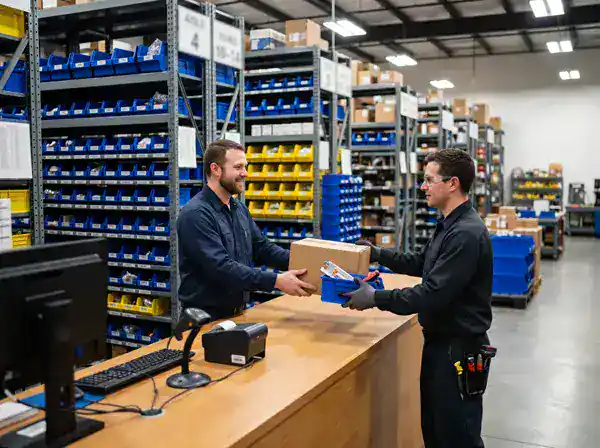
An MRO (maintenance, repair, and operations) storeroom holds the spare parts and supplies a maintenance team uses to keep equipment running: bearings, belts, filters, motors, electrical components, fasteners, lubricants, and safety supplies. Unlike a production warehouse, it doesn’t hold anything that gets sold. Its value is measured in downtime avoided.
A well-run storeroom means technicians spend their time on repairs, not searching shelves or waiting on parts. A poorly run one shows up as extra trips, emergency orders, duplicate purchases, and machines sitting idle while someone hunts for a part the system says is in stock.
1. Organize the Layout
Layout decides how fast a part can be found and pulled. A few principles cover most storerooms:
- Put fast movers near the counter. The parts issued most often (filters, belts, common fasteners, lubricants) should be closest to the issue window, so the most frequent trips are the shortest.
- Group by type, not by machine. Keep all bearings together, all belts together, and so on. The same bearing often fits several machines, and grouping by machine leads to duplicate stock in different places.
- Separate unserviceable parts. Give failed or waiting-for-repair parts their own clearly marked area, so they’re never issued by mistake. This matters most for rotable and repairable parts.
- Store heavy items low. Motors, gearboxes, and large pumps belong on lower shelves or pallet racking, for safety and easier handling.
- Leave room to grow. A storeroom packed to capacity forces parts into “temporary” spots that become permanent and get lost.
2. Give Every Part a Home (Bin Locations)
Every stocked part needs one defined location, recorded in the system, so anyone can find it without relying on one person’s memory. The most common approach is a location code that reads like an address:
| Code Part | Meaning | Example |
|---|---|---|
| Zone / Area | Section of the storeroom | A |
| Aisle or Rack | Which rack or aisle | 03 |
| Shelf | Which level, counted from the bottom | 2 |
| Bin | Position on the shelf | 07 |
| Full location | A-03-2-07 | |
Label every bin with the part number, description, and location code, ideally with a barcode so it can be scanned during issuing and cycle counts. When a part moves, update the location in the system the same day.
3. Standardize Part Numbers and Descriptions
Duplicate part records are one of the most common and expensive storeroom problems. The same bearing gets entered as “Bearing 6205,” “6205 bearing,” and “Ball Brg 6205-2RS,” and the storeroom ends up with three records, three bins, and more stock than it needs, while the system says the part is out.
- Use one naming format. Start with the noun, then the details: “Bearing, Ball, 6205-2RS” instead of free-form descriptions.
- Record the manufacturer part number alongside your internal number, so parts can be matched and reordered accurately.
- Search before you add. Make it a rule to search existing records before creating a new part.
- Clean up duplicates when you find them, merging the stock and history into one record.
4. Control Receiving and Issuing
Inventory records only stay accurate if every part coming in and going out is recorded. Most count errors trace back to one of these two moments.
Receiving
- Check deliveries against the purchase order for part number and quantity before putting them away.
- Record receipts in the system the same day, and put parts straight into their assigned locations.
- Watch units of measure: a box of 10 received as “1” throws off the count for months.
Issuing
- Issue parts against a work order whenever possible. That keeps the count current and records which asset used the part, which builds cost and failure history.
- Record returns of unused parts back to stock, so they don’t show as consumed.
- For planned work, kit the parts ahead of time: pull everything a preventive maintenance job needs into one labeled tote before the technician arrives.
5. Secure the Storeroom
An open storeroom where anyone can grab parts is the fastest way to lose inventory accuracy. The goal isn’t to slow technicians down; it’s to make sure every part that leaves is recorded.
- Limit access. Lock the storeroom, or staff it with a storeroom attendant during main shifts.
- Have an after-hours process. Night and weekend crews still need parts. Give them a simple way to record what they take, such as scanning the part against the work order, rather than leaving the door open.
- Keep satellite stock under control. Parts stored at the line or in a technician’s truck are still inventory. Track them in the system or keep them to low-cost consumables.
6. Set Stocking Rules and Review Them
Every stocked part should have a reason to be there and a rule for how much to carry.
- Set min/max levels. Use min/max stock levels and reorder points so parts are reordered automatically before they run out.
- Protect critical spares. Parts for critical equipment, especially ones with long lead times, may need to be stocked even if they’re rarely used. An asset criticality analysis shows which ones.
- Review slow and dead stock. At least once a year, list parts with no usage in the past 12 to 24 months. Decide for each one: keep it as a critical spare, return it to the vendor, or dispose of it. Check whether the equipment it fits is still on site.
7. Measure Storeroom Performance
A few KPIs show whether the storeroom is doing its job. Track them monthly so you can see trends, not just a single number.
| KPI | How to Calculate It | What It Tells You |
|---|---|---|
| Stock-Out Rate | (Work orders delayed by a missing part ÷ Work orders that needed parts) × 100 | How often the storeroom fails the technician |
| Inventory Record Accuracy | (Counts matching the record ÷ Total counts) × 100 | Whether the system can be trusted |
| Inventory Turns | Annual value of parts issued ÷ Average inventory value | How quickly stock is used; very low turns point to excess stock |
| Emergency Orders | Number of rush or expedited orders per month | How often stocking rules missed a need |
For example: in a month where 600 work orders needed parts and 18 were delayed because a part was missing, the stock-out rate is 18 ÷ 600 × 100 = 3%. If a storeroom issued $600,000 of parts over a year and carried an average of $400,000 in inventory, inventory turns are 600,000 ÷ 400,000 = 1.5.
There’s no single “right” number for every storeroom. What matters is the direction: stock-outs going down while accuracy goes up, without inventory value climbing to get there. For the full set of 12 metrics with formulas, see Spare Parts Inventory KPIs.
MRO Storeroom Self-Audit Checklist
Use these questions to spot where your storeroom needs work. Every “no” is a place to start.
- Does every stocked part have one assigned location recorded in the system?
- Are all bins labeled with part number, description, and location?
- Is there one standard naming format for part descriptions?
- Are receipts recorded the same day they arrive?
- Are parts issued against work orders?
- Is the storeroom locked or staffed, with an after-hours process?
- Are unserviceable and repairable parts kept separate from ready-to-use stock?
- Does every stocked part have min/max levels set?
- Are critical spares identified and protected from being used up by routine work?
- Is a cycle count program running on schedule?
- Has slow-moving and dead stock been reviewed in the past year?
- Are stock-out rate and inventory accuracy tracked monthly?
For a printable list of storeroom tasks, see the Spare Parts Inventory Checklist.
How a CMMS Supports the Storeroom
Most of these practices depend on one thing: every part and every transaction being recorded in one place. That’s where a CMMS comes in.
One record per part. Part numbers, descriptions, locations, vendors, and min/max levels live in one system instead of spreadsheets and memory.
Parts tied to work orders. Issuing parts on a work order updates the count and records which asset used them, which builds the cost and usage history needed for stocking decisions.
Automatic reorder alerts. When stock hits its minimum, the right person is alerted before the shelf is empty.
Scanning and counting. Barcode scanning speeds up issuing and cycle counts, and cuts down on wrong-part errors.
Frequently Asked Questions
What does MRO stand for in a storeroom?
MRO stands for maintenance, repair, and operations. An MRO storeroom holds the spare parts and supplies used to maintain equipment and facilities, as opposed to raw materials or finished goods for production.
Should a maintenance storeroom be locked?
In most cases, yes, or staffed during main shifts. An open storeroom makes it easy for parts to leave without being recorded, which quickly makes inventory records unreliable. Pair access control with a simple after-hours process so crews can still get parts when they need them.
How should storeroom parts be organized?
Group parts by type rather than by machine, keep fast-moving parts closest to the issue counter, store heavy items low, and give every part one assigned bin location recorded in the system, such as A-03-2-07 for zone, rack, shelf, and bin.
What KPIs should an MRO storeroom track?
Start with stock-out rate, inventory record accuracy, inventory turns, and the number of emergency orders. Together they show whether parts are available when needed, whether the records can be trusted, and whether the storeroom is carrying more stock than it needs.
Conclusion
A good MRO storeroom isn’t about having more parts. It’s about having the right parts, in known locations, with every transaction recorded. Organize the layout, give every part one home, standardize descriptions, control receiving and issuing, set stocking rules, and measure the results. Those habits turn the storeroom from a common cause of downtime into one of the reasons equipment gets back up fast.
Run a Storeroom Your Technicians Can Count On
A storeroom is only as reliable as its records. Keeping every part, location, and transaction in one place is the job of spare parts and inventory management in a CMMS. eWorkOrders has supported maintenance operations for over 30 years, serving teams at Honda and King River Packaging, rated 4.9 on Capterra and G2.
About the author: Janet Jaquis is Marketing Director at eWorkOrders, where she writes about maintenance strategy, asset reliability, and CMMS software for maintenance and facility teams.


