Fire Extinguisher and Fire Safety Inspection Checklist
A fire extinguisher that has not been checked, an exit sign that is not working, or a fire door that is blocked can go unnoticed during normal operations. For a maintenance team, routine inspections help identify these problems before an emergency puts the equipment or facility to the test.
This checklist covers recommended inspection, testing, and maintenance activities for portable fire extinguishers and selected fire and life-safety equipment in commercial and industrial facilities. It is intended as a general maintenance reference and starting point, not as a facility-specific compliance schedule. See the disclaimer below.
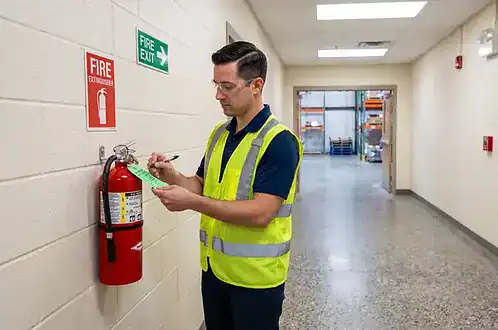
What Is a Fire Extinguisher and Fire Safety Inspection Checklist?
A fire extinguisher and fire safety inspection checklist is a documented list of inspection and maintenance activities used to help keep portable fire extinguishers and related fire protection equipment accessible, properly maintained, and ready for use.
In the United States, portable fire extinguisher inspection and maintenance requirements are addressed by standards such as NFPA 10, the Standard for Portable Fire Extinguishers, and by applicable OSHA requirements. The exact requirements can vary based on the extinguisher, facility, occupancy, jurisdiction, manufacturer instructions, and authority having jurisdiction.[1]
Fire Extinguisher Types to Know
The extinguisher needs to be suitable for the fire hazards it is intended to protect. Maintenance personnel should not assume that one extinguisher type is appropriate for every area.
- Class A — fires involving ordinary combustible materials such as wood, paper, cloth, and some plastics.
- Class B — fires involving flammable liquids and, where applicable, flammable gases.
- Class C — fires involving energized electrical equipment.
- Class D — fires involving combustible metals found in certain industrial operations.
- Class K — fires involving cooking oils and fats, particularly in commercial cooking operations.
Many facilities use multipurpose dry chemical extinguishers rated for Class A, B, and C hazards. The correct extinguisher type, rating, size, number, and placement should be determined based on the hazards present and the requirements applicable to the facility.
Monthly Visual Inspection — Recommended
Focus: location, accessibility, physical condition, and readiness
| Task | Details |
|---|---|
| Confirm the extinguisher is in its designated location | Verify the extinguisher is in its assigned location and has not been removed, relocated, or blocked. |
| Check access and visibility | Make sure the extinguisher is readily accessible and visible, with no equipment, materials, or other obstructions preventing access. |
| Check the pressure indicator | Where the extinguisher has a pressure gauge or indicator, confirm that it is within the manufacturer’s specified operable range. Follow the manufacturer’s instructions if the indicator shows an abnormal condition. |
| Check the safety pin and tamper seal | Verify the pin and tamper seal are present and appear intact. A missing or broken seal may indicate that the extinguisher has been discharged, used, or tampered with and should be evaluated by qualified service personnel. |
| Inspect for physical damage | Look for dents, corrosion, leakage, damaged hoses or nozzles, or other conditions that could affect the extinguisher’s safe operation. |
| Check the operating instructions | Make sure the manufacturer’s operating instructions and required markings are legible and visible. |
| Check for signs of discharge or loss of charge | Look for evidence that the extinguisher has been discharged or has otherwise lost its charge. Follow the manufacturer’s instructions and applicable servicing requirements if a problem is found. |
| Document the inspection | Record the inspection date, inspector, condition, and any deficiencies on the required inspection record or in the CMMS. Correct deficiencies or arrange for qualified service as appropriate. |
Annual Maintenance — Recommended
Focus: maintenance performed according to the extinguisher type, manufacturer’s instructions, applicable codes, and servicing requirements
| Task | Details |
|---|---|
| Schedule annual maintenance | Arrange for annual maintenance by qualified and appropriately trained fire equipment service personnel, as required by applicable codes, regulations, manufacturer’s instructions, and the authority having jurisdiction. |
| Complete the required maintenance examination | The service procedure should address the extinguisher’s condition, mechanical components, agent, and other items required by the applicable servicing procedure and manufacturer’s instructions. |
| Verify required service documentation | Confirm the extinguisher has the required maintenance tag, label, or other documentation showing the applicable service information and date. |
| Review the facility’s extinguisher inventory | Confirm the type, location, accessibility, and condition of extinguishers remain appropriate for the facility’s current hazards and layout. Changes should be reviewed against applicable requirements. |
6-Year Internal Maintenance — Recommended
Focus: internal examination of applicable extinguishers
| Task | Details |
|---|---|
| Schedule internal maintenance for applicable extinguishers | Certain rechargeable stored-pressure extinguishers that are subject to a 12-year hydrostatic test require an internal examination at six-year intervals. The exact requirement depends on the extinguisher type, manufacturer, applicable standard, and servicing procedure. |
| Follow the manufacturer’s servicing procedure | Internal examination and related servicing should be performed by personnel with the training, equipment, and qualifications required for the work. |
| Check nonrechargeable extinguishers separately | Nonrechargeable extinguishers are not serviced in the same manner as rechargeable units. Applicable models may have a maximum service life, including a 12-year removal-from-service requirement for certain nonrechargeable extinguishers. Verify the requirement for the specific extinguisher. |
Hydrostatic Testing — Recommended
Focus: testing the extinguisher cylinder at the applicable interval
| Task | Details |
|---|---|
| Schedule hydrostatic testing at the applicable interval | Hydrostatic testing intervals vary by extinguisher type. Some common examples include five-year intervals for water-based extinguishers and carbon dioxide extinguishers and 12-year intervals for many dry chemical stored-pressure extinguishers. Verify the exact interval for each extinguisher against the applicable requirements, manufacturer information, and servicing procedure. |
| Use qualified personnel and suitable equipment | Hydrostatic testing requires appropriate equipment, training, and procedures. The work should be performed by qualified personnel or a qualified service organization in accordance with applicable requirements. |
Broader Fire and Life-Safety Inspection Checklist
Fire extinguishers are only one part of a facility’s fire and life-safety program. Depending on the facility and the systems installed, maintenance personnel may also track:
- Fire alarm systems: inspections, testing, and maintenance required by the applicable code, manufacturer, system design, and authority having jurisdiction.
- Sprinkler systems: inspection of accessible components such as control valves, gauges, and visible piping, along with required testing and maintenance.
- Emergency and exit lighting: required inspection and testing of battery-backed lighting systems in accordance with applicable codes and manufacturer requirements.
- Exit signage: verify required signs are illuminated, visible, and unobstructed.
- Fire doors: check that required doors are not blocked or propped open and that they close and latch as intended.
- Egress paths: verify required aisles, exits, and stairways remain clear of stored materials, equipment, and other obstructions.
The inspection and testing frequency for these systems can vary by occupancy, system type, manufacturer, adopted fire and building codes, and the authority having jurisdiction. Maintenance teams should use the applicable requirements for their facility rather than treating this list as a universal inspection schedule.
Fire Extinguisher Training and Workplace Requirements
Fire extinguisher readiness involves more than maintaining the equipment. OSHA’s general industry standard for portable fire extinguishers, 29 CFR 1910.157, addresses requirements including extinguisher selection, placement, use, inspection, maintenance, and testing. OSHA also establishes employee education and training requirements in situations where portable fire extinguishers are provided for employee use.[2]
Employers should determine how these requirements apply to their specific workplace, emergency action plan, and method of providing fire extinguisher protection. State and local requirements may also apply.
How eWorkOrders CMMS Supports Fire Safety Maintenance
Fire and life-safety equipment requires scheduled inspections, maintenance, testing, and documentation. eWorkOrders can help maintenance and facility teams schedule recurring tasks, assign work to employees or vendors, record inspection results, document deficiencies, and maintain service history for individual assets.
Maintenance teams can use the CMMS to track inspection due dates, service records, work orders, attachments, and corrective actions associated with fire extinguishers and other facility equipment. Keeping these records in one system can make it easier for a maintenance team to see what has been inspected, what needs attention, and what work remains open.
Frequently Asked Questions
How often should fire extinguishers be inspected?
Portable fire extinguishers generally require regular visual inspection, including monthly inspections under applicable OSHA requirements for covered general industry workplaces. Annual maintenance and additional internal maintenance or hydrostatic testing may also be required, depending on the extinguisher type and applicable requirements. Always verify the schedule against NFPA 10, OSHA requirements, manufacturer instructions, and requirements of the authority having jurisdiction.
What’s included in a fire extinguisher inspection checklist?
A routine visual inspection may include checking the extinguisher’s location, accessibility, physical condition, pressure indicator where provided, safety pin and tamper seal, operating instructions, and signs of discharge or loss of charge. The inspection should also be documented, with deficiencies corrected or referred for qualified service as appropriate.
Who can perform fire extinguisher inspections?
Routine visual inspections may be performed by personnel who have been appropriately trained for the inspection. More involved maintenance, internal examination, recharging, repair, and hydrostatic testing require the appropriate training, equipment, qualifications, and authorization. Facility managers should verify applicable state and local requirements for service personnel and service organizations.
What happens if fire extinguishers aren’t maintained?
An extinguisher that is damaged, discharged, improperly located, inaccessible, or otherwise not maintained may not be ready for use when needed. Overdue or incomplete inspections can also create compliance concerns. Maintenance personnel should document deficiencies and arrange for appropriate corrective action or qualified service.
How long do fire extinguishers last?
Service life varies by extinguisher type, construction, manufacturer, condition, and applicable requirements. Some nonrechargeable extinguishers have a maximum service life, while rechargeable extinguishers may remain in service longer when they meet the applicable inspection, maintenance, internal examination, and hydrostatic testing requirements. Check the specific extinguisher’s label, manufacturer information, and applicable requirements.
What is the difference between hydrostatic testing and annual maintenance?
Annual maintenance is a periodic examination and servicing process that addresses the condition and operation of the extinguisher according to the applicable servicing requirements. Hydrostatic testing is a separate pressure test of the extinguisher cylinder performed at an applicable interval. The required interval depends on the extinguisher type and applicable requirements.
Does a fire safety inspection checklist cover more than extinguishers?
It can. A facility’s fire and life-safety maintenance program may also include fire alarm systems, sprinkler systems, emergency lighting, exit signs, fire doors, and required egress paths. Each system has its own inspection, testing, and maintenance requirements, so facilities should follow the requirements applicable to their specific systems and jurisdiction.
Important Disclaimer: This checklist is provided by eWorkOrders as a general maintenance reference and recommended starting point for commercial and industrial facilities. The tasks and intervals described are recommendations for planning and documentation purposes only. They are not a substitute for the requirements that apply to a specific facility, extinguisher, fire protection system, or jurisdiction.
Fire extinguisher and fire safety requirements can vary based on extinguisher type, manufacturer, occupancy, fire hazards, applicable federal, state, and local requirements, adopted fire and building codes, insurance requirements, and the authority having jurisdiction.
Before using this checklist as part of a facility maintenance or compliance program, facility owners and maintenance managers should review it against the applicable requirements and manufacturer’s instructions and, when appropriate, have the program reviewed by a qualified fire protection professional or qualified service provider.
This checklist does not replace NFPA 10, applicable OSHA requirements, other applicable NFPA standards, federal, state, or local laws and regulations, manufacturer instructions, requirements established by the authority having jurisdiction, or professional advice from qualified fire protection personnel.
Inspection, maintenance, internal examination, recharging, repair, and hydrostatic testing should only be performed by personnel who have the training, qualifications, equipment, and authorization required for the specific work and jurisdiction. Follow the manufacturer’s instructions and applicable servicing requirements.
eWorkOrders makes no representation that this checklist is complete or that following it alone will satisfy the requirements for any particular facility, occupancy, extinguisher, fire protection system, jurisdiction, or insurance program. The facility remains responsible for determining and meeting the requirements that apply to its operations.
By Janet Jaquis, Marketing Director | CMMS Software Specialist · Last updated September 9, 2026
Additional Resources
Part of the eWorkOrders Learning Center
The Ultimate Library of Maintenance Checklists
Electrical Maintenance Checklist
Maintenance Terms & Definitions Glossary
References
- National Fire Protection Association. NFPA 10: Standard for Portable Fire Extinguishers.
- Occupational Safety and Health Administration. 29 CFR 1910.157 — Portable Fire Extinguishers.


