Quality Assurance vs Quality Control (QA vs QC)
The difference comes down to one word: QA prevents defects by building a better process; QC catches defects by inspecting the result. You need both.
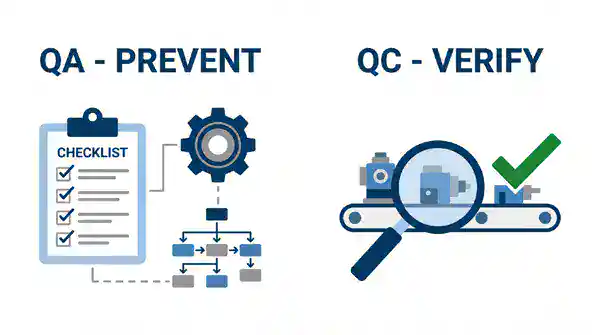
What’s the Difference Between Quality Assurance and Quality Control?
Quality assurance (QA) is process-oriented and preventive — it builds and verifies the procedures that make quality happen, so defects are avoided before they occur. Quality control (QC) is product-oriented and corrective — it inspects, tests, and measures the actual output to catch defects that slipped through. In one line: QA asks “are we doing the right things, the right way?” while QC asks “did the result meet the standard?”
Both sit inside the broader umbrella of quality management, and they are complementary rather than competing. QA reduces how many defects are created; QC finds the ones that still escape. An operation that relies on QC alone is constantly catching problems it never designed out, while an operation that relies on QA alone has no proof the process actually produced a conforming result. The two together form a loop — prevent, verify, and feed what you learn back into the process.
What Is Quality Assurance (QA)?
Quality assurance is the set of planned, systematic activities that give confidence a product or service will meet requirements — by getting the process right. Instead of checking finished output, QA works upstream: it defines standards, documents procedures, trains people, qualifies suppliers and equipment, and audits that the process is being followed. The logic is that a capable, well-documented process reliably produces good results, so you design quality in rather than inspect it in.
QA is proactive and typically owned across the whole workflow, not by a single inspection station. Its tools are the things that shape how work gets done before any output exists to measure.
- Standard operating procedures (SOPs) that define exactly how a task is performed, so results don’t depend on who does the work.
- Process design and validation — confirming a method, machine, or workflow is capable of consistently producing conforming output.
- Training and competency records that prove the people doing the work know how to do it correctly.
- Audits and process reviews that check the process is actually being followed as written, not just on paper.
- Documentation control so everyone works from the current, approved version of every procedure.
- Error-proofing (poka-yoke) — designing fixtures, steps, or checks so a mistake is hard or impossible to make in the first place.
- Supplier qualification and calibration schedules so incoming materials and the instruments used to measure them can be trusted.
Because QA is about prevention, its payoff is quieter than QC’s — fewer defects created means fewer problems to catch downstream, which is harder to see but far cheaper than scrapping or reworking finished output.
What Is Quality Control (QC)?
Quality control is the set of activities that verify the actual product or output meets the defined standard — by inspecting, testing, and measuring what was produced. Where QA shapes the process, QC examines the result. It is reactive by design: it exists to detect defects, nonconformances, and variation in the finished output so they can be contained before reaching the customer or the next stage.
QC is usually a defined step or station with clear accept/reject criteria. Its tools act on tangible output.
- Inspections against a checklist or specification — visual, dimensional, or functional.
- Testing and measurement using calibrated instruments to confirm the output is within tolerance.
- Sampling and statistical process control (SPC) to monitor whether output is staying within acceptable limits over time.
- Nonconformance handling — flagging, segregating, and dispositioning anything that fails the standard.
QC answers a narrow, important question: did this specific output pass? What it cannot do on its own is stop the same defect from happening again — that requires feeding the finding back into QA, which is why the two disciplines only work well as a pair.
QA vs QC: A Side-by-Side Comparison
The clearest way to separate the two is across five dimensions — what each focuses on, when it happens, what it acts on, who owns it, and the kind of question it answers.
| Dimension | Quality Assurance (QA) | Quality Control (QC) |
|---|---|---|
| Focus | The process that creates the output | The actual product or output itself |
| Goal | Prevent defects from occurring | Detect defects that have occurred |
| Orientation | Proactive — build quality in | Reactive — catch quality problems |
| Timing | Before and during the work (upstream) | During and after the work (downstream) |
| Process vs. product | Process-oriented | Product-oriented |
| Typical activities | SOPs, training, audits, process validation, documentation control | Inspection, testing, measurement, sampling, SPC |
| Question it answers | “Are we doing the right things the right way?” | “Did the result meet the standard?” |
| Ownership | Shared across the whole workflow | Usually a defined inspection/verification step |
A simple memory aid: QA = the recipe and the kitchen rules; QC = tasting the dish before it leaves the kitchen. A great recipe makes a good dish likely; the taste test confirms this particular plate is right.
QA vs QC Examples by Industry
The split between prevention and verification looks a little different in every operation, but the pattern is the same. Here’s how it plays out in three common settings:
| Industry | Quality Assurance (prevent) | Quality Control (verify) |
|---|---|---|
| Manufacturing | Documented work instructions, validated machine settings, operator training, and error-proofed fixtures | First-article inspection, dimensional checks, torque and leak tests, and in-process sampling |
| Food & beverage | HACCP plans, sanitation SOPs, supplier approval, and validated pasteurization or cook steps | Temperature and fill-weight checks, metal detection, and lab tests on finished batches |
| Healthcare & medical devices | Design controls, ISO 13485 procedures, equipment qualification, and staff competency records | Incoming and final inspection, electrical safety testing, and sterility checks |
| Facilities & maintenance | Standard job plans, a preventive maintenance schedule, and technician training | Completed checklist sign-off, inspection readings, and post-repair functional tests |
Metrics That Measure QA and QC
Because QA and QC do different jobs, they’re measured differently. QA metrics tell you whether the process is healthy; QC metrics tell you what actually came out of it.
- QA metrics: SOP compliance, training completion, audit findings closed on time, supplier quality performance, and process capability (Cp and Cpk).
- QC metrics: defect rate, first-pass yield, scrap and rework cost, inspection pass/fail rate, and customer complaints or returns.
- Maintenance equivalents: PM compliance and checklist completion on the QA side; repeat failures, rework orders, and callbacks on the QC side.
Watching both sets together is what shows you where to act. A rising defect rate with good SOP compliance points to a weak procedure; a rising defect rate with poor SOP compliance points to training or follow-through.
QA and QC Within a Quality Management System
QA and QC are both parts of a larger quality management system (QMS) — the documented framework of policies, procedures, and responsibilities an organization uses to manage quality. Standards such as ISO 9001 (general quality management), ISO 13485 (medical devices), GMP (pharmaceutical and food manufacturing), and HACCP (food safety) all expect both: documented, controlled processes (QA) and recorded inspections and tests that prove the output conforms (QC).
Broader philosophies like Total Quality Management (TQM) and continuous improvement sit on top of that system. They push the organization to keep tightening the loop — using QC data to improve QA — instead of treating quality as a single department’s job.
How QA and QC Work Together
QA and QC function as a closed loop: QA sets up the process to produce good output, QC verifies the output, and every QC finding flows back to QA to strengthen the process. Treating them as either/or is the most common mistake — they are two halves of a single system, and neither delivers reliable quality alone.
The loop runs like this in practice:
- QA establishes the standard and the method — the specification, the SOP, the trained people, the validated equipment.
- Work is performed against that defined process.
- QC inspects and tests the output against the standard and accepts, rejects, or flags it.
- Findings feed back to QA — a recurring defect signals a process gap, triggering a procedure change, retraining, or a design fix so the defect stops recurring.
This feedback is what turns inspection into improvement. A QC reject that is simply scrapped and forgotten teaches the organization nothing; the same reject, traced back to a weak step in the process and corrected there, prevents the next hundred. That corrective-and-preventive discipline is the bridge between QA and QC — and it is exactly how reliable maintenance operations improve over time.
QA and QC in a Maintenance and Asset-Reliability Context
In maintenance, QA and QC translate directly into how work is planned, performed, and verified on physical assets — the same prevent-then-verify loop, applied to equipment reliability rather than a production line. QA is the standardized way maintenance is supposed to be done; QC is the check that it was done correctly and that the asset actually meets condition standards afterward.
Here’s how each discipline maps onto a maintenance operation:
| Element | In maintenance, this is the QA side (prevent) | …and the QC side (verify) |
|---|---|---|
| Procedures | Standardized job plans and SOPs attached to each work order | Completed-checklist sign-off confirming every step was performed |
| Scheduled work | A documented preventive maintenance program that prevents failures | PM compliance and post-task inspection confirming the work held |
| Inspections | Defined inspection routes and acceptance criteria | Recorded readings and pass/fail results against those criteria |
| Problems | Corrective and preventive action (CAPA) that fixes the process | Root cause analysis on recurring failures feeding the CAPA |
| Documentation | Controlled, current procedures and asset records | An auditable history proving what was done, when, and by whom |
The common thread is documentation and consistency. QA depends on everyone working from the same current procedure; QC depends on a verifiable record of what was actually done. A work order management system supports both at once — it delivers the standardized job plan to the technician (QA) and captures the completed checklist, readings, parts, and sign-off as an auditable record (QC). When a failure recurs, that same history is what root cause analysis uses to decide whether the process itself needs to change. For a deeper look at measuring and improving this in a maintenance setting, see our guide to maintenance quality management.
None of this makes a CMMS a “validated” or certified quality system on its own — but consistent procedures, documented inspections, CAPA tracking, and a complete audit trail are the foundations that quality-driven and regulated maintenance environments are built on.
Build Quality Into Every Work Order
See how eWorkOrders helps your maintenance team schedule preventive maintenance, track inspections, and turn problems into work orders before small issues become costly downtime. See how it works in a free, personalized demo.
Frequently Asked Questions
What is the main difference between quality assurance and quality control?
The main difference is focus and timing. Quality assurance (QA) is process-oriented and preventive — it builds and verifies the procedures that produce quality, so defects are avoided. Quality control (QC) is product-oriented and corrective — it inspects and tests the actual output to catch defects that still occur. In short, QA prevents problems; QC detects them.
Is quality assurance done before or after quality control?
QA generally comes first and runs continuously upstream, because it shapes the process before and during the work — through SOPs, training, and process validation. QC happens during and after the work, inspecting the finished output. They aren’t strictly sequential, though: QC findings feed back into QA, so the two operate as an ongoing loop rather than a one-way handoff.
Can you have QC without QA?
You can inspect output without a strong QA program, but it’s inefficient and reactive. Without QA, QC keeps catching the same defects the process never designed out, so you pay for rework and scrap indefinitely. QA reduces how many defects are created in the first place, which makes QC’s job smaller and cheaper. Reliable quality needs both.
What is the difference between QA and QC roles?
QA roles, such as quality engineers and quality assurance managers, design and improve processes, write and control procedures, run audits, and manage corrective actions. QC roles, such as quality inspectors and technicians, inspect, test, and measure output against the specification and record pass/fail results. Smaller operations often combine both in one person or team.
What is a QA/QC checklist?
A QA/QC checklist is a step-by-step form used to confirm that a task followed the approved procedure and that the result met the standard. In maintenance, it’s usually attached to a work order so the technician records each step, readings, and a sign-off, giving you both process proof and an inspection record.
What do QA and QC have in common?
Both aim to deliver output that meets requirements, both rely on clear standards and good documentation, and both feed continuous improvement. They are two parts of the same quality management system rather than separate programs.
How do QA and QC apply to maintenance?
In maintenance, QA is the standardized, documented way work is supposed to be done — job plans, SOPs, a planned preventive maintenance program, and controlled procedures. QC is the verification that it was done correctly and that the asset meets condition standards — completed-checklist sign-offs, inspection readings, and PM compliance. A CMMS supports both by delivering standard job plans and capturing an auditable record of the work.
Part of the eWorkOrders Learning Center


