CAPA: Corrective and Preventive Action Explained
CAPA stands for Corrective and Preventive Action. It is the process a quality or maintenance team uses to fix the cause of a problem that already happened and to stop the same kind of problem from happening somewhere else.
This guide covers what CAPA means, how corrective and preventive action differ, the five steps of a CAPA, where CAPA is required, and how to run it inside a maintenance program.
What Is CAPA?
CAPA (Corrective and Preventive Action) is a structured method for dealing with problems. It finds out why a problem happened, removes that cause, and puts controls in place so the problem does not come back or show up on similar equipment, processes, or sites.
A repair fixes the symptom. A CAPA fixes the reason the symptom appeared. If a pump seal fails, replacing the seal is the repair. Finding out that the lubrication interval was too long for the pump’s duty cycle, changing that interval, and checking every pump on the same interval is the CAPA.
Quick definition: Corrective action removes the cause of a problem that has already occurred. Preventive action removes the cause of a potential problem before it occurs.
Corrective Action vs. Preventive Action
The two halves of CAPA answer different questions. Corrective action asks, “Why did this happen, and how do we stop it happening again?” Preventive action asks, “Where else could this happen, and how do we stop it before it does?”
| Corrective Action | Preventive Action | |
|---|---|---|
| Trigger | A problem that already happened: a failure, defect, complaint, incident, or audit finding | A risk or trend that has not caused a problem yet |
| Goal | Stop the same problem from recurring | Stop a similar problem from occurring at all |
| Timing | After the event | Before the event |
| Maintenance example | A conveyor bearing fails; the team finds an overdue lubrication task and fixes the scheduling gap | The team applies the same lubrication fix to every conveyor of the same model |
| Evidence | Root cause record, completed action, effectiveness check | Risk review, extended action, follow-up check |
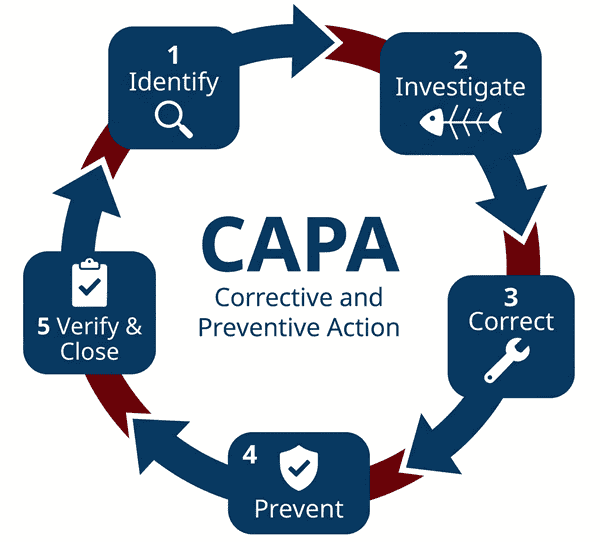
The 5 Steps of a CAPA
Organizations name the steps differently, but most CAPA processes follow the same five stages.
1. Identify the problem
Record what happened, where, when, and on which asset or process. Include how it was found: a breakdown, an inspection, a customer complaint, or an audit.
2. Investigate the root cause
Look past the immediate failure to the reason it happened. Common tools are the 5 Whys and the fishbone diagram. The asset’s work order and maintenance history is usually the best starting evidence.
3. Correct the problem
Take action that removes the root cause, not just the symptom. That might be a new PM interval, a revised procedure, a different part specification, or added training.
4. Prevent recurrence elsewhere
Apply the fix to similar assets, lines, or sites that share the same risk, and update standards so new equipment starts with the corrected practice.
5. Verify and close
Check that the action worked before closing the CAPA. A common approach is a follow-up review 60 to 90 days later to confirm the problem has not returned.
Where CAPA Is Required
CAPA started in regulated quality systems, and several standards and regulations still require it or something close to it.
- ISO 9001:2015. Clause 10.2 requires organizations to react to nonconformities, find their causes, and take corrective action. The 2015 edition no longer has a separate preventive action clause; prevention is handled through risk-based thinking in clause 6.1.
- ISO 13485:2016 (medical devices). Clause 8.5.2 covers corrective action and clause 8.5.3 covers preventive action, each with documented procedures.
- FDA Quality Management System Regulation (21 CFR Part 820). The QMSR took effect on February 2, 2026. It replaced the earlier Quality System Regulation and incorporates ISO 13485:2016 by reference for medical device manufacturers.
- Pharmaceutical quality systems. FDA’s guidance on ICH Q10 describes a CAPA system as one of the core elements of a pharmaceutical quality system.
Outside regulated industries, CAPA is not legally required, but many manufacturers, food plants, utilities, and facilities teams use it because it is the most direct way to stop repeat failures. See our OSHA maintenance regulations guide for the safety standards that apply to maintenance work.
How to Run CAPA in a Maintenance Program
Maintenance teams do not need a separate quality department to run CAPA. They need a few habits built into the way work is already logged and scheduled.
- Decide what triggers a CAPA. Set risk-based rules, for example a repeat failure on a critical asset, a safety incident, a missed PM tied to a breakdown, or an audit finding. Everything else stays a normal repair.
- Start from the asset’s history. Pull the work orders, PM completions, and parts used on the asset before deciding on a cause.
- Record the root cause separately from the repair. “Replaced seal” is the correction. “PM interval too long for this duty cycle” is the root cause. Keep both.
- Change the system, not just the part. The corrective action should change something lasting: a PM interval, a procedure, a lubrication specification, a training requirement, or a spare-parts standard.
- Extend the fix to similar assets. If one pump seal failed because of the interval, check every pump running the same interval. That is the preventive half of CAPA.
- Schedule the effectiveness check before closing. Create a follow-up task 60 to 90 days out and keep the CAPA open until it passes.
- Review open CAPAs regularly. Make aging and overdue CAPAs a standing item in the weekly or monthly maintenance meeting.
Common CAPA Pitfalls
- Treating the repair as the CAPA. Closing the record once the asset runs again leaves the cause in place.
- Stopping at “human error.” Human error is rarely a root cause. Ask why the procedure, training, or design allowed the error.
- Opening a CAPA for everything. Too many CAPAs bury the important ones. Use clear triggers.
- Skipping the effectiveness check. Without it, there is no evidence the action worked.
- Fixing one asset only. The same cause often exists on identical equipment elsewhere.
CAPA metrics worth tracking
| Metric | What it shows |
|---|---|
| Open CAPAs by age | Whether actions are stalling |
| Average time to close | How quickly causes are being removed |
| Effectiveness-check pass rate | Whether corrective actions actually work |
| Repeat failures on CAPA assets | Whether root causes were correctly identified |
| CAPAs with a documented root cause | Whether investigations are being completed |
How a CMMS Supports a CAPA Workflow
A computerized maintenance management system (CMMS) does not replace a quality system, but it holds most of the evidence a maintenance CAPA depends on.
- Asset history in one place. eWorkOrders keeps each asset’s work orders and maintenance history in the asset record, so investigations start from facts.
- Corrective work orders. The fix is assigned, tracked, and closed as a work order with a timestamped record of who did what.
- Lasting preventive changes. eWorkOrders schedules preventive maintenance by date or meter-based usage, such as run hours, so a corrected interval becomes the new schedule.
- Checklists on PM work orders. A revised procedure can be attached as a checklist to PM-generated work orders, so technicians follow the corrected steps.
- Follow-up tasks. The effectiveness check can be scheduled as its own work order so it is not forgotten.
Teams can start small with the Service Request or Preventive Maintenance (PM) module, then expand their use of eWorkOrders as their needs grow.
Close Every CAPA With Proof
See how eWorkOrders helps your maintenance team schedule preventive maintenance, track inspections, and turn problems into work orders before small issues become costly downtime. See how it works in a free, personalized demo.
Frequently Asked Questions
What does CAPA stand for?
CAPA stands for Corrective and Preventive Action. It is a process for finding and removing the cause of a problem that has happened, and for preventing similar problems from happening elsewhere.
What is the difference between corrective and preventive action?
Corrective action responds to a problem that already occurred and stops it from recurring. Preventive action addresses a risk before any problem occurs, often by applying a fix to similar assets or processes.
What are the steps of a CAPA?
Most CAPA processes follow five steps: identify the problem, investigate the root cause, correct the problem, prevent recurrence elsewhere, and verify the action worked before closing.
Is CAPA required by ISO 9001?
ISO 9001:2015 requires corrective action in clause 10.2. It no longer has a separate preventive action clause; prevention is handled through risk-based thinking in clause 6.1.
Does the FDA require CAPA?
Medical device manufacturers must meet the FDA Quality Management System Regulation (21 CFR Part 820), which took effect February 2, 2026 and incorporates ISO 13485:2016, including its corrective and preventive action requirements.
How does a CMMS help with CAPA?
A CMMS keeps the asset history used in the investigation, tracks the corrective work order, turns lasting fixes into updated PM schedules and checklists, and schedules the follow-up effectiveness check.
2. International Organization for Standardization, ISO 13485:2016 Medical devices, clauses 8.5.2 and 8.5.3. iso.org
3. U.S. Food and Drug Administration, Quality Management System Regulation (21 CFR Part 820), effective February 2, 2026. fda.gov
4. U.S. Food and Drug Administration, Q10 Pharmaceutical Quality System guidance. fda.gov
Disclaimer: This page is general information, not legal, safety, or compliance advice. Standards and regulations are amended over time, and the issuing body’s own site is authoritative. This page does not replace your organization’s own quality or compliance program.


