Heavy Equipment Maintenance Checklist
A skipped pre-operation walkaround or a missed hydraulic leak can turn into an expensive field failure — or a safety incident. Because heavy equipment runs on hour meters, not the calendar, this checklist is organized by inspection frequency and hour-meter interval: daily, weekly, monthly, quarterly, and annual.
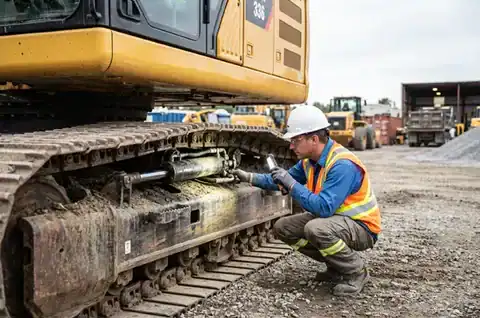
Daily Pre-Operation Walkaround
- Look for fluid puddles or wet spots underneath, damaged or leaking hoses, loose or missing hardware, and obvious new damage since the last shift.
- Check with the machine on level ground per the manufacturer’s procedure. Top off or report low levels before operating.
- Check tire condition and pressure, or track tension, pads, rollers, and sprockets for excessive wear or damage.
- Confirm all are functioning before the machine is put into service for the shift.
- Inspect the rollover and falling-object protective structure for visible damage, and confirm the seatbelt is present and functional. Do not operate with a damaged ROPS/FOPS or missing seatbelt.
- Check for cracks, worn pins and bushings, and damaged cutting edges or teeth.
- Fire extinguisher, first-aid kit, and any site-required items, where applicable to the machine and site.
- Report anything found before operating the equipment — a short pre-op defect is far cheaper than an in-field failure.
Weekly
- Follow the manufacturer’s lubrication chart and interval for pins, bushings, and grease fittings.
- Check for cracking, fraying, glazing, or soft/bulging spots that could indicate developing failure.
- Inspect terminals for corrosion and confirm connections are tight.
- Check track tension, rollers, idlers, and sprockets for wear.
- Built-up debris reduces cooling efficiency and can be a fire hazard.
Monthly / 250-Hour
- Follow the manufacturer’s recommended interval, which may be shorter under severe operating conditions.
- Check for leaks, abrasion, cracking, and rod damage on cylinders.
- Check for chafing, pinch points, and damaged insulation, especially near moving components.
- Track bolts, attachment pins, and other fasteners identified by the manufacturer as requiring periodic torque verification.
- On equipment with onboard diagnostics, review and address any stored codes.
- A fluid sample can catch internal component wear, contamination, or coolant breakdown well before it shows up as a performance problem on the machine.
Quarterly / 500–1,000-Hour
- Sample or inspect hydraulic fluid for contamination, discoloration, or breakdown.
- Replace per the manufacturer’s interval or restriction indicator, whichever comes first.
- Check hoses, cap, and fins, and test coolant concentration and condition against manufacturer specification.
- Check the frame, boom, arms, and attachment points for cracks, bending, or weld damage.
- Where applicable to the equipment type.
Annual / 2,000-Hour
- Engine, hydraulics, electrical system, and structural components, performed by a qualified technician.
- ROPS/FOPS, seatbelts, backup alarms, lighting, and other safety-critical systems.
- Where applicable and required by the equipment type and facility program.
- Use the year’s findings to adjust PM intervals based on actual usage, operating environment, and equipment condition.
- On equipment so equipped.
Seasonal Maintenance
- Spring (Recommissioning)
- Removes winter grime and road salt residue that can hide developing rust and corrosion.
- Equipment parked for an extended period is a common spot for nesting — look for chewed wiring or cables, nesting material, and droppings, which can cause electrical failures if missed.
- Check charge retention and clean terminals before reconnecting.
- Temperature swings between winter and spring can shift both.
- Summer
- Heat raises the risk of overheating, especially on machines already running dusty radiators.
- Do this before peak heat, not after the operator is already uncomfortable in the cab.
- Fall (Winterization)
- Trapped moisture against metal accelerates rust and corrosion over winter.
- A fuller tank reduces the air space where condensation can form over a cold, idle winter.
- Winter
- In extreme cold, consider a battery blanket or indoor storage between shifts.
- Block heater, glow plugs, or other cold-start equipment the machine is fitted with.
- Buildup that freezes between rollers and sprockets accelerates undercarriage wear.
Note: This checklist is a general maintenance reference and recommended starting point for heavy equipment fleets — it is not a manufacturer service schedule. Actual inspection and service intervals should follow the equipment manufacturer’s requirements, operating hours, duty cycle, and operating environment. See the full disclaimer below before using or adapting these recommendations.
What Is a Heavy Equipment Maintenance Checklist?
A heavy equipment maintenance checklist is a documented set of inspection, lubrication, fluid, and service tasks used to keep mobile equipment — excavators, wheel loaders, bulldozers, motor graders, backhoes, skid steers, and mobile cranes — running safely and reliably, and to catch developing problems before they cause a failure in the field.
Unlike stationary equipment, heavy equipment accumulates wear through a combination of engine hours, travel, load cycles, and exposure to dirt, moisture, vibration, and temperature extremes. That’s why most manufacturers publish service intervals in hours of operation rather than calendar time, and why an effective maintenance program needs a way to track hour-meter readings alongside the calendar.
The specific checklist is different for every fleet. A paving contractor running graders and rollers has different maintenance priorities than a site running excavators and dozers in wet, abrasive conditions. Maintenance managers should build the checklist around the actual equipment, attachments, and operating environment in use.
Key Systems to Inspect on Heavy Equipment
Engine & Fuel System: Oil, coolant, fuel, air filtration, belts, and the cooling system.
Hydraulic System: Fluid level and condition, filters, hoses, fittings, and cylinders.
Undercarriage, Tracks & Tires: Track tension, rollers, idlers, and sprockets on tracked machines; tire condition, pressure, and alignment on wheeled machines.
Electrical & Monitoring Systems: Battery, wiring harnesses, gauges, onboard diagnostics, lighting, and backup alarms.
Braking & Steering: Service brakes, parking brake, and steering components — safety-critical systems that should never be deferred.
Structural Components, ROPS/FOPS & Attachments: Frame, boom, arms, attachment pins and bushings, and the rollover/falling-object protective structure.
Safety Considerations for Heavy Equipment Maintenance
Heavy equipment maintenance carries real hazards: crush and pinch points, stored energy, raised or suspended loads and attachments, and rollover risk. A few practices apply across most fleets:
Pre-operation walkarounds matter. A short daily inspection is often what catches a developing problem — a leak, a damaged hose, a cracked weld — before it becomes a failure or an incident in the field.
Secure the machine before starting any maintenance task. Park on level, solid ground, lower all attachments to the ground, engage the parking brake, and chock the wheels or tracks. Stored energy doesn’t disappear just because the engine is off — hydraulic and pneumatic lines can still hold pressure, batteries and capacitors can still hold a charge, and a raised boom, bucket, or bed holds gravitational energy that can drop without warning. Follow the facility’s lockout/tagout program and the equipment manufacturer’s procedure for isolating each of these energy sources before working on or near them, and use proper blocking, cribbing, or safety stands to support any raised component — never rely on a hydraulic cylinder alone to hold a raised load in place.
OSHA’s construction standards address motor vehicles and mechanized equipment, including requirements such as rollover protective structures, seatbelts, and audible alarms on applicable equipment.[1] Specific requirements vary by equipment type, how and where it’s used, and applicable state and federal regulations — always confirm requirements with the equipment manufacturer and the facility’s safety program.
Personal Protective Equipment (PPE)
The right PPE depends on the specific task and the facility’s own safety program, but most heavy equipment maintenance work calls for some combination of the following:
Head Protection
A hard hat protects against falling objects, impacts, and incidental electrical exposure.
Eye and Face Protection
Safety glasses, goggles, or a face shield guard against flying debris, chemical splashes, and dust — especially during cleaning or grinding tasks.
Hearing Protection
Earplugs or earmuffs where engine noise, hydraulic systems, or power tools create sustained loud conditions.
Hand Protection
Heavy-duty gloves suited to the task — cuts and abrasions, chemical exposure, or heat, depending on what’s being handled.
Foot Protection
Steel-toed or composite-toe boots guard against crushing injuries and punctures from dropped tools or parts.
High-Visibility Clothing
A hi-vis vest or jacket keeps a technician visible to equipment operators and other traffic in an active work yard or job site.
Common Heavy Equipment Maintenance Mistakes
Rushing the daily walkaround
A walkaround done in 30 seconds catches almost nothing. The small signs — a fresh fluid spot, a hairline crack, a belt that’s starting to glaze — only show up to someone who’s actually looking, which is why operator training on what to look for matters as much as the checklist itself.
Finding a problem and not writing it down
A leak spotted on a Monday walkaround but never logged is a leak nobody follows up on by Friday. Without a record, there’s no way to track whether a small issue is getting worse, and no proof of what was found and when if it ever matters for a warranty claim or an incident review.
Letting the PM schedule slip when things get busy
Service intervals that hold up fine during a slow stretch are often the first thing pushed back once a crew falls behind — which tends to be exactly when a machine is being run the hardest and needs that service the most.
Frequently Asked Questions
How often should heavy equipment be inspected?
There is no single interval that applies to every machine. A daily pre-operation walkaround is standard practice for most heavy equipment, with additional service tasks following the manufacturer’s hour-meter intervals (commonly around 250, 500, 1,000, and 2,000 hours) and the facility’s own maintenance program.
What is included in a heavy equipment PM checklist?
A heavy equipment PM checklist typically covers fluid levels and condition, filters, undercarriage or tires, hydraulic components, electrical systems, braking and steering, structural components and attachments, and documentation of findings and completed work.
Should heavy equipment maintenance be scheduled by hours or by calendar date?
Both have a role. Daily and weekly checks are usually calendar- or shift-based, while deeper service tasks are commonly tied to hour-meter intervals because equipment usage — and therefore wear — varies significantly between machines even within the same fleet.
Who should perform heavy equipment maintenance?
Routine operator checks, such as the daily walkaround and fluid-level checks, are generally performed by the operator. More involved service, repairs, and inspections involving hydraulic, electrical, or structural systems should be performed by qualified maintenance personnel or technicians following the manufacturer’s procedures.
What can happen when heavy equipment isn’t maintained?
Deferred maintenance on heavy equipment can lead to hydraulic failures, undercarriage or tire damage, engine problems, brake issues, and structural fatigue — any of which can result in unplanned downtime, costly repairs, or a safety incident.
How much does heavy equipment maintenance cost?
Costs vary widely based on equipment type, age, operating hours, operating environment, and the scope of work required. A qualified dealer, technician, or service provider can provide a machine-specific estimate.
Does this checklist apply to all types of heavy equipment?
This checklist reflects general practices common across tracked and wheeled construction and earthmoving equipment, such as excavators, dozers, loaders, graders, and backhoes. Cranes, forklifts, and other specialized equipment may have additional manufacturer- or standard-specific inspection requirements beyond what’s covered here.
How eWorkOrders CMMS Supports Heavy Equipment Maintenance
PM Scheduling
Recurring PM schedules can be set by calendar date or by hour-meter reading.
Work Assignment
PMs and repair work orders are assigned to specific technicians or work groups.
Asset History
Each machine has a connected record of past work orders and completed PMs.
Condition Monitoring
eWorkOrders integrates with condition-monitoring vendors such as AssetWatch, which can generate a work order when a monitored value — for example, hydraulic fluid temperature — crosses a set threshold.
A Skipped Walkaround Is How Small Problems Become Field Failures
A hydraulic leak, a worn undercarriage component, a cracked weld — caught on a walkaround, each one is a quick fix; missed, each one can take a machine out of service. eWorkOrders lets your team build PM schedules by hour-meter reading or calendar date, assign the work, and keep each machine’s maintenance and meter-reading history connected.
Additional Resources
- Part of the eWorkOrders Learning Center
- The Ultimate Library of Maintenance Checklists
- Pump Maintenance Checklist
- Conveyor Belt Maintenance Checklist
- Maintenance Terms & Definitions Glossary
References
- Occupational Safety and Health Administration. 29 CFR 1926.602 — Material Handling Equipment (part of 29 CFR 1926 Subpart O — Motor Vehicles, Mechanized Equipment, and Marine Operations).
Important Disclaimer: This heavy equipment maintenance checklist is provided by eWorkOrders as a general reference and recommended starting point for fleet and maintenance programs. The tasks, inspection intervals, and suggested maintenance considerations are recommendations only. They are not intended to establish a universal maintenance schedule or to state that every task applies to every machine.
Heavy equipment maintenance requirements vary according to equipment make, model, and age, manufacturer instructions, operating hours and duty cycle, operating environment, attachment configuration, equipment condition, facility procedures, jurisdiction, applicable laws, codes and standards, and other site-specific conditions.
Before using this checklist, fleet owners, maintenance managers, and other responsible personnel should review and adapt it for the specific equipment and conditions at their facility or job site. Appropriate tasks, inspection intervals, and acceptance criteria should be established using the equipment manufacturer’s service literature and the judgment of qualified maintenance personnel.
This checklist does not replace the equipment manufacturer’s operation and maintenance manual, applicable federal, state, or local laws and regulations, requirements of the authority having jurisdiction, applicable safety standards, the facility’s safety program, or the judgment of qualified personnel.
Heavy equipment maintenance and repair can expose workers to serious hazards, including crushing, pinch points, stored hydraulic or mechanical energy, falling or moving components, and rollover. Such work should only be performed by personnel who are appropriately trained, authorized, and equipped for the work, following applicable lockout/tagout and other safety procedures.
eWorkOrders makes no representation that this checklist is complete or appropriate for any particular fleet, equipment type, industry, jurisdiction, or operating environment. Responsibility for determining the appropriate maintenance activities, inspection frequencies, and compliance obligations remains with the fleet and the qualified professionals responsible for its equipment.


