What Is a Manufacturing Execution System (MES)?
An MES is the software that runs, tracks, and documents production as it happens on the plant floor — turning a production order into a real-time record of exactly what was made, how, and by which equipment.
MES Meaning and Definition
A Manufacturing Execution System (MES) is a software system that manages and monitors production operations on the factory floor in real time, from the moment a work order is released until the finished product is complete. It sits between the business-planning systems that decide what to make and the machine-level controls that physically make it, translating production orders into executable instructions and capturing what actually happens back as data.
In practical terms, an MES answers the questions a plant manager asks all shift: What is running right now? Is it on schedule? What materials and lots went into this batch? Who operated the machine, and at what settings? How much did we make, how much was scrapped, and why? Because it records this as production unfolds — not after the fact — an MES gives operations a live, traceable picture of the shop floor instead of a spreadsheet reconstructed at the end of the day.
MES is sometimes used interchangeably with “manufacturing operations management” (MOM), though MOM is the broader umbrella and MES is the execution layer within it. The core idea is the same: connect the plan to the plant, and make every unit produced accountable to a digital record.
Core Functions of an MES
The core job of an MES is to execute and record production, and most systems do that through a consistent set of functions. The international reference model for these capabilities is ISA-95, which defines the standard activities an MES performs between enterprise planning and process control. The functions below are the ones you will find in nearly every system.
| MES function | What it does on the plant floor |
|---|---|
| Production scheduling & dispatch | Breaks orders into executable jobs and sequences them across work centers, so operators know what to run next and in what order. |
| Work-order & recipe execution | Delivers the correct routing, recipe, or build instructions to each station and enforces that steps are completed in sequence. |
| Data collection & machine integration | Pulls counts, cycle times, temperatures, and status directly from equipment and operators, replacing manual logs with live data. |
| Product & material traceability (genealogy) | Records which raw-material lots, components, and settings went into each finished unit or batch — the backbone of recalls and audits. |
| Quality management | Enforces in-process checks, captures inspection results, and flags or holds nonconforming product before it moves downstream. |
| Performance analysis (OEE) | Calculates throughput, downtime, and Overall Equipment Effectiveness from live data so losses are visible as they happen. |
| Labor & resource management | Tracks who is working which job, operator certifications, and the tooling and resources assigned to a run. |
| Document & compliance control | Serves the current work instructions, SOPs, and specs at the point of use and logs the electronic records regulators expect. |
Not every plant turns on every function at once. A discrete manufacturer may lean on scheduling, data collection, and OEE, while a regulated food, pharmaceutical, or medical-device plant will weight traceability, quality, and document control heavily because of audit requirements.
The MESA-11 Functions
Another widely cited model comes from MESA International (the Manufacturing Enterprise Solutions Association), which originally defined 11 core MES functions: detailed scheduling, resource allocation and status, dispatching production units, document control, data collection and acquisition, labor management, quality management, process management, maintenance management, product tracking and genealogy, and performance analysis. Maintenance is on the list for a reason — production plans only work when the equipment is available — and in most plants that job is handled by a dedicated CMMS working alongside the MES.
The ISA-95 Levels
ISA-95 organizes manufacturing systems into levels. MES lives at Level 3:
| Level | What it covers | Typical systems |
|---|---|---|
| Level 4 | Business planning and logistics | ERP |
| Level 3 | Manufacturing operations management | MES (and often the CMMS) |
| Level 2 | Monitoring and supervisory control | SCADA, HMIs |
| Level 1 | Sensing and manipulating the process | PLCs, sensors, actuators |
| Level 0 | The physical production process | The equipment itself |
MES vs ERP vs SCADA: Where MES Sits in the Stack
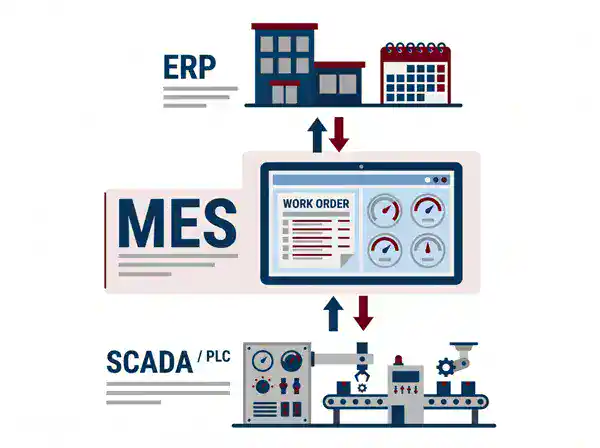
An MES occupies the middle layer of the manufacturing technology stack — above the control systems that run the machines and below the enterprise systems that run the business. The automation industry describes this as a three-tier hierarchy, and MES is the bridge between the top and bottom tiers. Knowing which system owns which job prevents the most common mistake: expecting one layer to do another layer’s work.
| System | Layer | Primary job | Time horizon |
|---|---|---|---|
| ERP | Enterprise / business (top) | Planning the business — orders, inventory, procurement, finance, and master scheduling. Decides what and when to produce. | Days, weeks, months |
| MES | Operations / execution (middle) | Running and tracking production — dispatching jobs, collecting data, enforcing quality, and recording genealogy. Manages how it gets made. | Minutes to shifts |
| SCADA / PLC | Control / process (bottom) | Supervising and controlling equipment — reading sensors and driving actuators, valves, and motors in real time. | Milliseconds to seconds |
For a closer look at the control layer, see SCADA and DCS explained. The flow runs in both directions. ERP sends the production plan down to the MES; the MES translates it into executable jobs and feeds instructions down to SCADA and the PLCs that control the machines. Live data then flows back up: SCADA reports machine status and sensor readings to the MES, and the MES rolls up confirmed production, scrap, and performance to ERP so the business books reflect reality. SCADA is strong at real-time machine supervision but is not built to manage work orders, genealogy, or quality records — that is the MES’s role. ERP is strong at planning but has no real-time view of the floor — that is also the MES’s role. The MES is what makes the plan and the plant speak the same language.
Rule of thumb: ERP decides what to make, SCADA controls the machine that makes it, and MES manages how it actually gets made — and keeps the record of it.
Benefits of an MES on the Plant Floor
The benefit of an MES is visibility and control over production in real time, which translates directly into higher throughput, lower waste, and defensible records. Because the system captures what happens as it happens, it replaces guesswork and paper trails with data you can act on during the shift rather than after it.
- Real-time visibility: Managers see current status, bottlenecks, and schedule adherence across every work center without walking the floor or waiting for end-of-shift reports.
- Higher productivity and OEE: Live downtime and performance tracking exposes where time and throughput are leaking, so teams fix the losses that actually move the number.
- Less waste and rework: In-process quality checks catch defects early and hold nonconforming product before it consumes more material or ships to a customer.
- Full traceability: Lot-level genealogy makes recalls, root-cause investigations, and customer audits fast and precise instead of a scramble through paperwork.
- Paperless, consistent operations: Current work instructions and specs are served at the point of use, reducing errors from outdated documents and manual data entry.
- Audit-ready compliance: Electronic records of who did what, when, and to which lot support regulated environments and quality-system requirements.
- Better decisions: Accurate, timely production data feeds continuous-improvement programs and gives ERP a true picture of what the plant actually produced.
How MES and Maintenance (CMMS) Work Together
An MES and a CMMS are complementary systems that cover different halves of the same equipment: the MES runs and tracks what the equipment produces, while a CMMS (computerized maintenance management system) manages the maintenance that keeps that equipment running. An MES can tell you a machine is down or running slow; a CMMS is where the repair, the preventive schedule, the parts, and the asset history live. Production depends on the equipment, and the equipment depends on maintenance — so the two systems address the same assets from opposite sides.
The practical connection is straightforward. When an MES records unplanned downtime or a performance drop, that is frequently a maintenance event — a breakdown, a worn component, or a machine drifting out of spec. A CMMS turns those events into managed work: a structured preventive maintenance program converts surprise failures into scheduled service, and disciplined work order management shortens the gap between a fault and a technician on the machine. The result is fewer stoppages feeding into the MES’s downtime column in the first place.
Over time, the maintenance side builds the long view of equipment health that production planning relies on. Tracking reliability through asset performance management and managing the full equipment lifecycle through enterprise asset management help ensure the assets an MES schedules are actually available and capable when the plan calls for them. To be clear, a CMMS is not an MES and does not run production — but keeping the underlying equipment reliable is what makes the production the MES is tracking possible. Many plants run both: the MES to execute and document production, and a CMMS to keep the equipment that production runs on in service. See how this works in manufacturing maintenance with a CMMS.
Keep the Equipment Your Production Runs On
See how eWorkOrders helps your maintenance team schedule preventive maintenance, track inspections, and turn problems into work orders before small issues become costly downtime. See how it works in a free, personalized demo.
Frequently Asked Questions
What does a manufacturing execution system (MES) do?
An MES manages and tracks production on the factory floor in real time — dispatching work orders, collecting data from machines and operators, enforcing quality checks, recording material and lot traceability, and measuring performance such as OEE. It turns a production plan into an executable, documented record of what was actually made.
What is the difference between MES and ERP?
ERP is the enterprise planning layer — it decides what and when to produce and handles orders, inventory, and finance over days and weeks. MES is the execution layer that runs and tracks production on the floor in minutes and shifts. ERP sends the plan down to the MES, and the MES sends confirmed production and performance data back up to ERP.
Is MES the same as SCADA?
No. SCADA (and the PLCs beneath it) controls equipment in real time, reading sensors and driving machine actuators in milliseconds. MES sits a layer above and manages the broader execution of production — work orders, scheduling, quality, and traceability. SCADA tells a machine how to run; MES manages how the overall job gets made and keeps the record of it.
What is ISA-95?
ISA-95 is the international standard for integrating enterprise and control systems in manufacturing. It defines a level model in which ERP sits at Level 4, manufacturing operations management such as MES at Level 3, and supervisory and control systems such as SCADA, HMIs, and PLCs at Levels 2 and 1, so data can flow cleanly between the business and the plant floor.
Is a CMMS a manufacturing execution system?
No. A CMMS manages the maintenance of equipment — work orders, preventive schedules, spare parts, and asset history — while an MES runs and tracks the production that equipment performs. They are complementary: the MES depends on the equipment being available and reliable, which is exactly what a CMMS is built to keep it. Many manufacturers run both systems.
Part of the eWorkOrders Learning Center
Additional Resources
- Work Order Management
- Preventive Maintenance System
- What Is Asset Performance Management?
- Enterprise Asset Management (EAM)
- SCADA and DCS: Industrial Control Systems Explained
- OEE Software: Track and Improve Overall Equipment Effectiveness
- Manufacturing Maintenance: CMMS for Plants and Production Lines
- Best CMMS Software Comparison


