Cooling Tower Maintenance Checklist
A cooling tower that’s losing cycles of concentration or drifting warmer than it should is usually a maintenance gap, not an equipment failure. This checklist covers daily, weekly, monthly, quarterly, and annual cooling tower maintenance tasks, plus water treatment, Legionella control, and when a repair stops being worth it.
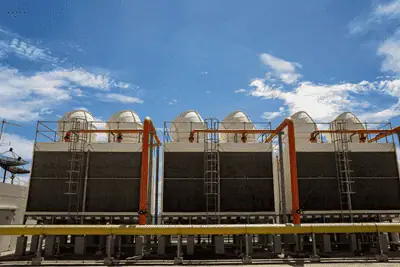
Daily
Weekly
Monthly
Quarterly
Annual / Seasonal
Startup & Shutdown
These are general guidelines. Follow the manufacturer’s recommendations, your water treatment provider’s program, and any local requirements. Cooling towers work hand in hand with chillers, so plan their maintenance together — see the chiller maintenance guide, or the broader Commercial HVAC Maintenance Checklist.
What Is a Cooling Tower?
Put simply, a cooling tower removes heat from water by letting a small part of it evaporate into the air. First, nozzles spray warm water from a chiller condenser or an industrial process over fill, a material that spreads the water into thin films. Then fans or natural airflow move air through the fill, some of the water evaporates, and as a result the remaining water cools. Finally, the cooled water collects in the basin, and pumps send it back to the process.
Cooling towers serve power plants, chemical plants, refineries, manufacturing, data centers, and commercial buildings, where they pair with water-cooled chillers for air conditioning. Because they’re constantly exposed to water, heat, and outdoor air, they therefore need consistent maintenance and water treatment to stay efficient and safe.
Key Cooling Tower Components
| Component | What It Does |
|---|---|
| Distribution system | Nozzles or a hot water basin spread incoming water evenly over the fill |
| Fill | Increases the contact area between water and air so that heat transfers efficiently |
| Fan and drive | Moves air through the tower (motor, belts or gearbox, fan blades) |
| Drift eliminators | Catch water droplets before they leave the tower with the air |
| Cold water basin | Collects cooled water for the pumps |
| Makeup water system | Replaces water lost to evaporation, drift, and blowdown, so the basin stays full |
| Blowdown (bleed-off) | Removes some water so that dissolved minerals don’t concentrate too much |
| Water treatment system | Feeds chemicals to control scale, corrosion, and biological growth |
Types of Cooling Towers
| Type | How It Works | Typical Use |
|---|---|---|
| Natural draft | A tall chimney-like shell creates airflow without fans | Very large installations such as power plants |
| Mechanical draft: induced | A fan at the top pulls air up through the tower | The most common design in industrial and commercial use |
| Mechanical draft: forced | A fan at the base or side pushes air into the tower | Smaller towers and installations with space limits |
| Counterflow | Water falls down through the fill while air moves up against it | Compact footprint; common in many applications |
| Crossflow | Water falls down through the fill while air moves across it horizontally | Easy access to distribution for maintenance; common in HVAC |
| Closed-circuit (fluid cooler) | Process fluid stays inside a coil; tower water sprays over the coil | Keeps process fluid clean where contamination is a concern |
In other words, draft type (natural, induced, or forced) describes how air moves, while flow type (counterflow or crossflow) describes how air and water meet. For this reason, people usually describe a tower by both, for example an induced draft counterflow tower.
Common Cooling Tower Problems and Solutions
| Problem | Why It Happens | How to Prevent or Fix It |
|---|---|---|
| Scaling | Because water evaporates, minerals concentrate and deposit on fill and heat exchange surfaces | Maintain water treatment and blowdown, then clean fill and surfaces and also monitor cycles of concentration |
| Corrosion | Constant exposure to water, oxygen, and treatment chemicals attacks metal parts | Use corrosion inhibitors and keep chemistry in range; also inspect and coat structural parts |
| Biological growth (algae, slime, bacteria) | Warm water, sunlight, and nutrients encourage growth, such as Legionella | Run a biocide program and clean regularly; in addition, keep sunlight off the water and follow a water management plan |
| Clogged fill or nozzles | Debris, scale, and algae block water distribution, so flow becomes uneven | Clean distribution nozzles and basins, then inspect and replace damaged fill |
| Fan and drive problems | Worn bearings, belt or gearbox wear, imbalance, loose blades | Lubricate as specified, check belt tension or gearbox oil, and then balance and inspect blades |
| Vibration and noise | Fan imbalance, worn bearings, loose components, gearbox problems | Check vibration switches and tighten hardware; after that, repair worn parts |
| Leaks and water loss | Damaged basins, piping, or seals; excessive drift or splash-out | Inspect basin and piping, check drift eliminators, and then repair leaks |
| Poor cooling (water leaving too warm) | Fouled fill, blocked airflow, fan problems, uneven water distribution | Clean fill and nozzles and clear air inlets; finally, confirm fans and controls work |
| Control and sensor faults | Faulty level controls, float valves, conductivity or temperature sensors | Calibrate and test controls, and also check makeup valve operation |
| Electrical problems | Loose connections, moisture in motors or panels | Inspect and tighten connections, and then protect enclosures from water |
In short, most of these problems come back to two things: water treatment and routine inspection. As a result, towers with good treatment and on-schedule inspections run cleaner, cool better, and last longer.
Cooling Tower Water Treatment Basics
As water evaporates, the minerals in it stay behind and become more concentrated. For that reason, water treatment keeps that concentration, and the scale, corrosion, and biological growth that come with it, under control. Two numbers matter most:
| Measure | Formula |
|---|---|
| Cycles of concentration | Conductivity of tower water ÷ Conductivity of makeup water |
| Blowdown rate | Evaporation rate ÷ (Cycles of concentration − 1) |
For example: tower water at 1,500 µS/cm and makeup water at 300 µS/cm means 1,500 ÷ 300 = 5 cycles of concentration. If the tower evaporates 10 gallons per minute, the blowdown needed to hold 5 cycles is 10 ÷ (5 − 1) = 2.5 gallons per minute. Running more cycles saves water; however, it also raises scale risk, so your water treatment provider sets the target for your water quality.
Above all, log conductivity, pH, and chemical levels regularly, and then review the results with your water treatment provider.
Legionella and Cooling Tower Safety
Cooling towers can grow Legionella bacteria, which cause Legionnaires’ disease when people inhale contaminated water droplets. Therefore, biological control is a health and safety issue, not just an efficiency issue. A CDC-presented study of 196 cooling towers sampled across eight U.S. climate regions found Legionella DNA in 84% of them — a reminder that detecting the bacteria at some level is common, which is exactly why ongoing treatment and monitoring matter more than a one-time check. (DNA detection alone doesn’t mean a tower is actively causing illness; outbreak risk depends on concentration, strain, and how much water aerosol people actually breathe in — but it’s the reason water management programs treat every cooling tower as a potential source, not just the ones with a known problem.)
- Have a water management program. ASHRAE Standard 188 and CDC guidance describe how to build one: identify risks, set control measures, monitor them, and document corrective actions. Some states and cities also have their own cooling tower requirements.
- Keep treatment and cleaning on schedule, such as biocide levels and periodic cleaning and disinfection.
- Maintain drift eliminators so that fewer droplets leave the tower.
- Avoid stagnant water, for example in idle towers and dead legs in piping.
- Protect workers: use appropriate respiratory protection when cleaning, lock out fans before entering, and watch for slippery surfaces and fall hazards. See what lockout/tagout is.
Why Preventive Maintenance Matters for Cooling Towers
First of all, regular cleaning, inspections, and repairs catch problems before they cause major damage or downtime. As a result, the tower keeps cooling efficiently, the chiller or process it serves uses less energy, water and chemical use stays under control, and the equipment lasts longer. In addition, consistent maintenance keeps Legionella risk low and gives you the records a water management program requires. A tower that’s falling behind on maintenance shows it first as approach temperature creep — the gap between the water leaving the tower and the outdoor wet-bulb temperature slowly widening as fill fouls, nozzles clog, or airflow drops. That matters beyond the tower itself: as a general industry rule of thumb, each 1°F of unwanted rise in condenser water temperature tends to cost the chiller it feeds roughly 1-1.5% more energy, since the compressor has to work harder against a warmer condensing temperature. A few degrees of creep, left unaddressed for a season, adds up.
When to Repair vs. Replace an Aging Cooling Tower
Most cooling tower problems are fixable with the maintenance above, but towers do eventually reach the point where repair stops making sense. A commonly used industry rule of thumb: if a single repair’s cost approaches or exceeds roughly half of what a comparable replacement tower would cost, it’s worth getting a replacement quote before authorizing the repair — especially for an older unit that’s already had multiple major repairs. Other signs it may be time to plan for replacement rather than another repair:
- Persistent approach-temperature creep that doesn’t resolve after a full cleaning and water-treatment review — this can point to fill or structural degradation rather than a fixable fouling problem.
- Structural corrosion in the basin, casing, or support structure, rather than surface rust on hardware that can be treated or replaced individually.
- Repeated gearbox, motor, or fan-drive failures on the same unit within a short span, which often signals the drive system — not just one worn part — is reaching end of life.
- Parts becoming hard to source for an older or discontinued tower model.
Whichever way a team decides, keeping a connected repair history for the asset — what failed, when, and what it cost — makes that comparison easier the next time a major repair comes up, which is one of the practical reasons to track cooling tower work through a CMMS rather than in scattered paper records.
How eWorkOrders CMMS Supports Cooling Tower Maintenance
A computerized maintenance management system (CMMS) keeps cooling tower work on schedule and documented.
Scheduled Tasks
The system generates daily checks, weekly water tests, and seasonal cleanings as preventive maintenance work orders so nothing gets missed.
Documentation
The CMMS records every test, cleaning, and corrective action, which supports a water management program and inspections.
Parts and Supplies
Track belts, bearings, gearbox oil, strainers, and fill with reorder points.
Sensor Monitoring
eWorkOrders supports MQTT-based monitoring from pre-configured sensors or gateways, including temperature, water levels, alarms, and other equipment measurements. The available documentation does not identify specific sensor brands; contact eWorkOrders support to confirm compatibility with a particular device or system.
Frequently Asked Questions
What are the most common cooling tower problems?
The most common cooling tower problems are scaling, corrosion, biological growth, clogged fill or nozzles, fan and drive problems, vibration, leaks, poor cooling, control faults, and electrical issues. In most cases, they trace back to water treatment and inspection.
How often should you clean a cooling tower?
Most teams inspect cooling towers weekly to monthly, and they fully clean and disinfect them at least once a year, often before seasonal startup. However, towers with heavy debris, poor water quality, or biological problems may need more frequent cleaning. Follow your water treatment provider’s program and any local requirements.
What is the difference between counterflow and crossflow cooling towers?
Water falls down through the fill in both designs. However, in a counterflow tower, air moves up against the falling water, while in a crossflow tower, air moves horizontally across it.
What are cycles of concentration in a cooling tower?
Cycles of concentration compare the dissolved minerals in the tower water to those in the makeup water, usually by dividing the tower water’s conductivity by the makeup water’s conductivity. Higher cycles save water; however, they also increase scaling risk.
Why is Legionella a concern with cooling towers?
Cooling towers can grow Legionella bacteria, and contaminated droplets released by the tower can cause Legionnaires’ disease if inhaled. For this reason, a water management program, proper biocide treatment, regular cleaning, and working drift eliminators all help control the risk.
What does cooling tower maintenance include?
It includes checking water level and makeup, testing and adjusting water treatment, controlling blowdown, cleaning nozzles, basins, and fill, inspecting fans, belts, gearboxes, and motors, checking drift eliminators, and inspecting the structure for corrosion.
When should a cooling tower be repaired vs. replaced?
As a general rule of thumb, if a single repair’s cost approaches or exceeds roughly half of a comparable replacement tower’s cost, it’s worth getting a replacement quote before authorizing the repair, especially on an older unit with a history of major repairs. Persistent approach-temperature creep that doesn’t resolve after cleaning and a water-treatment review, structural corrosion in the basin or casing, and repeated drive-system failures are other signs it may be time to plan for replacement.
A Cooling Tower Rarely Fails Without a Trail of Missed Readings First
Scale buildup, drift in cycles of concentration, a fan bearing starting to wear — the warning signs are usually there before a tower actually fails, but only if someone’s recording them consistently. eWorkOrders lets your team schedule cooling tower PMs by frequency, assign the work, and keep water-treatment readings and repair history connected to the asset.
About the author: Janet Jaquis is Marketing Director at eWorkOrders, where she writes about maintenance strategy, asset reliability, and CMMS software for maintenance and facility teams.
Disclaimer: This checklist is general guidance, not a substitute for your water treatment provider’s program, the tower manufacturer’s instructions, or applicable local Legionella/cooling-tower regulations. Cooling tower work involves water-treatment chemicals, rotating equipment, and work at height or in confined spaces — follow your facility’s lockout/tagout program and PPE requirements, and have unfamiliar repairs performed by qualified personnel.


