Predictive Maintenance Techniques: The 6 Methods Explained
Predictive maintenance is not one technology — it is a set of condition-monitoring techniques, each built to catch a different kind of failure. This guide walks through the six most widely used methods, what each one actually detects, and how to decide which ones make sense for your assets.
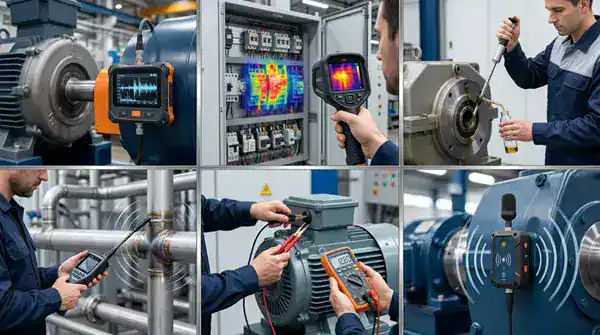
The 6 Techniques at a Glance
Each technique below detects a different physical signature of a developing failure. Most reliability-focused maintenance programs use more than one, because no single method catches every failure mode.
| Technique | What it measures | Best for |
|---|---|---|
| Vibration analysis | Frequency and amplitude of mechanical motion | Rotating equipment: bearings, gears, pumps, motors, fans |
| Infrared thermography | Surface heat patterns | Electrical connections, panels, transformers, motors, insulation |
| Oil analysis | Wear particles, contamination, and chemical breakdown in lubricant | Gearboxes, hydraulics, engines, large rotating equipment |
| Ultrasonic testing | High-frequency sound outside the range of human hearing | Leaks, bearing lubrication, electrical arcing |
| Motor circuit analysis | Electrical resistance, impedance, and winding signatures | Electric motors, generators, transformers |
| Acoustic emission monitoring | Sound signature changes during operation | Bearings, gears, structural integrity, leaks |
1. Vibration Analysis
Every piece of rotating equipment produces vibration tied to its physical geometry — its bearings, gears, and shaft speed. Vibration analysis measures that vibration and tracks how it changes over time. A healthy machine produces a predictable, low-level signature; a developing defect — an unbalanced shaft, a misaligned coupling, a worn bearing — shows up as a distinct change in that signature well before it’s audible or visible.
In practice, a technician or analyst takes an overall reading first as a quick screen, then digs into the detailed frequency data only on assets that flag as a concern — isolating whether the issue is unbalance, misalignment, or a specific bearing defect. You don’t need to run the analysis yourself to use this technique: most programs use a data collector or in-house/outsourced analyst to do the technical interpretation, and the maintenance team just needs the resulting finding and severity rating to decide what to do next.
Vibration analysis is most valuable on assets with rotating components and a real consequence of failure — because the payoff can be large. In one documented case, early detection of a deteriorating industrial gearbox allowed a repair costing about €5,000, avoiding a failure that would have cost roughly €27,000. In a wind turbine example, catching a bearing defect early meant a €5,000 bearing replacement instead of a roughly €250,000 gearbox replacement.
One caution worth building into any vibration program: bearing fatigue itself accounts for less than 3% of in-service bearing failures. Most bearing failures actually trace back to contamination, poor lubrication, misalignment, or improper installation — which is exactly the kind of thing vibration monitoring, combined with oil analysis, is built to catch early.
2. Infrared Thermography
Infrared thermography uses a thermal imaging camera to find heat anomalies without touching the equipment. Many electrical and mechanical problems can produce excess heat before failure — a loose connection develops resistance and warms up, a failing bearing generates friction heat, an overloaded breaker runs hotter than its neighbors on the same panel. A thermal camera makes those temperature differences visible well before they’re detectable by touch or by eye.
It’s used across electrical panels, transformers, motors, compressors, and HVAC equipment, and it’s especially effective for catching overheating connections, insufficient insulation, and loose terminations — failure modes that are otherwise invisible during a normal visual inspection. Because it’s non-contact, it can be performed on live, energized equipment without shutting it down, which is part of why it’s a standard tool in electrical safety inspection programs as well as maintenance programs.
Typical inspection cadence is annual or semi-annual for high-risk electrical equipment, with continuous thermal sensors reserved for the most critical, hardest-to-take-offline assets.
3. Oil Analysis
Lubricating oil is in direct contact with almost every moving part inside a gearbox, engine, or hydraulic system — which means it picks up evidence of wear before that wear becomes visible anywhere else. Oil analysis examines a sample for wear metal particles (via spectroscopy), contamination (dirt, water, or process fluid), viscosity (whether the oil can still protect the surfaces it’s coating), and oxidation (whether the oil itself is breaking down).
A rising trend in a specific wear metal — iron, copper, or chromium, for example — can point to which specific component is wearing before it fails, since different metals correspond to different parts. Water contamination is a leading cause of accelerated bearing failure and corrosion, and it’s often invisible without a lab test. Because these trends develop gradually, oil analysis works best as a scheduled program with a consistent sampling interval, rather than a one-time check.
This technique pairs naturally with vibration analysis on the same equipment: vibration tends to catch mechanical defects earlier, while oil analysis is often better at catching the root cause — contamination or lubrication failure — that leads to the mechanical defect in the first place.
4. Ultrasonic Testing
Ultrasonic instruments listen for sound in the 20 kHz–100 kHz range, well above human hearing, where developing mechanical and electrical problems produce distinctive signatures long before they’re audible. Ultrasonic testing runs in two modes: airborne/scan mode, used to find compressed-air and gas leaks and electrical arcing or tracking from a safe distance, and contact/structure-borne mode, used to listen to the internal condition of a bearing through a probe touched to the housing.
Bearing condition has a distinctive ultrasonic signature at each stage: a healthy, properly lubricated bearing produces a soft, consistent whirring sound; an under-lubricated bearing produces an intense scraping sound as metal-to-metal friction increases; a damaged bearing produces intermittent popping or grating with visibly irregular waveforms. That progression makes ultrasonic testing one of the most direct ways to catch a lubrication problem before it becomes a bearing failure — and lubrication-related issues are, as noted above, a leading cause of bearing failure in the first place.
Ultrasonic leak detection is also one of the faster-payback applications of this technique: compressed air leaks are a continuous, invisible energy cost, and ultrasonic scanning finds them directly, even in noisy plant environments where the leak itself can’t be heard by ear.
5. Motor Circuit Analysis (MCA)
Motor circuit analysis is a de-energized electrical test, typically taking just a few minutes, that sends a low-voltage signal through a motor and reads how its electrical circuit responds. It checks the entire electrical path — windings, connections, and cabling between the test point and the motor — giving a much fuller picture of motor health than a quick continuity check would.
The reason it’s used alongside (not instead of) simpler tests like a megohmmeter check: a megohmmeter only tests insulation-to-ground resistance, so it only catches ground faults. A significant share of motor winding failures begin as internal turn-to-turn or phase-to-phase faults that never touch ground — and a megohmmeter alone will not catch those until they progress much further. MCA’s broader signature catches those internal winding faults, along with rotor problems, open connections, and contamination, much earlier in the failure progression.
Because it’s fast and non-destructive, MCA fits into three different points of a maintenance program: commissioning testing on new or rebuilt motors, troubleshooting an underperforming motor, and — the predictive use case — periodic trending on critical motors to catch degradation before an unplanned failure.
6. Acoustic Emission Monitoring
Acoustic emission monitoring uses microphones or specialized sensors to capture the sound signature of operating equipment and establish a baseline for what “normal” sounds like. Once that baseline exists, the system flags deviations — a new rattle, a change in pitch, an intermittent pop — that indicate a developing problem.
It’s used to detect bearing and gear wear, misalignment, overheating, blockages, cracks, leaks, and certain electrical faults, which makes it one of the broader-spectrum techniques on this list. It overlaps conceptually with ultrasonic testing — both are sound-based — but acoustic emission monitoring more often refers to continuous, sensor-based baseline monitoring across a wider frequency range, while ultrasonic testing is more often a targeted, technician-run inspection at specific points. In practice, many programs use both: continuous acoustic monitoring to flag that something has changed, and a targeted ultrasonic or vibration check to confirm what it is.
How to Choose Which Techniques You Need
Most plants don’t need all six on every asset — that gets expensive and generates more data than anyone can act on. A more practical approach is to match the technique to the failure mode you’re actually trying to catch, and start with your highest-consequence assets.
- Rotating equipment with bearings, gears, or shafts — start with vibration analysis, and add oil analysis if it’s gear-driven or has a large lubricant reservoir.
- Electrical distribution, panels, and connections — infrared thermography is the standard first technique; it’s non-contact and can be done without an outage.
- Electric motors, especially critical or hard-to-replace ones — motor circuit analysis, ideally alongside vibration analysis if the motor also drives rotating equipment.
- Compressed air, gas, or steam systems — ultrasonic testing, specifically for leak detection, tends to have the fastest payback of any technique on this list.
- Assets where you want one continuous monitoring layer across several failure types — acoustic emission monitoring, often layered on top of one of the more targeted techniques above rather than used alone.
Whichever techniques you choose, the technology only produces value if the finding leads to an action — whether that’s a scheduled work order, an immediate repair, further inspection, or continued monitoring. A documented condition with no follow-up is just data, not maintenance.
Where eWorkOrders fits. eWorkOrders does not perform vibration analysis, thermography, oil analysis, ultrasonic testing, motor circuit analysis, or acoustic monitoring itself — those are specialized instruments and trained technicians. What the CMMS does is turn a finding from any of these techniques into a tracked work order, record the condition reading against the asset’s history, and give you the failure and cost data needed to prove whether the program is paying for itself. See our Predictive Maintenance ROI guide for how to build that business case.
Turn Condition-Monitoring Findings Into Tracked Work
Whatever technique flags a problem, eWorkOrders gives your team one place to turn that finding into a work order, track the repair, and build the asset history that proves your predictive maintenance program is working. Rated 4.9 stars on Capterra and G2. Over 30 years serving maintenance teams.
Frequently Asked Questions
What is the most common predictive maintenance technique?
Vibration analysis and infrared thermography are the two most widely adopted, largely because they apply to the broadest range of equipment (rotating machinery and electrical systems, respectively) and don’t require taking equipment offline to inspect it.
Do I need more than one predictive maintenance technique?
Usually, yes, for a well-rounded program. Each technique is built to catch a different failure signature — vibration catches mechanical defects, thermography catches heat-related electrical and mechanical issues, oil analysis catches lubrication and contamination problems. Most reliability programs layer two or three techniques on their most critical assets rather than relying on one.
Which predictive maintenance technique has the fastest payback?
Ultrasonic leak detection on compressed air and gas systems tends to have one of the fastest, most direct paybacks, since leaks are a continuous, quantifiable energy cost that’s otherwise invisible in a noisy plant environment.
Can a CMMS perform these predictive maintenance techniques?
No. Vibration analysis, thermography, oil analysis, ultrasonic testing, motor circuit analysis, and acoustic emission monitoring are performed with specialized instruments, often by trained technicians or third-party services. A CMMS like eWorkOrders manages what happens with the finding — creating and tracking the resulting work order and keeping the condition history against the asset — not the condition-monitoring itself.
How often should predictive maintenance inspections be performed?
It depends on the technique and the asset’s criticality. Infrared thermography on electrical equipment is often done annually or semi-annually, while vibration and oil analysis on critical rotating equipment are frequently run on a monthly or continuous basis. The right interval depends on how quickly the specific failure mode you’re watching for tends to progress.
Sources
2. Advanced Technology Services — Thermographic Testing & Infrared Electrical Inspections ·
3. Advanced Technology Services — What is Oil Analysis for Predictive Maintenance? ·
4. Plant Engineering — Using Ultrasonics in Predictive Maintenance (bearing sound signatures, PdM adoption survey data) ·
5. ALL-TEST Pro — Motor Circuit Analysis: Motor Testing With MCA Tools ·
6. NI (National Instruments) — What is Acoustic Monitoring? Condition Monitoring
Scope: This is a general educational guide. Predictive maintenance techniques described here should be performed by appropriately trained personnel using calibrated instruments.


