ISO 55001 and Asset Management Policy: What It Requires, and Whether You Need Certification
ISO 55001 is the international standard for a formal asset management system — the one utilities, government agencies, and capital-intensive operators are increasingly asked to certify against. Here’s what it actually requires, and how much of it makes sense to adopt even if you never pursue certification.
What is ISO 55001?
ISO 55001 is the international standard that specifies requirements for an asset management system — a formal, documented approach to managing physical assets that balances performance, risk, and cost against an organization’s objectives. It’s a certifiable standard: an accredited body can independently audit and certify an organization against it, the same way companies certify to ISO 9001 for quality or ISO 14001 for environmental management.
The current edition is ISO 55001:2024, published July 3, 2024, which replaced and withdrew the original ISO 55001:2014. It sits inside the broader ISO 55000 family: ISO 55000 gives the overview, principles, and terminology; ISO 55001 is the requirements standard organizations are actually certified against; and ISO 55002 provides implementation guidance for applying ISO 55001 in practice.
Who actually needs it
ISO 55001 certification tends to matter most for organizations where asset performance ties directly to regulatory compliance, public safety, or large capital budgets — utilities, transportation authorities, oil & gas operators, and government or municipal infrastructure agencies. In those sectors, a regulator, an investor, or a customer RFP that specifically requires it usually drives the decision to certify.
Most facilities and manufacturing maintenance teams will never pursue formal certification, and that’s a reasonable call, since certification requires ongoing external audits and a level of documentation overhead that isn’t justified unless something external demands it. That said, the underlying framework is worth borrowing regardless: a written asset management policy, a documented strategy, and measurable objectives are good practice at almost any scale, certified or not.
The three-tier documentation structure
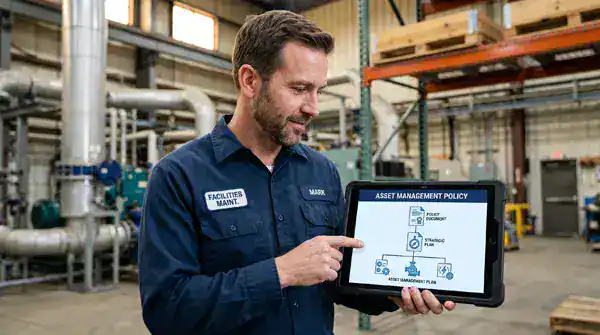
ISO 55001 organizes an asset management program into three connected documents, each answering a different question at a different altitude:
| Document | Typical length | Answers |
|---|---|---|
| Asset Management Policy | 1–3 pages | What does leadership commit to? A short, top-management-authorized statement of intent. |
| Strategic Asset Management Plan (SAMP) | 15–50 pages | How does asset strategy connect to organizational objectives? Covers a 5–50 year horizon depending on asset life. |
| Asset Management Plans | 20–100+ pages each | How is this specific asset class, site, or business function actually managed day to day? |
The three documents are meant to trace directly to each other — a “line of sight” from the one-page policy statement down to the operational plan for a specific piece of equipment. In practice, ISO 55001 audits commonly flag a policy that isn’t reflected in the SAMP, or a SAMP with no connection to what’s actually happening on the shop floor.
What the standard actually requires
ISO 55001 follows the same high-level structure as other modern ISO management-system standards, organized into seven areas:
- Context of the organization. Identify internal and external stakeholders and document how their requirements shape asset management decisions.
- Leadership. Top management has to demonstrably lead this work — not just sign off on a policy, but actively support the SAMP and make sure the organization understands why it matters.
- Planning. Address risks and opportunities across the asset lifecycle, and document who’s responsible for what.
- Support. Documented competence requirements, adequate resourcing, and communication protocols that keep the asset management system running.
- Operation. Defined processes and controls, including a formal management-of-change procedure that applies to internal work and outsourced/contracted activity alike.
- Performance evaluation. Ongoing monitoring, internal audits, and management review — including periodically evaluating whether the evaluation process itself is still working.
- Improvement. A documented process for identifying nonconformities, correcting them, and continuously improving the system.
Do you need certification, or just the framework?
These are two different decisions, and it’s worth separating them. Certification means external audits, a maintained management-system structure, and ongoing cost, so it’s only worth it when a regulator, customer, or investor is specifically asking for it.
By contrast, adopting the framework without certifying is a lower-cost, high-value option most maintenance teams can benefit from:
- Write a one-page asset management policy. A short, specific statement of what your organization commits to in how it manages assets — not a generic template, but something that reflects how your facility actually operates.
- Document a basic strategy. Even a lightweight version of a SAMP — what assets matter most, what the multi-year plan is for them — gives you a reference point instead of ad-hoc decisions.
- Set measurable objectives. Tie asset management goals to numbers you can actually track: PM compliance rate, unplanned downtime, MC/RAV (maintenance cost as a percentage of replacement asset value).
- Keep the records an audit would ask for. Even without an external audit, having your asset register, maintenance history, and change records organized makes it far easier to adopt formal certification later if the need ever comes up.
How a CMMS supports this work
Most of what ISO 55001 asks for — a documented asset register, traceable maintenance history, risk and criticality data, performance monitoring, and records for management review — is exactly what a CMMS is built to hold. In eWorkOrders specifically:
- The asset register and hierarchy provide the “line of sight.” See asset hierarchy for how individual equipment records connect up to systems, buildings, and sites — the same structure an Asset Management Plan needs to reference.
- Maintenance history and cost data support performance evaluation. PM compliance, downtime, and cost roll-ups give you the numbers a SAMP’s objectives need to be measured against.
- Work order and change records create an audit trail. The system timestamps and attributes every job, approval, and change — useful whether or not you’re ever formally audited.
None of this requires certification to be worth doing, either. See asset management with a CMMS for the full picture of how asset records, lifecycle tracking, and reporting fit together.
Build the record-keeping ISO 55001 expects — certified or not
Whether or not certification is on your roadmap, the underlying discipline — a documented asset register, traceable history, and measurable objectives — is what actually reduces downtime and cost. eWorkOrders has supported maintenance operations for over 30 years, serving teams at Honda and King River Packaging, and rated 4.9 on both Capterra and G2.
Frequently Asked Questions
What is ISO 55001?
ISO 55001 is the international standard specifying requirements for a formal asset management system, covering how an organization manages physical assets to balance performance, risk, and cost. The current edition is ISO 55001:2024, which replaced ISO 55001:2014 on July 3, 2024.
What’s the difference between ISO 55000, 55001, and 55002?
ISO 55000 provides an overview of principles and terminology, while ISO 55001 is the requirements standard organizations are actually certified against. Practical guidance for applying those requirements comes from ISO 55002.
What’s the difference between an Asset Management Policy and a SAMP?
The Asset Management Policy is a short (1–3 page), top-management-authorized statement of intent. The Strategic Asset Management Plan (SAMP) is a longer document, typically 15–50 pages, that connects organizational objectives to actual asset strategy over a multi-year horizon. Asset Management Plans are the operational-level documents underneath both, covering specific asset classes or sites.
Do I need to be ISO 55001 certified?
Only if a regulator, customer, or investor specifically requires it — certification involves ongoing external audits and documentation overhead. Most maintenance teams can benefit from adopting the underlying framework (a written policy, a basic strategy, measurable objectives) without pursuing formal certification.
Does a CMMS help with ISO 55001 compliance?
Yes — a CMMS’s asset register, maintenance history, and reporting cover much of what the standard expects: a documented asset hierarchy, traceable performance data, and records for management review. It doesn’t replace the policy and planning documents themselves, but it supplies the operational data those documents depend on.
- ISO 55001:2024, “Asset management — Asset management system — Requirements,” International Organization for Standardization
- ISO 55000 family overview (ISO 55000, ISO 55001, ISO 55002), International Organization for Standardization
About the author: Janet Jaquis is Marketing Director at eWorkOrders, where she writes about maintenance strategy, asset reliability, and CMMS software for maintenance and facility teams.
Disclaimer: This article is for general informational and educational purposes only and does not constitute legal, compliance, or certification advice. Accredited certification bodies set and audit ISO 55001 certification requirements, so consult a qualified asset management consultant or accredited certification body before making decisions about pursuing certification for your organization.


