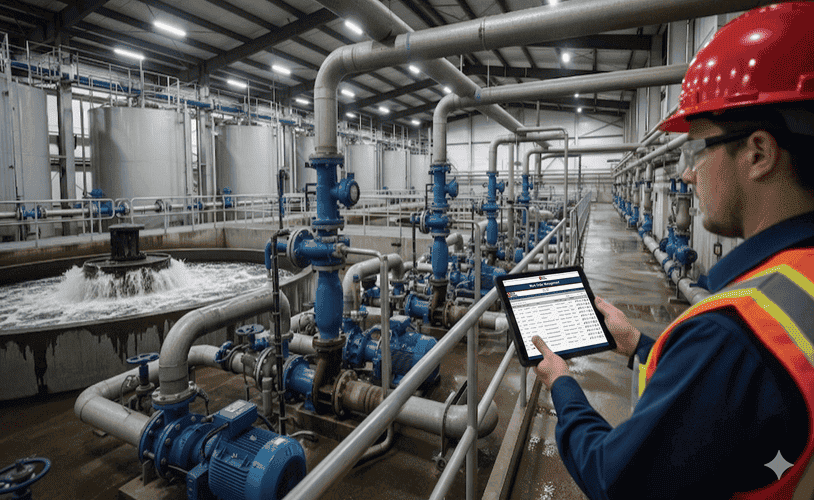
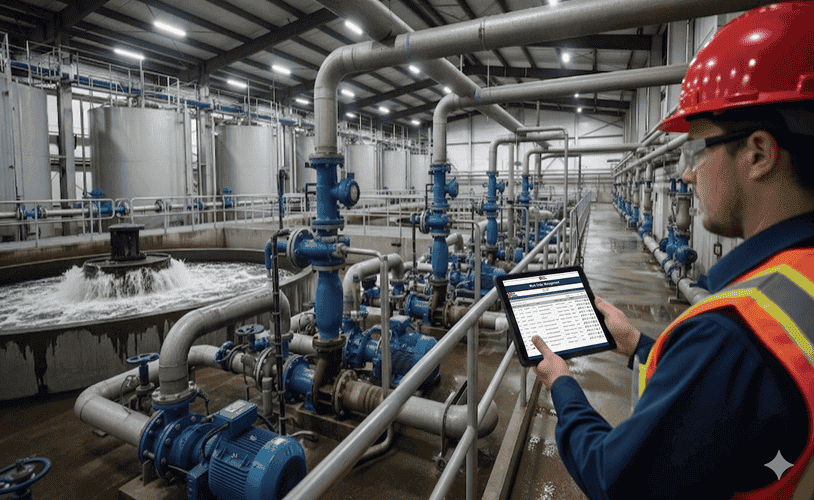
Plant managers use CMMS software to monitor maintenance activity and equipment performance across wastewater treatment infrastructure.
How David, a municipal wastewater plant manager, regained maintenance visibility and control using CMMS software
Follow David’s journey from fragmented maintenance tracking to operational control.
Water and wastewater treatment plants must operate continuously to meet strict uptime, safety, and regulatory standards. Even small gaps in maintenance can impact treatment efficiency and compliance readiness. However, maintaining control becomes difficult when maintenance data is scattered across spreadsheets, paper logs, and disconnected tools, limiting visibility across critical assets.
David Morgan, a 45-year-old plant manager at a municipal wastewater treatment facility, was going through this very struggle. He was serving a rapidly growing community and managing hundreds of assets, including pumps, blowers, and aeration systems, while ensuring maintenance records remain audit-ready.
But without a centralized CMMS software, David had limited visibility into maintenance history and struggled with inconsistent tracking across systems, making routine maintenance difficult to verify and control.
Keep reading to see how CMMS software helped him regain control.
Why Maintenance Complexity Became a Growing Challenge for David
David’s facility processes millions of gallons of wastewater every day. The plant depends on a network of interconnected assets: pumps that move water through treatment stages, aeration systems that support biological treatment, and filtration units that remove impurities before discharge. Each asset requires regular inspections, scheduled servicing, and accurate documentation to maintain treatment capacity and regulatory compliance.
As the facility and its asset count grew, tracking them became increasingly complex. What started as manageable spreadsheets turned into a fragmented mix of files, notebooks, and handwritten logs, each capturing only part of the information, but never the complete picture.
Although the facility relied on basic tools, it lacked a computerized maintenance management system to centralize asset records and maintenance schedules, leaving the team to operate in a largely reactive mode.
When a Pump Failure Exposed the Real Problem: No Maintenance Control

With CMMS software, technicians can quickly access equipment service history and work orders, even during unexpected failures.
One of several critical aeration pumps suddenly shut down during peak treatment hours. This pump was essential for maintaining oxygen levels in the aeration basin. Even a brief disruption could destabilize the treatment process and put the facility at risk of violating discharge standards.
Operators quickly switched to backup equipment to keep the system running, but the transition was not seamless. Load distribution shifted, secondary systems began operating under increased stress, and the margin for maintaining stable treatment conditions narrowed.
Before restarting the pump, David needed answers. He asked his team to pull the latest inspection records and maintenance logs. What should have taken minutes became a fragmented search across spreadsheets, paper logs, and handwritten notes, each offering partial, and sometimes conflicting, information. Some records suggested the pump had been inspected. Others indicated routine servicing had been scheduled. Nobody could confirm whether the most recent maintenance had actually been completed.
Without a computerized maintenance management system, the team had no single source of truth and was forced to react in the moment.
At that moment, a compliance inspector called, requesting records of recent equipment inspections tied to the facility’s discharge permit. David scrambled, knowing he had to dig through a maze of emails, reports, and scattered files, every second stretching the pressure tighter. Standing in the control room, heart pounding, he realized the pump failure was just a symptom; the true problem was the lack of clear maintenance visibility across critical assets, turning even routine decisions into a high-stakes gamble.
How eWorkOrders CMMS Software Gave David’s Team a Single Source of Truth
In the days following the incident, David focused on one question: how to prevent the same uncertainty from happening again.
After speaking with other plant managers, David realized that CMMS software might be the solution he needed, a system that could bring work orders, asset histories, and inspection schedules together in one place. As he explored different options, eWorkOrders stood out for being flexible, easy to set up, and practical for a busy municipal facility, without the headaches of a large, complicated enterprise system.
The transition required effort. Asset records had to be consolidated, historical data organized, and technicians had to adapt to a more structured workflow. But the impact became visible quickly.

CMMS software helps plant engineers track inspections, work orders, and asset maintenance in wastewater facilities.
Once eWorkOrders CMMS software was in place, work orders were no longer scattered across multiple systems. Every request was logged, assigned, and tracked within a single platform. Asset histories were linked directly to each piece of equipment, allowing technicians to verify past inspections, service records, and outstanding tasks in seconds. Automated preventive maintenance schedules ensured recurring inspections happened on time, shifting the team from reactive firefighting to proactive, confident maintenance management.
During compliance checks, maintenance records and inspection logs were immediately accessible. What previously required hours of searching could now be retrieved in minutes, improving audit readiness and reducing operational pressure.
The result was not just better organization. It was operational control: a single, reliable view of every work order, every asset, and every inspection across the entire facility.
What Changes When a Water Plant Runs on Computerized Maintenance Management
With a computerized maintenance management system in place, David’s facility began operating with measurable consistency.
- Maintenance schedules ran automatically, reducing missed inspections.
- Asset history became centralized and accessible in real time.
- Work orders were tracked from initial request through to completion.
- Compliance documentation stayed organized and audit-ready.
- Preventive maintenance began catching potential failures before they became emergencies.
The team spent less time searching for information and more time executing maintenance effectively, which is exactly what a treatment plant’s uptime demands.
Why CMMS Software Creates Long-Term Operational Stability
David realized something important: the equipment failure wasn’t the real problem. The true issue was the lack of clear visibility and control over maintenance operations.
With eWorkOrders CMMS software in place, the facility replaced scattered tracking and reactive firefighting with a simple, organized system. Asset and maintenance data were centralized, workflows aligned with plant operations, and preventive maintenance ran automatically—easy for technicians to use without extensive training.
Because the platform is quick to deploy and avoids the complexity of traditional systems, the transition was smooth and sustainable. For water and wastewater plants, this meant not just greater efficiency, but reliable long-term operations and the confidence that compliance requirements would be met.
FAQs
A computerized maintenance management system creates a complete, timestamped record of every inspection, work order, and servicing activity tied to specific assets. When an inspector requests documentation tied to a discharge permit or consent order, that information is immediately retrievable, no digging through emails or paper files. This makes routine audits faster and reduces the risk of compliance gaps caused by missing or incomplete records.
Yes. eWorkOrders allows you to build an asset registry specific to your facility’s equipment, including pumps, blowers, chemical feed systems, clarifiers, and any other infrastructure. Each asset carries its full maintenance history, upcoming scheduled tasks, and associated work orders, so technicians and managers always have a complete picture of that equipment’s condition and service status.
Historical maintenance data from spreadsheets can be imported and mapped to your asset records during implementation. The eWorkOrders team works with facilities to consolidate existing records so your asset histories remain intact and searchable from day one, not lost in a transition.
The strongest case is built around risk and cost. Unplanned equipment failures carry direct costs, emergency repairs, overtime, potential permit violations, and indirect costs like reduced treatment capacity.
CMMS software reduces those risks through preventive maintenance automation, faster response to work orders, and defensible documentation during audits. Many facilities also track KPIs like mean time between failures (MTBF) and work order completion rates to demonstrate ongoing ROI to leadership.
Most facilities can go live with core functionality, asset records, work orders, and preventive maintenance schedules within a few weeks.
Because eWorkOrders is designed for fast deployment without heavy IT infrastructure, the transition is practical for municipal operations teams. Implementation is typically phased, starting with critical assets, so daily operations continue uninterrupted throughout the process.
Prevent Downtime and Compliance Risk Before the Next Failure with CMMS Software
Wastewater treatment plants cannot afford maintenance blind spots. eWorkOrders gives your team centralized asset records, automated preventive maintenance, and audit-ready documentation, so the next inspection or equipment issue never catches you off guard.
Names and select identifying information have been changed to protect the privacy of individuals and organizations.


