SCADA and DCS: Industrial Control Systems Explained
SCADA and DCS are the two main architectures that monitor and control industrial processes. Here is what each one does, how they differ, and where PLCs, RTUs and HMIs fit in.
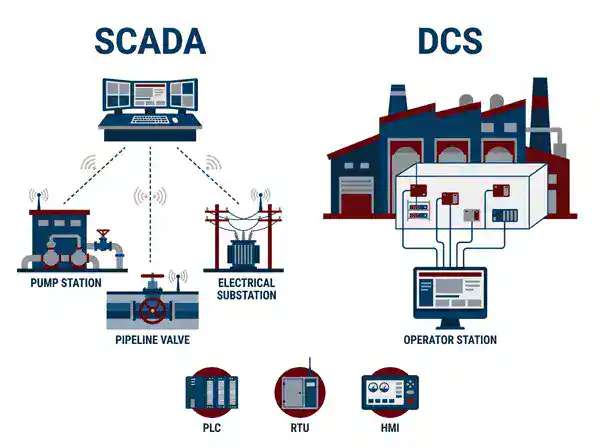
What Are SCADA and DCS?
SCADA (Supervisory Control and Data Acquisition) and DCS (Distributed Control System) are the two dominant types of industrial control systems used to monitor and control physical processes such as pumping water, refining oil, or running a production line. Both collect data from field sensors, let operators supervise operations from a central screen, and send commands back to equipment — the difference is scope and design. SCADA is built to supervise assets spread across large distances, while a DCS is built to tightly control a continuous process inside a single plant.
In practical terms, a SCADA system is the right fit when the equipment is geographically dispersed and the priority is visibility and remote supervision — think a utility monitoring hundreds of miles of pipeline or a water authority overseeing dozens of pump stations. A DCS is the right fit when a single, continuous process must be controlled precisely and reliably in one location — think a refinery, a chemical plant, or a power generation unit. Both rely on the same lower-level building blocks (PLCs, RTUs and HMIs), which is why the terms are often confused.
The short version: SCADA supervises widely distributed assets and emphasizes remote monitoring; DCS controls a concentrated, continuous process and emphasizes tight, automated regulation. Both sit on top of controllers like PLCs and present data to operators through HMIs.
SCADA Explained
SCADA is a control-system architecture for monitoring and supervising equipment that is spread across a wide geographic area. Rather than controlling a process second-by-second itself, SCADA gathers measurements from remote field devices, presents them to operators in a central control room, logs the data for analysis, and lets operators issue supervisory commands — for example, opening a valve or starting a remote pump. The control logic usually lives in local controllers in the field; SCADA provides the overarching visibility and coordination.
A typical SCADA system has four layers working together:
- Field instrumentation — sensors and actuators that measure conditions (pressure, flow, level, temperature) and physically move equipment.
- Remote controllers (RTUs and PLCs) — devices installed at each remote site that read the sensors, run local logic, and relay data upstream.
- Communications — the network (radio, cellular, fiber, or leased lines) that carries data between remote sites and the central host, often over long distances.
- Supervisory software and HMI — the central servers and operator screens that aggregate everything, raise alarms, trend historical data, and accept operator commands.
SCADA’s defining strength is reach. Because it is designed to tolerate distance and intermittent communications, it suits applications where assets cannot practically be wired into a single plant network. Its emphasis is on acquiring data and enabling supervisory control, not on the high-speed, closed-loop regulation that defines a DCS.
DCS Explained
A DCS, or Distributed Control System, is a control architecture that automates and regulates a continuous industrial process within a single facility using controllers distributed throughout the plant. The word “distributed” refers to the control itself: instead of one central computer doing all the work, control functions are spread across multiple controllers located near the equipment they manage, all tied together by a high-speed, reliable plant network and a unified operator interface. This design keeps the process running smoothly even if one controller fails, and it keeps control loops close to the equipment for fast, stable response.
DCS platforms are process-centric. They are engineered to hold thousands of control loops that continuously adjust setpoints — regulating temperature, pressure, flow and chemical composition — to keep a process on target without constant operator intervention. Key characteristics include:
- Process orientation — built around continuous and batch processes rather than discrete, on/off operations.
- Integrated engineering — control logic, operator graphics, alarms and historian are configured within one coherent system from a single vendor environment.
- High reliability — redundant controllers, networks and power supplies are standard because downtime in a continuous process is costly and sometimes hazardous.
- Advanced regulatory control — supports sophisticated control strategies (cascade, feedforward, model-based) that a simple supervisory system does not.
Where SCADA watches over distance, a DCS governs a concentrated, interconnected process where many variables must be balanced in real time.
SCADA vs DCS: How They Compare
The clearest way to tell SCADA and DCS apart is by scope and purpose: SCADA is distributed geographically and focused on supervision, while a DCS is distributed within a plant and focused on process control. The lines have blurred as both technologies modernize — modern SCADA can do closed-loop control, and modern DCS platforms offer excellent remote visibility — but the following distinctions still hold in most real deployments.
| Dimension | SCADA | DCS |
|---|---|---|
| Architecture | Central host supervises many remote sites; control logic typically lives in field RTUs/PLCs. | Multiple controllers distributed across one plant, tied together by a high-speed, redundant network. |
| Geographic scope | Wide-area — assets spread over miles or regions. | Localized — a single facility or process unit. |
| Primary focus | Data acquisition and supervisory (operator-initiated) control. | Continuous, automated closed-loop process regulation. |
| Process type | Often discrete, event-driven, or intermittent operations. | Continuous and batch process operations. |
| Communications | Designed to tolerate distance, latency and intermittent links (radio, cellular, fiber). | Fast, deterministic, highly reliable local network. |
| Operator role | Monitor conditions, respond to alarms, issue supervisory commands. | Oversee an automated process; intervene mainly on exceptions. |
| Typical use cases | Utilities, water/wastewater networks, pipelines, transmission grids. | Refineries, chemical plants, power generation, pharmaceuticals. |
Neither architecture is “better” — they solve different problems. Many large operations run both: a DCS controlling the core process inside a plant, with SCADA supervising the broader network of remote sites that feed into or draw from it.
How PLCs, RTUs and HMIs Fit In
PLCs, RTUs and HMIs are the lower-level components that both SCADA and DCS are built on — they are not alternatives to SCADA or DCS but pieces inside them. Understanding these three removes most of the confusion around industrial control terminology.
| Component | What it is | Role in the system |
|---|---|---|
| PLC (Programmable Logic Controller) | A rugged industrial computer that executes control logic on inputs and outputs. | Runs the actual control at the equipment level — starting motors, sequencing a machine, holding a control loop. PLCs appear inside both SCADA and DCS deployments. |
| RTU (Remote Terminal Unit) | A field device built for remote, often low-power or harsh-environment sites. | Collects sensor data and relays it to a SCADA host over long-distance communications; common where sites are too remote to wire conventionally. |
| HMI (Human-Machine Interface) | The screen and graphics operators use to view and interact with the system. | Presents live process data, alarms and trends, and gives operators the controls to respond. Every SCADA and DCS has an HMI layer. |
A useful way to think about it: PLCs and RTUs do the controlling and data collection at the edge, the HMI is the window operators look through, and SCADA or DCS is the overarching system that ties those pieces together and gives the whole operation its structure. If you want to go deeper on the controllers themselves, see our guide to programmable logic controller maintenance.
Where Each System Is Used
SCADA dominates in geographically distributed industries, while DCS dominates in concentrated, continuous-process facilities. The industry a system serves is often the quickest clue to which architecture is in use.
Utilities and Water/Wastewater
Water and wastewater authorities, electric transmission operators and gas utilities are classic SCADA environments. Their assets — pump stations, lift stations, reservoirs, substations, remote valves — are spread across wide service territories, so the priority is remote visibility and supervisory control from a central operations center. Operators need to see conditions at every site, respond to alarms quickly, and dispatch crews or adjust equipment without driving out to each location.
Manufacturing and Process Industries
Refineries, chemical plants, pulp and paper mills, food and beverage production and pharmaceutical manufacturing typically run on a DCS. These are continuous or batch processes where many variables must be controlled together in real time, within one facility, and where a brief loss of control can ruin product or create safety risk. Discrete manufacturing (assembly lines, packaging) more often relies on networked PLCs, sometimes supervised by a SCADA layer.
Oil and Gas
Oil and gas spans both worlds. Upstream production and midstream pipelines — wellheads, compressor stations, metering sites strung across long distances — are natural SCADA applications. Downstream refining and processing, concentrated in a single complex, is classic DCS territory. It is common for one operator to run SCADA for the gathering and transmission network and a DCS for the processing facility.
The Maintenance Angle: Keeping Control-System Hardware Reliable
Control systems run the process, but the physical hardware they depend on still has to be maintained — and that maintenance work is where a CMMS fits alongside SCADA and DCS, not inside them. A SCADA or DCS controls and monitors the process in real time; it is not a maintenance management system and does not plan, schedule, or document the upkeep of the equipment it runs. Those are two distinct jobs. The control system keeps the plant operating; the maintenance team keeps the control system and its field devices operating.
The hardware that maintenance teams keep reliable includes the controllers (PLCs, RTUs), the sensors and transmitters that feed them, the actuators and valves they command, the HMIs and servers in the control room, communication equipment, and the power and cooling those cabinets depend on. A drifting sensor, a failing power supply, or a neglected cooling fan can degrade control long before anyone sees it on a screen. Keeping these assets reliable depends on the same disciplines any critical equipment needs:
- Preventive maintenance — scheduled inspections, calibrations and component replacements so instruments stay accurate and controllers stay healthy. See preventive maintenance and proactive care.
- Asset records — a complete register of every controller, instrument and panel, with location, specs, firmware, spares and full service history. See asset management.
- Performance tracking — monitoring reliability and failure trends to catch recurring problems and prioritize upgrades. See asset performance management.
This is where a CMMS complements a control system. The control system knows the live state of the process; a CMMS manages the maintenance of the equipment behind it — generating and scheduling work orders, tracking spare parts, holding service history, and documenting the calibrations and inspections that keep instruments trustworthy. The two also connect: condition data from monitoring systems can trigger a work order automatically (see IoT integration in CMMS systems), so that when a reading crosses a threshold, a maintenance task is created and assigned instead of the signal being noticed and forgotten. A CMMS is not a SCADA or DCS and does not control the process — it manages the maintenance of the assets that make the control system dependable.
Connecting Control-System Data to eWorkOrders
eWorkOrders can take in equipment data through standard REST integrations or by subscribing to live MQTT topics, a messaging protocol many modern SCADA and IIoT platforms already publish to. When a reading crosses a threshold you set, eWorkOrders automatically generates a work order matched to the asset and the severity of the alert. Condition-monitoring partners such as AssetWatch can also create work orders inside eWorkOrders the moment they detect a developing fault. See real-time sensor data for how alerts become work orders.
Control-System Security Is Part of Maintenance
Because SCADA and DCS networks run physical equipment, keeping them secure is a reliability issue, not just an IT one. The international standard series for industrial control system security is ISA/IEC 62443, and in the U.S. the Cybersecurity and Infrastructure Security Agency (CISA) publishes advisories on control-system vulnerabilities. Several security tasks are recurring maintenance work and belong on a schedule:
- Firmware and software updates — applying vendor patches to controllers, HMIs, and servers in planned maintenance windows, after testing.
- Configuration backups — keeping current copies of PLC programs, controller configurations, and HMI projects so a failed device can be restored quickly.
- Access reviews — periodically checking who has accounts and remote access to the control system, and removing access that is no longer needed.
- Change records — documenting every change to control logic or setpoints, who made it, and why.
Keep Control-System Hardware Reliable
See how eWorkOrders helps your maintenance team schedule preventive maintenance, track inspections, and turn problems into work orders before small issues become costly downtime. See how it works in a free, personalized demo.
Frequently Asked Questions
What is the main difference between SCADA and DCS?
The main difference is scope and purpose. SCADA supervises equipment spread across a wide geographic area and emphasizes remote monitoring and operator-initiated supervisory control. A DCS controls a continuous process concentrated in a single facility and emphasizes automated, closed-loop regulation. SCADA is distributed geographically; a DCS is distributed within a plant.
What is a DCS system?
A DCS (Distributed Control System) is an industrial control architecture that automates and regulates a continuous process within one facility using multiple controllers distributed throughout the plant and linked by a high-speed, redundant network. It is built for process industries like refining, chemicals and power generation, where thousands of control loops must run reliably in real time.
Is a PLC the same as SCADA or DCS?
No. A PLC (Programmable Logic Controller) is a single rugged controller that executes control logic at the equipment level. SCADA and DCS are larger systems that sit above controllers, tying many PLCs (and, in SCADA, RTUs) and HMIs together into one coordinated operation. A PLC is a building block inside a SCADA or DCS, not an alternative to them.
How do you keep SCADA and DCS systems secure?
Treat control-system security as recurring maintenance: apply tested firmware and software updates in planned windows, keep current backups of PLC programs and controller configurations, review user and remote access regularly, and document every change to control logic. ISA/IEC 62443 is the international standard series for industrial control system security, and CISA publishes U.S. advisories on control-system vulnerabilities.
How does a CMMS relate to SCADA and DCS?
A CMMS complements SCADA and DCS but does a different job. The control system runs and monitors the process in real time; a CMMS manages the maintenance of the physical equipment behind it — scheduling preventive maintenance, tracking assets and spare parts, and holding service history. Condition data can even trigger a work order automatically. A CMMS is not a control system and does not control the process itself.


