Elevator & Escalator Maintenance Checklist
An elevator or escalator rarely gives much warning before a code-required test gets missed — a Category 1 test that’s gone a year overdue, a Maintenance Control Program nobody’s updated since the equipment changed, an escalator inspection skipped because the program only ever tracked elevators. Because elevators and escalators run on different components, different safety devices, and in some cases different inspection intervals, this checklist is organized by how often each area actually needs attention, from the daily cab and step observations any staff member can make to the annual Category 1 and Category 5 testing a licensed elevator contractor has to perform.
Daily
Weekly
Monthly
- An MCP should reflect the real equipment on site — a program written for different units, or never updated after a modernization, doesn’t meet its purpose.
Quarterly
- Escalator periodic inspections are generally required at intervals no longer than six months under ASME A17.1 — shorter than an elevator’s annual cycle, and easy to miss if a program only tracks elevators.[1]
Annual
- CAT 1 testing covers the elevator’s safety devices — governors, safeties, buffers, and terminal stopping devices — and is generally required annually.[2]
- CAT 5 testing is generally required every five years, alongside that year’s periodic/CAT 1 test, for elevators with the applicable components.[2]
- A minimum 5-year retention is a common recordkeeping practice tied to MCP requirements — confirm the applicable requirement for the specific jurisdiction.
Note: This checklist is a general maintenance reference and recommended starting point for elevator and escalator maintenance programs — it is not a substitute for a facility’s Maintenance Control Program, the equipment manufacturer’s service documentation, or applicable regulatory requirements. Category 1 and Category 5 testing, and most escalator and elevator service work, must be performed by qualified, licensed personnel. See the full disclaimer below before using or adapting these recommendations.
What Is an Elevator & Escalator Maintenance Checklist?
An elevator and escalator maintenance checklist is a documented set of inspection, testing, and recordkeeping tasks covering the systems that keep elevators and escalators running safely — the cab and door operation, the machine room and hoistway, safety devices, and, for escalators, the step and handrail system.
Elevators and escalators are often managed under the same facility maintenance program, but they’re mechanically different pieces of equipment with their own components and, in places, their own code-required inspection intervals. A checklist built only around elevators can leave escalator-specific devices — comb plates, skirt obstruction switches, step and drive chains — without a dedicated inspection routine of their own.
The specific tasks, intervals, and who’s qualified to perform them are set by the applicable code — in the U.S., ASME A17.1, the Safety Code for Elevators and Escalators[1] — and by the local Authority Having Jurisdiction. Building owners and managers should confirm current requirements for their specific equipment and location.
Key Systems to Inspect
Cab & Door Operation: Lighting, leveling, door open/close, and reopening devices.
Machine Room & Hoistway: Controller, wiring, governor, and pit condition.
Safety & Emergency Devices: Buffers, safeties, emergency phone, and fire service recall.
Escalator Steps & Drive: Step/pallet condition, drive chain, and step chain.
Escalator Safety Devices: Comb plates, skirt obstruction device, and handrail entry device.
Documentation & Compliance: Maintenance Control Program, test records, and permits.
Safety Considerations for Elevator & Escalator Maintenance
Elevator and escalator maintenance combines electrical equipment, moving mechanical parts, and confined or elevated work areas — a few points apply across most facilities:
Code-required testing has to be performed by qualified personnel. Category 1 and Category 5 testing, and most service and repair work, must be performed by a licensed or certified elevator contractor, not general facilities staff — daily and weekly observation tasks are appropriate for non-technical staff, but testing and repair are not.
Pit and hoistway entry carries real fall and entrapment hazards. Lock out and tag out equipment, use the pit’s own stop switch, and follow the facility’s confined-space and fall-protection procedures before anyone enters a pit or hoistway.
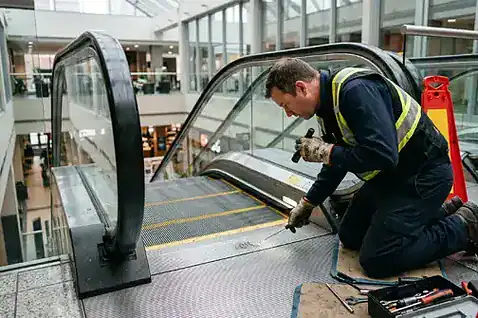
Escalators have their own moving-part hazards. The comb plate, step/skirt clearance, and handrail entry point are common entanglement and entrapment locations — this is exactly why the safety devices that monitor them (skirt obstruction device, handrail entry device, broken-chain devices) need to be tested on their own schedule, not assumed to be fine because the escalator is running.
A Maintenance Control Program is a code requirement in most jurisdictions, not just good practice. Most Authorities Having Jurisdiction that have adopted ASME A17.1/CSA B44 from 2000 onward require a written MCP specifying maintenance tasks, intervals, and procedures — and building owners should maintain one even where it isn’t locally mandated.[2]
Personal Protective Equipment (PPE)
The right PPE depends on the specific task and the facility’s own safety program, but most elevator and escalator maintenance work calls for some combination of the following:
Hand Protection
Cut-resistant or general-purpose work gloves for handling cables, chains, and sheet-metal panels.
Hearing Protection
Hearing protection in machine rooms where motor and equipment noise levels warrant it.
Fall Protection
A harness and lanyard anchored to an approved point when working in a hoistway or on an elevated machine-room platform.
Electrical PPE
Appropriately rated electrical PPE when work requires opening an energized controller or panel.
Common Elevator & Escalator Maintenance Mistakes
Treating Category 1 testing as the whole compliance picture
CAT 1 happens every year, but Category 5 full-load testing is still due every five years for applicable equipment — a program that only tracks the annual test can miss it entirely.
Writing an MCP that doesn’t match the equipment actually in service
A Maintenance Control Program created once and never revisited after a modernization, a new unit, or a changed task schedule no longer reflects what’s really being maintained — and doesn’t meet the purpose of having one.
Running escalator maintenance under a program built only for elevators
Escalators have their own components, their own safety devices, and in some cases their own code-required inspection interval — treating them as a footnote to the elevator program is how a comb plate or skirt obstruction device goes unchecked.
Frequently Asked Questions
What is an elevator and escalator maintenance checklist?
An elevator and escalator maintenance checklist is a documented set of inspection, testing, and recordkeeping tasks covering an elevator’s cab, doors, machine room, and safety devices, and an escalator’s steps, drive system, and safety devices — organized so each area gets checked at an appropriate frequency.
How often should elevators be inspected and tested?
Most elevators need daily observation of cab and door operation, weekly checks on the emergency phone and door reopening function, monthly machine room and hoistway inspection, quarterly checks on safety devices, and annual Category 1 testing — plus Category 5 full-load testing every five years for applicable equipment. Confirm the specific requirements for the equipment and jurisdiction.
What is a Maintenance Control Program (MCP) and is it required?
An MCP is a written plan specifying the maintenance tasks, procedures, intervals, and training required to maintain an elevator or escalator correctly. Most Authorities Having Jurisdiction that adopted ASME A17.1/CSA B44 from 2000 onward require one, and it’s good practice to maintain one even where it isn’t locally mandated.
How often should escalators be inspected?
Escalator periodic inspections are generally required at intervals no longer than six months under ASME A17.1 — shorter than an elevator’s typical annual testing cycle. Escalator-specific safety devices, including the skirt obstruction device, handrail entry device, and step/drive chain devices, should be checked on that same schedule.
What’s the difference between elevator maintenance and escalator maintenance?
Elevator maintenance centers on the cab, doors, hoistway, machine room, and safety devices like governors and buffers. Escalator maintenance covers a different set of moving parts — steps, pallets, the drive and step chains, comb plates, and handrails — with its own safety devices and, in many jurisdictions, a shorter inspection interval.
Who is qualified to perform Category 1 and Category 5 testing?
Category 1 and Category 5 testing must be performed by a qualified, licensed elevator contractor — not general facilities or maintenance staff. Daily and weekly observation tasks are appropriate for non-technical staff, but code-required testing and repair work are not.
How does a CMMS help with elevator and escalator maintenance?
A CMMS helps by scheduling recurring PM work and tracking Category 1/Category 5 test due dates for elevators and escalators, assigning that work to a technician, and keeping a connected record of inspections, test results, and MCP updates tied to each unit.
How eWorkOrders CMMS Supports Elevator & Escalator Maintenance
PM Scheduling
Recurring PM schedules can be set for elevator and escalator inspections, and for Category 1/Category 5 test due dates, by calendar date.
Work Assignment
PMs and repair work orders are assigned to specific technicians or contractors.
Asset History
Each elevator and escalator has a connected record of completed PMs, test results, and repair history.
Spare Parts Inventory
Track spare parts inventory — door operators, step chains, comb plates, handrail belts — and link parts used to the specific work order and asset, so parts history stays connected to the equipment.
Additional Resources
- Part of the eWorkOrders Learning Center
- The Ultimate Library of Maintenance Checklists
- Elevator Maintenance Tips — the companion guide article
- Heavy Equipment Maintenance Checklist
- Facilities Maintenance Checklist
References
- American Society of Mechanical Engineers. A17.1 — Safety Code for Elevators and Escalators.
- Elevator Industry Work Preservation Fund. Elevator Maintenance Control Programs (MCP) for Building Owners & Managers (Maintenance Control Program requirements; Category 1 and Category 5 testing frequency).
Elevator and Escalator Maintenance Is a Daily Job, Not Just an Annual One
A hesitating door or a worn comb plate usually shows up in the daily walkaround long before it turns into a missed Category 1 or Category 5 test. eWorkOrders lets your team schedule recurring PM work for elevator and escalator assets, assign the resulting work orders to employees or contractor-associated workers, and keep related work orders, checklist results, and maintenance records available for review by unit.
Important Disclaimer: This elevator and escalator maintenance checklist is provided by eWorkOrders as a general reference and recommended starting point for elevator and escalator maintenance programs. The tasks, inspection intervals, and suggested maintenance considerations are recommendations only. They are not intended to establish a universal maintenance schedule, a substitute for a facility’s required Maintenance Control Program, or a statement that every task applies to every elevator or escalator.
Elevator and escalator maintenance requirements vary according to equipment type, age, manufacturer, configuration, usage, jurisdiction, and applicable codes and standards (including ASME A17.1/CSA B44 and local amendments where applicable). Inspection intervals, testing categories, and qualification requirements are set by the applicable code and the Authority Having Jurisdiction, and can change.
Before using this checklist, facility owners, maintenance managers, and other responsible personnel should review and adapt it for the specific equipment and conditions in their operation, and should establish or maintain a written Maintenance Control Program using the equipment manufacturer’s documentation, applicable code requirements, and the judgment of qualified elevator and escalator personnel.
This checklist does not replace manufacturer documentation, applicable federal, state, or local laws and codes, requirements of the Authority Having Jurisdiction, the facility’s own safety program, or the judgment of qualified personnel. Category 1 and Category 5 testing, and most service, repair, and adjustment work, must be performed by qualified, licensed, or certified elevator and escalator personnel, not general facilities staff.
Elevator and escalator maintenance work can expose workers to serious hazards, including electrical shock, falls, and entanglement or entrapment in moving mechanical parts. Such work should only be performed by personnel who are appropriately trained, licensed or certified where required, and equipped for the work, following applicable lockout/tagout and other safety procedures.
eWorkOrders makes no representation that this checklist is complete or appropriate for any particular elevator, escalator, facility, jurisdiction, or operating environment. Responsibility for determining the appropriate maintenance activities, inspection frequencies, and compliance obligations remains with the facility and the qualified professionals responsible for it.


