Critical Spare Parts: How to Identify and Stock Them
Critical spare parts are the ones you can’t afford to wait for. When a key machine fails and its part is weeks away, the cost is counted in lost production, not in the price of the part. Here’s how to identify critical spares, decide which to stock, protect them in the storeroom, and keep the list current.
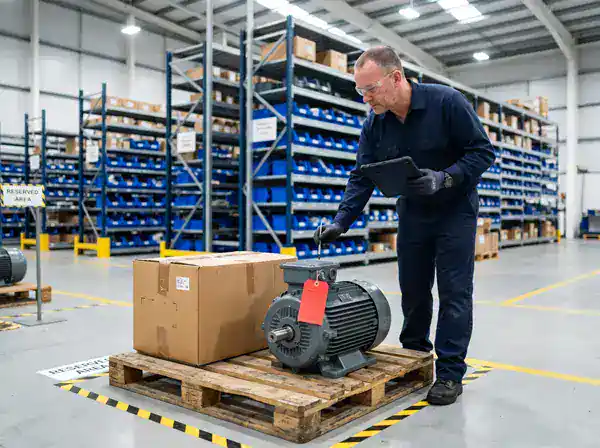
What Are Critical Spare Parts?
Critical spare parts are components whose absence would cause an unacceptable result if the part failed: a long production stop, a safety or environmental risk, or a regulatory problem. They’re usually parts for critical equipment that are expensive, slow to get, or both.
What makes a part critical isn’t how often it’s used. Many critical spares sit on the shelf for years. They’re kept because the cost of not having one when it’s needed is far higher than the cost of holding it.
Critical Spares vs. Insurance Spares vs. Common Spares
| Type | What It Is | How It’s Stocked |
|---|---|---|
| Common spares | Frequently used, easy-to-get parts such as filters, belts, and fasteners | By usage, with min/max levels |
| Critical spares | Parts for critical equipment where a stock-out causes major downtime or risk; may be used occasionally | Stocked on purpose, with levels set for protection, not just usage |
| Insurance spares | A type of critical spare that’s rarely or never expected to fail, but would be disastrous if it did, such as a large motor, main gearbox, or transformer | Usually one unit held “just in case,” reviewed rather than reordered by usage |
The distinction matters because the usual stocking rules don’t work for critical and insurance spares. A part with almost no usage history would normally be flagged as dead stock and removed. For an insurance spare, that would be exactly the wrong decision.
How to Identify Critical Spare Parts
Start with the equipment, then work down to the parts. An asset criticality analysis tells you which machines matter most. From there, score each part on a few factors.
| Factor | Question to Ask |
|---|---|
| Equipment criticality | How critical is the machine this part belongs to? |
| Failure impact | If this part fails, does the machine stop, run degraded, or keep running? |
| Lead time | How long does it take to get a replacement, including shipping? |
| Availability | Is it single-source, custom-made, or close to obsolete? |
| Workaround | Is there a backup machine, bypass, or temporary fix? |
A Simple Scoring Method
Score each of the first four factors from 1 (low) to 5 (high), and score Workaround from 1 (easy workaround) to 5 (no workaround). Add them up for a total out of 25. Many teams treat anything above a set threshold, for example 18, as critical.
For example: a drive motor on a main production line (equipment criticality 5), where failure stops the line (impact 5), with an 8-week lead time (lead time 5), available from one supplier (availability 4), and no backup motor (workaround 5) scores 24. That’s a critical spare. A filter for the same line might score 5 + 2 + 1 + 1 + 2 = 11: important to keep in stock, but managed as a common spare.
The threshold and scale above are an example. What matters is scoring every part the same way, so the list reflects real risk instead of whoever argues loudest.
Should You Stock It? A Quick Cost Check
Holding a critical spare costs money every year: storage, capital tied up, insurance, and the risk that it becomes obsolete. The question is whether that cost is smaller than the downtime you’d risk by not holding one.
| Compare | How to Estimate It |
|---|---|
| Expected cost of not stocking | Chance of failure per year × Downtime cost while waiting for the part |
| Cost of stocking | Part price × Your annual carrying cost rate |
For example: a gearbox costs $8,000. If it fails without a spare on hand, the line is down for 3 days waiting for a replacement, at a downtime cost of $5,000 per hour: 72 hours × $5,000 = $360,000. If you estimate a 10% chance of failure in any given year, the expected cost of not stocking is 0.10 × $360,000 = $36,000 per year. Using an example carrying cost rate of 20%, holding one spare costs $8,000 × 0.20 = $1,600 per year. Stocking it is the clear choice.
Use your own numbers. Your finance team can give you the carrying cost rate, and your downtime cost and failure history come from your maintenance records. Even rough estimates usually make the decision obvious.
How to Protect Critical Spares in the Storeroom
Identifying critical spares is only half the job. The other half is making sure they’re actually there, and still usable, when the failure happens.
- Flag them in the system. Mark critical spares so everyone knows they’re not ordinary stock.
- Reserve them. Don’t let routine or planned work use up a critical spare. If a planned job needs the same part, order one for that job.
- Reorder immediately after use. When a critical spare is used, its replacement should be ordered the same day, not when someone notices the empty shelf.
- Store them properly. Keep them clean, dry, and protected. Some need care while stored: large motors and gearboxes may need their shafts rotated periodically, and seals, belts, and some electronics have shelf lives.
- Count them often. Put critical spares in the most frequent class of your cycle counting program, so you know they’re there before you need them.
- Consider repairable units. Many critical spares, such as motors, pumps, and gearboxes, can be managed as rotable parts: a failed unit is repaired and becomes the next spare.
Keep the Critical Spares List Current
A critical spares list is not a one-time project. Equipment changes, suppliers change, and parts go obsolete.
- Review it at least once a year, and whenever critical equipment is added, replaced, or retired.
- Watch for obsolescence. If a manufacturer announces a part is being discontinued, decide early whether to buy extra, find an alternative, or plan an upgrade.
- Remove spares for equipment that’s gone. Critical spares for a machine that was removed from service are just dead stock.
- Learn from failures. If a breakdown ran long because a part wasn’t on hand, re-score that part.
How a CMMS Helps Manage Critical Spares
Managing critical spares depends on knowing which parts belong to which equipment, and seeing their status at a glance.
Parts linked to assets. When parts are connected to the equipment they fit, it’s easy to see which spares support critical machines, and which spares no longer have a machine to support.
Failure and downtime history. Work order history shows how often equipment actually fails and how long it’s down, which feeds the scoring and cost check above with real numbers instead of guesses.
Reorder alerts. Setting a critical spare’s minimum to 1 means an alert goes out the moment it’s used.
One place for the list. The critical spares list lives with the rest of the inventory, not in a separate spreadsheet that falls out of date.
Frequently Asked Questions
What makes a spare part critical?
A spare part is critical when its absence during a failure would cause an unacceptable result, such as a long production stop or a safety risk. The main factors are how critical the equipment is, what happens when the part fails, how long a replacement takes to get, whether it’s hard to source, and whether there’s a workaround.
What is an insurance spare?
An insurance spare is a critical spare that’s rarely expected to fail but would cause major downtime if it did, such as a large motor or main gearbox. It’s usually kept as a single unit and reviewed periodically, rather than reordered based on usage.
How many critical spares should you keep?
Often just one, especially for insurance spares. Keep more if the part fails regularly, if several machines share it, or if the replacement lead time is long compared with how often it fails. A quick cost check, comparing expected downtime cost against the cost of holding the part, helps confirm the number.
Should critical spares be used for planned maintenance?
Generally, no. Critical spares should be reserved for unplanned failures. If planned work needs the same part, order one for that job, so the critical spare stays on the shelf.
Conclusion
Critical spare parts are the parts you stock for protection, not convenience. Identify them by scoring equipment criticality, failure impact, lead time, availability, and workarounds. Confirm the decision with a simple cost check, protect them from routine use, count them often, and review the list every year. Done well, a critical spares program turns a weeks-long outage into a same-day repair.
Have the Part Ready Before the Critical Machine Fails
A critical spare only protects you if you know it’s on the shelf. Linking parts to the equipment they support is the job of spare parts and inventory management in a CMMS. eWorkOrders has supported maintenance operations for over 30 years, serving teams at Honda and King River Packaging, rated 4.9 on Capterra and G2.
About the author: Janet Jaquis is Marketing Director at eWorkOrders, where she writes about maintenance strategy, asset reliability, and CMMS software for maintenance and facility teams.


