Commercial HVAC Maintenance Checklist
When a rooftop unit goes down, indoor temperatures can move outside the required range, occupant comfort can suffer, and facility operations may be disrupted. In industrial manufacturing, Deloitte has estimated that unplanned downtime costs manufacturers about $50 billion annually.[1]
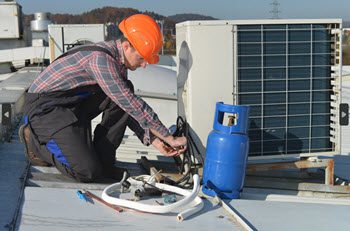
Spring & Summer HVAC Maintenance
- Compare measured conditions with building requirements and control setpoints. Investigate abnormal humidity readings.
- Remove dirt and debris as required to maintain heat transfer and airflow. Follow manufacturer cleaning procedures.
- Look for signs of leakage and abnormal system conditions. Where charge needs to be verified, calculating superheat and subcooling is the standard diagnostic method — a pressure reading alone doesn’t confirm correct charge the way those two numbers together do.
- On dual-fuel or heat-pump-furnace combo systems, the furnace sits idle most of the cooling season, but a slow gas leak doesn’t pause for summer — worth a quick check even though heating isn’t in use.
- Clear obstructions, verify proper drainage, and inspect for standing water, corrosion, or signs of overflow.
- Check filter condition, loading, fit, and pressure drop where applicable. Replace filters according to the PM schedule and equipment requirements.
- Check belt condition, alignment, tension, and wear. Replace components when inspection results or manufacturer requirements indicate they are due.
- Check for abnormal noise, vibration, temperature, or wear. Lubricate only where the motor or bearing manufacturer specifies lubrication.
- Check blades, guards, mounting, alignment, vibration, and physical condition. Clean components as required.
- Check temperature readings, setpoints, schedules, sensors, and control response. Verify calibration where required.
- Check accessible wiring, terminals, disconnects, contactors, relays, and other components for signs of overheating, looseness, damage, or deterioration. Follow applicable electrical safety procedures.
- Verify airflow is within the expected operating range. Investigate abnormal readings, restrictions, damper positions, or distribution problems.
- Remove leaves, trash, vegetation, and other debris that could restrict airflow, obstruct access, or interfere with equipment operation.
- Secure loose panels and fasteners and inspect for corrosion, damaged seals, vibration, or other abnormal conditions.
- Replace batteries when required by the device manufacturer or PM procedure. Verify sensors and controllers return the expected readings after replacement.
- Check for damaged, missing, or deteriorated insulation and signs of condensation or moisture.
- A damper that sticks partway through its stroke isn’t always obvious at a quick glance — cycling it fully catches a stuck or slipping actuator before the season’s load exposes it.
- Document readings, abnormal conditions, parts used, labor, corrective recommendations, and follow-up work in the CMMS.
Fall & Winter HVAC Maintenance
- Check filter condition and airflow restriction. Replace filters according to the PM schedule and equipment requirements.
- For combustion equipment, inspect burners for dirt, corrosion, damage, and proper operation according to the manufacturer’s procedure.
- Inspect for visible cracks, corrosion, deterioration, or other conditions that could affect safe operation. Follow manufacturer and applicable inspection requirements.
- Use appropriate testing procedures and equipment to identify unsafe combustion or flue conditions. Correct deficiencies before returning equipment to normal operation.
- Check vent connections, supports, corrosion, blockage, and overall integrity — including the flue’s physical attachment to the furnace itself, not just the venting run. A loose connection there is as much a hazard as a blocked vent.
- For gas-fired equipment, verify operating pressures and combustion performance according to manufacturer specifications and applicable procedures.
- Check accessible wiring, terminals, disconnects, and controls for loose connections, damaged insulation, overheating, or other abnormal conditions.
- Check for abnormal noise, vibration, temperature, or wear. Lubricate only components designed to be lubricated.
- Check belt condition, tension, alignment, and wear. Replace components according to condition and manufacturer requirements.
- Clear restrictions and verify proper drainage. Check for freezing risk and conditions that could result in water damage.
- Verify temperature sensing, setpoints, schedules, control response, and heating cycles.
- Check for visible leakage, damage, blocked vents, damper problems, and airflow restrictions.
- For heat-pump equipment, verify the defrost sequence operates according to manufacturer requirements and investigate abnormal frost buildup.
- Record operating readings and inspection findings. Create corrective work orders for deficiencies requiring repair or additional troubleshooting.
Important: The checklists above are general maintenance guidelines. Actual PM tasks and frequencies should be adjusted for the equipment type, manufacturer requirements, equipment condition, operating environment, facility criticality, applicable codes, and the qualifications of the personnel performing the work.
What Is Commercial HVAC Maintenance?
Commercial HVAC maintenance is the planned inspection, servicing, adjustment, cleaning, testing, and repair of heating, ventilation, and air-conditioning equipment in a commercial facility. Maintenance frequency should be established at the asset level — a rooftop unit serving a warehouse doesn’t need the same PM schedule as an air handler serving a hospital or data room — rather than applying one schedule to every piece of equipment. ASHRAE Standard 180 sets minimum HVAC inspection and maintenance requirements for commercial buildings and recognizes that actual frequencies should fit the equipment, facility, and operating conditions.[4]
Commercial HVAC Preventive Maintenance Schedule by Frequency
The seasonal checklists above cover the major cooling-season and heating-season PM visits. Most commercial HVAC preventive maintenance programs also run shorter recurring tasks between those visits. A common starting structure looks like this:
| Frequency | Typical commercial HVAC PM tasks |
|---|---|
| Monthly | Inspect filters and replace them based on condition and pressure drop; walk the units for leaks, noise, and debris; confirm thermostat and control setpoints and schedules; check condensate drainage. |
| Quarterly | Inspect belts, pulleys, and tension; light coil cleaning; clear condensate lines and pans; check motor and bearing condition; verify damper and economizer operation. |
| Semi-annual | Seasonal changeover: prepare cooling before spring and summer and heating before fall and winter; full coil cleaning; airflow checks against expected ranges; control calibration. |
| Annual | Verify refrigerant charge using superheat and subcooling; combustion analysis and CO testing on heating equipment; heat-exchanger inspection; electrical connection checks; motor lubrication where the manufacturer specifies it; review the year’s readings and work orders. |
Use this as a starting point, then set the final interval for each asset from manufacturer requirements, runtime hours, condition, and criticality. Whether it’s called preventive or preventative maintenance, the schedule only works if every completed task and reading is recorded. See preventive maintenance software.
Why Proactive Commercial HVAC Maintenance Matters
When HVAC equipment develops a problem, the effects can go beyond temperature complaints — a failed unit can affect production areas, occupied spaces, inventory, and indoor air quality. The U.S. Department of Energy notes that well-practiced operations and maintenance is one of the most cost-effective ways to support reliability, safety, and energy performance.[2]
- Controls maintenance costs: Finding worn belts, dirty coils, clogged filters, failing motors, and other developing problems during a PM reduces the likelihood of larger corrective repairs.
- Supports reliable operation: Regular inspections catch abnormal conditions before they cause an unplanned outage.
- Helps control energy use: Properly maintained controls, filters, coils, and dampers help HVAC systems operate as intended.
- Extends useful equipment life: Commercial HVAC equipment commonly lasts 15–20 years with proper maintenance, though actual service life varies by equipment type, usage, and climate.
- Improves repair-vs-replace decisions: Recorded inspection results, run hours, and repair costs give maintenance managers better data for that call.
Common Commercial HVAC System Types
- Single-split system: One indoor unit paired with one outdoor unit. Common in smaller commercial spaces with a single zone to condition.
- Multi-split system: Several indoor units connected to one outdoor unit, so different zones can be controlled independently.
- Variable air volume (VAV) system: Holds a constant supply-air temperature and varies airflow to match the load in each zone.
- Variable refrigerant flow (VRF) system: Uses refrigerant as the heating/cooling medium between multiple indoor units and one or more outdoor units.
- Constant air volume (CAV) system: Delivers a constant airflow rate and varies the supply-air temperature instead.
- Heat pump system: Moves heat rather than generating it, so the same equipment both heats and cools.
Knowing which architecture is installed changes what a PM should check — a VRF system’s refrigerant piping and multiple indoor units call for different inspection points than a single rooftop unit.
Commercial HVAC Equipment Maintenance by System
Commercial HVAC equipment maintenance is organized by equipment type because each major system wears, fails, and is serviced differently. These are the five systems found in most commercial and industrial buildings:
| System | What maintenance involves | Representative tasks |
|---|---|---|
| Rooftop units (RTUs) | Packaged heating and cooling equipment exposed to weather. | Clean condenser and evaporator coils, replace filters, inspect belts and economizer dampers, check refrigerant charge, clear debris around the unit, secure cabinet panels. |
| Chillers | Central cooling for larger facilities, where small efficiency losses add up in energy cost. | Monitor approach temperatures, check refrigerant and oil, inspect tubes for fouling, log compressor amps and pressures, test safety controls. See chiller maintenance tips. |
| Air handlers (AHUs) | Commercial air handler maintenance keeps airflow, filtration, and coil performance within spec. | Replace filters by pressure drop and schedule, clean coils and drain pans, inspect belts, pulleys, and bearings, check fan alignment and vibration, verify damper actuation. |
| Boilers and heating equipment | Commercial heating system maintenance is safety-critical; combustion and venting must be verified. | Inspect and clean burners, inspect the heat exchanger for cracks, test for carbon monoxide, verify gas pressures and combustion settings, inspect flue and venting, test heating controls. |
| Cooling towers | Reject heat from water-cooled systems; water treatment and Legionella control are central. | Maintain water treatment, clean the basin and fill, inspect the fan, drift eliminators, and float valve, check for scale and biological growth, confirm makeup-water and bleed operation. |
Because each system carries different risks and runtime, keep a separate asset record and PM task list for each one, so the schedule follows the equipment’s real needs and the history stays with the asset.
What Commercial HVAC Maintenance Services Cover
Commercial HVAC maintenance services are recurring programs in which an in-house team or an outside contractor performs scheduled inspections, cleaning, testing, and minor repairs on HVAC equipment. Contracted programs are commonly set up as a planned maintenance agreement billed per visit, per unit, or annually. A typical service program covers:
- Scheduled PM visits: Seasonal changeovers plus the monthly and quarterly tasks, on a fixed calendar.
- Inspection and reporting: Documented readings and a deficiency list after every visit, so repairs can be prioritized and budgeted.
- Consumable replacement: Filters, belts, and other wear parts replaced on schedule.
- Corrective repairs: Repairs for problems found during a PM visit or failures between visits.
- Safety and compliance checks: Combustion and CO testing, refrigerant handling, and water treatment where applicable, documented for audits and warranty.
Whether the work is in-house, outsourced, or a mix, keep the schedule, work orders, and completion records in your own system so the maintenance history stays with each asset. See work order management.
How eWorkOrders CMMS Supports Commercial HVAC Maintenance
Commercial HVAC maintenance involves recurring inspections, operating readings, corrective work, and seasonal PM visits across a lot of equipment. A CMMS can help maintenance teams keep those activities organized.
PM Scheduling
Build recurring PM schedules by calendar date, meter reading, or run hours for seasonal and routine HVAC inspections.
Mobile Work Orders
Technicians access, update, and close work orders from a phone or tablet while working on the unit.
Asset History
Each piece of HVAC equipment keeps a connected record of past PMs, work orders, parts, and labor — the maintenance history that makes recurring problems visible over time.
Deficiency Follow-Up
Problems found during a PM turn directly into corrective work orders, so they don’t stay buried in a completed checklist.
Condition Monitoring
eWorkOrders integrates with predictive-maintenance and condition-monitoring partners such as AssetWatch, whose sensors can automatically generate a work order inside eWorkOrders when vibration or temperature drifts out of range.
For maintenance managers, the value isn’t simply having a checklist. It’s having a documented maintenance history that shows what was inspected, what was found, what corrective action was taken, and what still needs attention.
Frequently Asked Questions (FAQs)
How do you maintain a commercial HVAC system?
Start with an asset-specific preventive maintenance program based on the equipment type, manufacturer requirements, operating conditions, equipment criticality, and applicable maintenance standards. Typical work includes inspecting filters, coils, belts, motors, drains, controls, electrical components, airflow, and other equipment-specific components. Technicians should record relevant readings and findings and create corrective work orders when deficiencies are identified.
What is the $5,000 rule for HVAC?
The $5,000 rule is a commonly cited HVAC replacement rule of thumb, not an industry standard. The basic calculation multiplies the equipment’s age by the estimated repair cost. If the result exceeds $5,000, replacement may be worth considering. Maintenance managers should also consider equipment condition, repair history, energy performance, refrigerant issues, remaining useful life, replacement cost, and the criticality of the asset before making a replacement decision.
How much does commercial HVAC maintenance cost?
There is no single maintenance cost that applies to every commercial HVAC system. Cost depends on equipment type and size, equipment age, operating hours, PM frequency, parts requirements, contractor rates, emergency coverage, and contract scope. A maintenance department should budget using its actual equipment inventory, PM workload, historical labor, parts usage, contractor costs, and corrective-maintenance history.
What are the 4 types of HVAC maintenance?
Commercial HVAC programs commonly use corrective maintenance, preventive maintenance, predictive or condition-based maintenance, and reliability-centered maintenance. Corrective maintenance addresses identified problems or failures. Preventive maintenance uses scheduled tasks. Predictive or condition-based maintenance uses equipment condition or operating data to determine when action is needed. Reliability-centered maintenance combines maintenance strategies based on equipment function, failure consequences, and risk.
How often should commercial HVAC be serviced?
The correct service frequency depends on the equipment, manufacturer requirements, operating hours, equipment condition, facility criticality, environmental conditions, and applicable maintenance standards. Many facilities perform seasonal HVAC PM before major cooling and heating periods, while equipment with higher operating demands or critical service requirements may need more frequent inspection. ASHRAE Standard 180 provides minimum inspection and maintenance requirements for applicable commercial HVAC systems.
What’s included in a commercial HVAC preventive maintenance checklist?
A commercial HVAC PM checklist should be specific to the equipment being maintained. Depending on the system, tasks can include filter inspection, coil cleaning, condensate drain inspection, belt and pulley inspection, motor and bearing checks, electrical inspection, control and thermostat checks, airflow measurements, refrigerant leak checks, burner and heat-exchanger inspection, flue inspection, and other manufacturer-specific tasks. The technician should also record applicable readings and document deficiencies that require corrective work.
How long does a commercial HVAC maintenance visit take?
There is no standard service time for every commercial HVAC PM. The time required depends on the equipment type, number of components, access, condition, PM scope, and whether corrective work is identified. A basic inspection will take less time than a full service that includes cleaning, measurements, combustion testing, troubleshooting, or repairs. Maintenance managers should establish expected labor hours from their actual equipment and historical work-order data rather than relying on a generic time estimate.
Put Your Commercial HVAC Maintenance on Autopilot
eWorkOrders is a CMMS trusted for over 30 years by teams at McDonald’s, Burger King, and ASSA ABLOY, with 99.99% uptime and a 4.9-star rating on Capterra (121 reviews) and G2. Schedule HVAC PMs, auto-generate work orders, track every asset’s history, and connect condition-monitoring sensors — with unlimited users on the Starter and Advanced plans and a configured-to-fit setup done in a single 90-minute-to-2-hour session.
Additional Resources
- Part of the eWorkOrders Learning Center
- The Ultimate Library of Maintenance Checklists
- CMMS Articles & Directories
- Maintenance Terms & Definitions Glossary
- Asset Management Glossary of Terms and Definitions
- Chiller Maintenance Tips: Common Issues & Solutions
- Work Smarter, Not Harder – Optimizing Fan Maintenance With A CMMS
- Top 7 Asset Management Challenges and Strategies for Managing Them
References
- Deloitte Insights. Making Maintenance Smarter: Predictive Maintenance and the Digital Supply Network.
- U.S. Department of Energy / Federal Energy Management Program. Operations & Maintenance Best Practices: A Guide to Achieving Operational Efficiency.
- ASHRAE. ANSI/ASHRAE/ACCA Standard 180: Standard Practice for Inspection and Maintenance of Commercial Building HVAC Systems.


