Turnaround Maintenance: How Planned Shutdowns Are Planned and Run
Turnaround maintenance is one of the most expensive jobs a maintenance organization takes on — and one of the few where there is very little room to improvise. Planning can start one to two years before the shutdown, while the actual window may be only 20 to 60 days. The scope has to be right, the work has to be ready, and the people, parts, contractors, permits, and equipment all have to be lined up before the unit goes down.
Get the scope wrong and the schedule slips. Miss a critical part and a crew sits idle. Let work pile up at the end and the restart — the most dangerous phase of the whole event — gets rushed.
So what exactly counts as turnaround maintenance, and how is it different from the routine maintenance your crew manages every day?
What Turnaround Maintenance Is
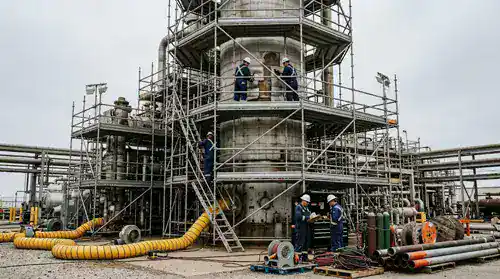
Turnaround maintenance is a planned shutdown of a process unit or an entire plant so crews can inspect, repair, replace, overhaul, and test equipment that cannot be worked on while the plant is operating. Planners schedule the turnaround well in advance, which gives maintenance, operations, and contractors a defined window to finish the major work before equipment returns to service.
How a Turnaround Differs from Routine PM
It is not the same as routine preventive maintenance, and it is not an emergency shutdown. Routine PM happens while the plant keeps producing. An emergency shutdown happens because equipment failed or an unsafe condition developed. However, a turnaround is different: you plan it specifically so crews can do work that normal operation rules out.
How the Regulations Define It
California’s refinery process safety rule puts it in those terms. Under 8 CCR §5189.1, a turnaround is “a planned total or partial shutdown of a petroleum refinery process unit or plant to perform maintenance, overhaul or repair of a process and process equipment, and to inspect, test and replace process materials and equipment.” The rule also distinguishes a turnaround from an unplanned emergency shutdown and routine maintenance.
The U.S. Energy Information Administration describes it similarly — a planned, periodic shutdown of one or more units, or the whole refinery, to inspect and repair equipment.
What Different Industries Call It
What you call it depends on where you work. Refineries and chemical plants say turnaround, TAR, or TA. In the UK and much of Europe, it is a shutdown. Power plants say planned outage. Pulp and paper mills say outage or shut.
What defines a turnaround is that production stops on purpose. Crews need the equipment out of service to enter vessels, pull exchanger bundles, perform internal inspections, and replace major components. None of that work is safe while the unit is running.
Why the Turnaround Cycle Exists
Turnarounds are not scheduled simply because it is time to shut down. You schedule them because certain equipment needs inspection at defined intervals, and because crews cannot do some of those inspections while the equipment runs. If an inspection finds equipment outside its acceptable limits, you fix the problem before that equipment returns to operation.
For sites covered by federal process safety management requirements, OSHA’s mechanical integrity rule drives that work directly. Under 29 CFR 1910.119(j), the requirements cover pressure vessels and storage tanks, piping and valves, relief and vent systems, emergency shutdown systems, controls, and pumps. Our guide to OSHA maintenance regulations covers the broader requirements that apply to maintenance work.
What the Rule Requires
- Crews have to inspect and test process equipment. Paragraph (j)(4)(i) states: “Inspections and tests shall be performed on process equipment.”
- Inspection procedures have to follow accepted engineering practices. Paragraph (j)(4)(ii) requires procedures to “follow recognized and generally accepted good engineering practices.” This is commonly referred to as RAGAGEP and brings recognized inspection and engineering codes into the mechanical integrity program.
- You have to set an inspection frequency. Paragraph (j)(4)(iii) ties inspection and test frequency to applicable manufacturers’ recommendations and good engineering practices, with more frequent inspections when operating experience shows they are needed.
- You have to correct what an inspection finds. Paragraph (j)(5) requires deficiencies outside acceptable limits to be corrected “before further use.” When that work requires the unit to come down, it becomes part of the turnaround scope.
OSHA’s refinery emphasis program, CPL 03-00-004, identifies several commonly used codes for this equipment. API 510 covers pressure vessels, API 570 covers piping, API 653 covers aboveground storage tanks, and API 579 covers fitness-for-service evaluations.
One important point about inspection intervals: do not rely on a number you find on a vendor website or in a generic online article. Inspection intervals can depend on the applicable code, the edition your site follows, equipment condition, operating history, and your inspection program. Use the requirements and standards applicable to your facility and confirm the interval with your inspection group.
The connection to the turnaround is straightforward. You have to inspect the equipment. Some of those inspections require the unit to come down. Therefore any problem the inspection turns up may need repair or replacement before that equipment runs again, and that work becomes part of the turnaround.
The Turnaround Cycle in Practice
The U.S. Energy Information Administration publishes the clearest public picture of the refinery turnaround cycle. It is worth using because most numbers on this subject come from vendors. These do not.
How Often
Refineries plan routine turnarounds on key fuel-production units every three to five years. However, that is the plan, not always the outcome. EIA surveyed 22 fluid catalytic cracking units. Only 16 hit their four-to-five-year target. Roughly a quarter missed the cycle they intended to run.
How Long to Plan
Planning takes one to two years, and longer when the scope includes major equipment replacement. People outside maintenance consistently underestimate this. Planning can run about ten times longer than the actual turnaround.
How Long the Unit Is Down
Outages last about 20 to 60 days. In practice the range is wide, because it depends on the unit, the work scope, and whether crews are repairing equipment or replacing it.
When Turnarounds Happen
In addition, turnarounds tend to cluster in the first quarter and in the fall. Those windows generally have lower fuel demand than the summer driving season. Taking a unit down in July, when demand and margins can be higher, can mean significantly more lost production than taking the same unit down in February.
Tracking that history against each asset makes the next turnaround easier to plan. Our guide to asset lifecycle management covers how that record builds over time.
A caveat on the public data. EIA’s quarterly Planned Refinery Outages series appears dormant. The last edition published was Q4 2018. A GAO review, GAO-09-87, confirmed that no federal requirement exists for refineries to report outages, and that EIA purchased the underlying data from a commercial provider. These cycle figures remain the best public description available, but no one publishes a current national dataset.
The Phases of a Turnaround
The six phases of a turnaround are initiation and business case, scope development, scope challenge and freeze, detailed planning, execution, and startup and closeout. Most turnaround organizations use some version of this sequence. It is important to be clear about its status: no government agency and no industry association defines turnaround phases. The six-phase model is practitioner convention, developed over decades by the people who run these events. It is widely used and it is useful, but it is not a published standard.
Initiation & Business Case
Inspection history and equipment condition set the timing. The event enters the capital and operating plan. Total planning lead time runs 1 to 2 years.
Enters the plan
Scope Development
Pull inspection findings, deferred repairs, code obligations, and capital tie-ins into a candidate worklist.
Before freeze
Scope Challenge & Freeze
Strip out anything that does not require the unit to come down. What survives becomes the frozen scope.
~12 months out
Detailed Planning
Job plans, critical-path schedule, labor and materials plans, contractor packages. Long-lead parts ordered.
After freeze
Execution
Shutdown, isolation, opening equipment, inspection, repair, reassembly, testing. Discovery work managed against frozen scope.
20–60 days
Startup & Closeout
Return to service under a pre-startup safety review, then capture actual cost, duration, findings, and deferred work.
Highest-risk phase
Only three timings here are sourced figures: total planning runs 1 to 2 years and execution runs about 20 to 60 days, both from U.S. Energy Information Administration data on refinery turnarounds, and scope freeze sits at roughly 12 months out, from Gordon Lawrence in The Chemical Engineer. The remaining labels show sequence, not duration. The six-phase model itself is practitioner convention, not a published standard.
1. Initiation and Business Case
Inspection history, equipment condition, and the date of the last turnaround tell you roughly when the next one has to happen and what it will cost in lost production. This is where the event gets into the capital and operating plan, usually years ahead.
2. Scope Development
Inspection recommendations, deferred repairs, equipment history, code obligations, and capital projects that need a shutdown window all get pulled into a candidate worklist. Every item needs a reason tied to condition, code, or risk. Not convenience.
3. Scope Challenge and Freeze
Go through the candidate list item by item and pull out anything that does not actually need the unit down. What is left is the frozen scope. This phase is where turnarounds get won or lost, which is why it gets its own section below.
4. Detailed Planning
Frozen scope turns into job plans, a critical-path schedule, a labor plan, materials and long-lead parts, contractor packages, and the safety paperwork for each job. Order long-lead items here. A part that shows up during the outage is a part that extends the outage.
5. Execution
Shutdown, decon, isolation and lockout, opening equipment, inspection, repair, reassembly, testing. Contractor headcount peaks. The team manages discovery work against the frozen scope instead of quietly absorbing it.
6. Startup and Closeout
The unit goes back in service under a pre-startup safety review. Then you capture actual cost, actual duration, what you found, and what you deferred. That closeout record is the first input to the next turnaround.
These phases overlap in real life. Detailed planning keeps going after scope freeze. Discovery work during execution feeds straight back into planning. Treat the six phases as hard sequential gates and the work will surprise you.
Scope Is What Usually Goes Wrong
Ask anyone who has run turnarounds what kills them and you will rarely hear about a technical failure. You will hear about scope. Too much of it, added too late, with nobody re-baselining the schedule and the budget to match.
For example, Gordon Lawrence, a chartered engineer and IChemE Fellow, laid out the mechanics in The Chemical Engineer in November 2021. His numbers, drawn partly from AP-Networks benchmarking data, are the most specific published figures on this from a named, credentialed author.
- Freeze scope about 12 months out. Any later and detailed planning, procurement, and contractor mobilization are all chasing a moving target.
- Average scope growth after freeze is about 23%. Top-quartile performers hold it near 8%. That gap is most of the difference between a turnaround that lands and one that does not.
- High-complexity turnarounds run about 20% over on cost and 30% over on schedule compared to simpler ones.
In addition, the AP-Networks paper Lawrence draws on reports that more than two-thirds of turnarounds miss planned cost or schedule by 10 percent, or trip after startup, and that 40 percent miss by 30 percent or more. That comes from a proprietary benchmarking database with no published sample size, so treat it as directional.
Why Scope Grows
- Discovery. You open the equipment and it is worse than the inspection history said. That is legitimate, and every turnaround budget should carry contingency for it.
- Deferred work looking for a window. Crews bolt on jobs they could do in service, because the unit will be down anyway. This is exactly what a scope challenge exists to catch, and it is easier to catch when deferred jobs sit in the system as open work orders against the asset.
- Capital projects riding along. Someone folds in a tie-in or a modification late, dragging engineering and procurement dependencies the schedule never accounted for.
- No gate. If nobody has the authority to say no after freeze, additions pile up one reasonable request at a time.
The test that settles it. For every item on the worklist, ask one question: does this actually require the unit to be down? If the crew can do it in service, it belongs in routine maintenance, not in the turnaround. A worklist that has never been through that question is not a frozen scope.
Why Startup Is One of the Most Dangerous Phases of a Turnaround
Startup is one of the most dangerous phases of a turnaround. The unit is in a transient state that behaves differently from normal operation, and the maintenance team is under pressure to finish the remaining work and get the plant back online. Two of the worst refinery disasters in U.S. history — BP Texas City in 2005 and Tesoro Anacortes in 2010 — both happened during startup. A turnaround is not over when the last job closes. It is over when the unit is back in stable operation. The stretch between those two points is where process safety risks can increase significantly.
The U.S. Chemical Safety Board has made this point repeatedly, and for good reason. Its case files show what can happen when a plant treats startup and restart like routine operations.
Tesoro Anacortes, April 2, 2010 — Seven Killed
A heat exchanger in the naphtha hydrotreater failed catastrophically during startup, after three days of cleaning and maintenance on the exchanger bank. Seven people died. The CSB described startup, shutdown, and cleaning as “a hazardous nonroutine operation.” It is not simply a return to normal operation.
BP Texas City, March 23, 2005 — 15 Killed, 180 Injured
An isomerization unit was starting up when a distillation tower was overfilled and hydrocarbons were released. Fifteen workers died. Most were in or near contractor trailers parked as close as 121 feet from the unit. The CSB also identified organizational factors related to budget reductions and turnaround work.
Other Startup and Shutdown Incidents
The CSB’s own digest on startup and shutdown incidents documents additional cases. BP Amoco Augusta, 2001: three killed during a startup. Bayer CropScience, 2008: two killed during a restart. First Chemical in Pascagoula, 2002: three injured during a shutdown.
What This Means for the Maintenance Organization
These incidents were not maintenance failures in the narrow sense. They involved failures in how the organization managed the work, the equipment, the people, and the restart. A few things follow from that:
- Treat startup as nonroutine work, not as the end of the job. That is the CSB’s own language, and it is the difference between a controlled restart and a rushed one.
- Do not let work pile up at the end. A schedule that pushes the last jobs into the startup window puts maintenance and operations under pressure at exactly the wrong time.
- Know where your people are during restart. Contractor trailer siting was a central finding at Texas City. Temporary structures and contractor work areas near a unit coming back online deserve the same attention as the equipment itself.
- Close the records before the crews leave. Capture what the crew found, what they repaired, and what you deferred, then carry all of it into the pre-startup review and the next turnaround.
Where the “50% of Incidents” Figure Actually Comes From
You have probably seen the claim that half of all process safety incidents happen during startups, shutdowns, and other infrequent operations, usually credited to the CSB. Follow it back and it runs through CSB material to a 2010 Chemical Processing article by Ostrowski and Keim of ExxonMobil, and from there to Duguid in the IChemE Loss Prevention Bulletin in 1998. The original is paywalled. Credit the ExxonMobil authors, not the CSB, and pair the claim with the point that plants spend well under ten percent of their operating time in transient states.
There is a separate, older figure — incidents happening roughly five times more often during startup — from CCPS material citing a 1992 Marsh & McLennan loss compilation. It is traceable, but it rests on an insurance dataset that is now more than thirty years old.
What OSHA Requires at Restart
OSHA’s process safety management standard addresses restart directly. Paragraph 1910.119(i)(2) requires a pre-startup safety review for new facilities and for modified facilities where the modification is significant enough to require a change in process safety information. The contractor provisions in 1910.119(h) also specifically address contractor work during turnaround activities, which is important because much of the workforce during a turnaround may come from outside contractors.
Two related deadlines the turnaround cycle tends to surface. The standard requires process hazard analyses to be revalidated at least every five years under (e)(6), and compliance audits at least every three years under (o)(1). Both can overlap with a typical turnaround cycle, so it makes sense to track them alongside the turnaround rather than separately. A preventive maintenance schedule carries recurring compliance tasks like these, so the date does not depend on somebody remembering it.
Who Does the Work During a Turnaround
Turnarounds run on contract labor. Boilermakers, pipefitters, scaffolders, insulators, riggers, inspectors — they show up for a few weeks and they leave. Your own maintenance headcount is a fraction of the peak.
You will hear ratios thrown around, five to one, ten to one. However, none of them trace to a source. There is no published contractor-to-staff ratio for turnarounds, and quoting one is guessing with a decimal point on it.
The record is clearer on what happens when a plant defers a turnaround. In April 2020, Bay Area refineries postponed planned turnarounds and let go more than 1,000 contract workers. Boilermakers Local 549 reported 85 to 90 percent of its members out of work. That is the clearest evidence available of how much this workforce depends on a schedule set years in advance.
Two things follow from that for your maintenance organization:
- The people doing the work do not know your plant. Job plans, isolation lists, equipment records, and drawings have to carry the information a permanent crew would just know. Keeping that documentation attached to the equipment puts it in front of a crew seeing the asset for the first time.
- Documentation is not optional. A contractor closes a job and leaves. Whatever the crew wrote down is what stays behind — and that record becomes your input to the next turnaround, several years out.
Where eWorkOrders Fits in a Turnaround
A turnaround has two halves. One is running the event: the critical-path schedule, contractor packages, daily execution meetings, and the specialist tools built for that work. The other is the maintenance data you plan the turnaround from, and the records the event leaves behind.
eWorkOrders handles the second half. It is not turnaround planning software and it is not a critical-path scheduler. What it gives your team is one place where the asset history that supports your scope, the turnaround worklist, parts and materials, and work completion records are kept together.
What the CMMS Handles
- The asset register your scope comes from. The register carries every vessel, exchanger, pump, and line as an asset with its own ID, location, and service information. Scope development starts with equipment history, and that history is only as good as the asset register behind it.
- Inspection and repair history across cycles. Every work order attaches to the asset, so the record shows what you found during the last turnaround, what the crew repaired, and what you deferred. That history gives the maintenance team evidence to support or remove an item during scope review.
- The worklist as real work orders. Scope items become assigned work with an owner, due date, and status instead of sitting in a spreadsheet that only one planner can easily manage.
- Deferred work that stays visible. A repair pushed to the next shutdown stays recorded against the asset instead of getting lost. When you build the next scope, that deferred work is already part of the equipment history.
- Parts and materials. Tie spare parts to the assets that use them, so the maintenance team can see what is on hand and what to order before the outage.
- The closure record. Your team can capture what they did, who did it, which parts they used, and what they found, all against the asset while the contractor is still on site. That is the best time to capture it.
- Documents on the equipment. Store drawings, procedures, inspection reports, and manufacturer information with the asset instead of in a folder somebody has to track down.
In short, the specialist tools run the event. The CMMS is where your maintenance history comes from before the turnaround, and where your team records the completed work afterward. Since your next turnaround may be three to five years away, that record is what your maintenance team will rely on when planning starts again.
Build your turnaround program against your own requirements, not this article. Inspection intervals, process safety obligations, and pre-startup review requirements vary by jurisdiction, applicable standards, and site-specific requirements. Set them with your inspection group, process safety staff, and other responsible personnel.
Keep the Record Your Next Turnaround Will Be Built On
Your asset history, deferred work, work orders, parts, and turnaround records in one place. eWorkOrders gives your maintenance team the record it needs to plan the next turnaround with better information.
Rated 4.9 stars on Capterra and G2 · Over 30 years serving maintenance teams
Frequently Asked Questions
What is turnaround maintenance?
Turnaround maintenance is a planned shutdown of a process unit or an entire plant so crews can inspect, overhaul, repair, and return equipment to service. California’s refinery process safety standard defines it as a planned total or partial shutdown to perform maintenance, overhaul or repair of a process and process equipment, and to inspect, test and replace process materials and equipment. It specifically excludes unplanned emergency shutdowns and the routine maintenance crews perform while the unit runs.
How often does a turnaround happen?
According to the U.S. Energy Information Administration, refineries plan routine turnarounds on key fuel-production units every three to five years. That is a target rather than a guarantee. In an EIA survey of 22 fluid catalytic cracking units, only 16 hit their targeted four-to-five-year intervals. Intervals vary by unit type, equipment condition, and applicable inspection requirements.
How long does a turnaround take?
The Energy Information Administration reports that refinery turnaround outages last about 20 to 60 days. Planning takes far longer than execution: one to two years of advance planning is typical, and more when the scope replaces major equipment rather than repairing it.
What is the difference between a turnaround, a shutdown, and an outage?
They generally describe the same event with different regional and industry vocabulary. Refineries and chemical plants in North America say turnaround, often shortened to TAR or TA. In the United Kingdom and much of Europe, crews call the same event a shutdown. Power generation calls it a planned outage. What they share is that production stops on purpose, so crews can do work that is impossible in service.
What are the phases of a turnaround?
Most turnaround organizations use six: initiation and business case, scope development, scope challenge and freeze, detailed planning, execution, and startup and closeout. It is worth knowing that this model is practitioner convention rather than a published standard. No government agency or industry association defines turnaround phases, and in practice the phases overlap rather than running as strict sequential gates.
When should turnaround scope be frozen?
Writing in The Chemical Engineer, chartered engineer Gordon Lawrence puts scope freeze at roughly 12 months before execution. His figures, drawn partly from AP-Networks benchmarking data, show average scope growth after freeze of about 23 percent, with top-quartile performers holding growth to about 8 percent. High-complexity turnarounds run roughly 20 percent over on cost and 30 percent over on schedule relative to less complex events.
Why is startup the most dangerous part of a turnaround?
Because a unit coming back online is in a transient state that behaves nothing like normal operation, and because the organization is often already treating the event as finished. The U.S. Chemical Safety Board investigated the 2010 Tesoro Anacortes heat exchanger failure, which killed seven people during startup after three days of cleaning and maintenance, and concluded that startup, shutdown, and cleaning are hazardous nonroutine operations. The 2005 BP Texas City disaster, which killed 15 and injured 180, also occurred during unit startup. OSHA’s process safety management standard also requires a pre-startup safety review before a modified facility returns to service.
What OSHA requirements apply to turnaround work?
For facilities covered by 29 CFR 1910.119, the mechanical integrity provisions at paragraph (j) require inspections and tests on process equipment, following recognized and generally accepted good engineering practices, at frequencies consistent with manufacturer recommendations and prior operating experience. Paragraph (j)(5) requires deficiencies outside acceptable limits to be corrected before further use. Paragraph (i)(2) requires a pre-startup safety review, and the contractor provisions at (h)(1) reference turnaround work directly. OSHA’s refinery emphasis program identifies API 510, 570, 653, and 579 as the accepted inspection practices for this equipment.
Can a CMMS run a turnaround?
A CMMS handles the maintenance-management side rather than the event management. It holds the asset register you develop the scope from, the inspection and repair history that justifies each scope item, deferred work so it stays visible between cycles, the worklist as assigned work orders, spare parts tied to the equipment, and the closure records captured while contractors are still on site. It is not a critical-path scheduler and it does not replace dedicated turnaround planning tools. In eWorkOrders, the value is continuity: because every record attaches to the asset, the history is still there when planning starts for the next turnaround three to five years later.
Sources
2. U.S. Energy Information Administration — Refinery Outages: Description and Potential Impact on Petroleum Product Prices
3. U.S. Energy Information Administration — Planned Refinery Outages
4. OSHA — 29 CFR 1910.119, Process Safety Management
5. OSHA — Petroleum Refinery Process Safety Management National Emphasis Program
6. U.S. Chemical Safety Board — Tesoro Anacortes Refinery Investigation
7. U.S. Chemical Safety Board — BP Texas City Investigation Digest
8. U.S. Chemical Safety Board — Startup and Shutdown Safety Digest
9. Gordon Lawrence, CEng FIChemE — “Controlling Your Maintenance Turnaround Scope,” The Chemical Engineer
10. AP-Networks — Benchmarking and Optimizing Maintenance Work Scope for Turnarounds
11. KQED — Bay Area Refinery Turnaround Coverage, April 2020
12. U.S. Government Accountability Office — GAO-09-87, Energy Markets
Important Notes
Regulatory and inspection requirements: Turnaround intervals, inspection requirements, process safety obligations, and pre-startup requirements vary by jurisdiction, applicable standards, permits, and site conditions. This article is for general education and does not determine what requirements apply to a specific facility. Confirm requirements with your applicable standards, permits, inspection group, and process safety personnel.
General information: This article is not legal, regulatory, process safety, engineering, or compliance advice. API standards are copyrighted and sold by the American Petroleum Institute; specific inspection intervals should be taken from the edition of the applicable standard held by your facility. Third-party figures reflect their publishers’ data and methodology.
About the Author
Janet Jaquis is a CMMS software specialist with over 8 years at eWorkOrders, where she develops educational content, technical guides, and implementation resources for maintenance management professionals. Her work covers preventive maintenance, work order management, asset reliability, inventory management, and CMMS implementation across manufacturing, healthcare, government, food and beverage, and facilities operations.


