MSDS / Safety Data Sheets (SDS): What Maintenance Teams Need to Know
A Safety Data Sheet is the standardized document that tells your crew how to safely handle, store, and respond to every hazardous chemical on site — and “MSDS” is just the older name for it.
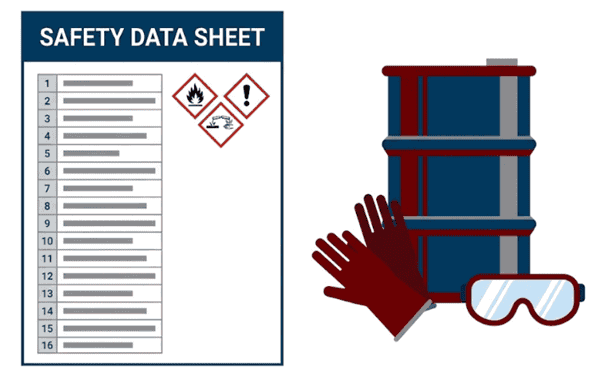
What Is an MSDS / Safety Data Sheet (SDS)?
A Safety Data Sheet (SDS) is a standardized, 16-section document that communicates the hazards of a chemical product and the precautions for handling, storing, transporting, and disposing of it. Every hazardous chemical in a workplace — from a solvent or lubricant to a cleaning compound, coolant, or welding gas — is supposed to have one, supplied by the manufacturer, importer, or distributor.
“MSDS” (Material Safety Data Sheet) is the older name for the same kind of document. The content and purpose are nearly identical: identify the chemical, spell out the hazards, and tell the people who work with it how to stay safe and what to do in an emergency. The practical difference is format and terminology, which changed when the United States aligned its rules with a global standard (more on that below).
For a maintenance or facilities team, the SDS is the single most important reference when something goes wrong with a chemical — a spill in the shop, a splash during a parts wash, smoke from an overheated lubricant, or a technician asking which gloves and respirator a task requires. It is also the document an OSHA inspector will ask to see first.
Quick answer: MSDS and SDS describe the same thing — a hazard-communication document for a chemical. “SDS” is the current, standardized term; “MSDS” is the legacy term you will still see on older binders and labels.
MSDS vs SDS: The GHS Transition Explained
The shift from MSDS to SDS happened because the United States adopted the United Nations’ Globally Harmonized System of Classification and Labelling of Chemicals (GHS). In 2012, OSHA revised its Hazard Communication Standard (HCS, 29 CFR 1910.1200) to align with GHS, and that revision replaced the loosely-formatted MSDS with a standardized 16-section SDS and a uniform order for the information.
Under the old system, Material Safety Data Sheets had no required layout. Two manufacturers could document the same solvent with different section orders, different headings, and different levels of detail, which made it slow to find critical information in an emergency. The GHS-aligned SDS fixed that by mandating the same 16 sections in the same sequence for every chemical, everywhere the standard applies. It also standardized hazard pictograms, signal words (“Danger” / “Warning”), and hazard statements so a label and its SDS speak the same language.
The change was phased in over several years following the 2012 rule, with employers required to maintain the new SDS format and update their hazard-communication programs as the transition dates passed. In day-to-day maintenance work, the takeaways are simple:
- SDS is current. New chemicals arrive with a 16-section Safety Data Sheet. Your library should be built around that format.
- MSDS is legacy. If you still have old “MSDS” documents on file, they are outdated references — replace them with the manufacturer’s current SDS.
- Same job, clearer format. The purpose never changed: tell workers how to handle the chemical safely and what to do in an emergency.
| Aspect | MSDS (legacy) | SDS (current, GHS-aligned) |
|---|---|---|
| Term | Material Safety Data Sheet | Safety Data Sheet |
| Format | No required order; varied by manufacturer | Standardized 16 sections in a fixed sequence |
| Basis | Older OSHA Hazard Communication Standard | GHS-aligned HCS (2012 revision) |
| Labels | Inconsistent warnings | Standard pictograms, signal words, hazard statements |
| Status | Outdated — replace | What you keep on file today |
The 2024 Hazard Communication Update
OSHA updated the Hazard Communication Standard again in a final rule published May 20, 2024, aligning it with a newer revision of GHS (Revision 7). The 16-section SDS format stays the same, but some hazard classifications, label rules, and precautionary statements changed — including reclassification of aerosols, desensitized explosives, and flammable gases, and new labeling provisions for very small and bulk containers. Chemical manufacturers and suppliers are phasing in updated SDSs and labels, with employer deadlines to update workplace labels, hazard communication programs, and training of July 20, 2026 for substances and January 19, 2028 for mixtures.
For maintenance teams, the practical result is that revised SDSs will keep arriving from suppliers over the next few years. Swap each one into your library as it comes in, and retrain crews on any newly identified hazards.
The 16-Section SDS Format
Every GHS-aligned Safety Data Sheet contains the same 16 sections in the same order. Knowing which section answers which question lets a technician get to the right information in seconds instead of reading the whole sheet. Sections 1 through 11 and 16 cover the information OSHA enforces; sections 12 through 15 (ecological, disposal, transport, and regulatory) are required for a complete GHS sheet but fall under the authority of other agencies.
| # | Section | What it tells a maintenance team |
|---|---|---|
| 1 | Identification | Product name, manufacturer, emergency phone number, recommended use |
| 2 | Hazard(s) identification | Hazard class, pictograms, signal word, and hazard/precautionary statements |
| 3 | Composition / ingredients | Chemical ingredients and concentrations; CAS numbers |
| 4 | First-aid measures | What to do for skin, eye, inhalation, or ingestion exposure |
| 5 | Fire-fighting measures | Suitable extinguishing media and firefighting hazards |
| 6 | Accidental release measures | Spill containment, cleanup, and protective steps |
| 7 | Handling and storage | Safe handling practices and storage/incompatibility conditions |
| 8 | Exposure controls / PPE | Exposure limits, engineering controls, and required PPE |
| 9 | Physical and chemical properties | Flash point, boiling point, appearance, odor, pH, and more |
| 10 | Stability and reactivity | Conditions and materials to avoid; hazardous reactions |
| 11 | Toxicological information | Routes of exposure and health effects |
| 12 | Ecological information | Environmental impact (enforced by other agencies) |
| 13 | Disposal considerations | Safe disposal and container handling guidance |
| 14 | Transport information | Shipping classification and transport precautions |
| 15 | Regulatory information | Applicable safety, health, and environmental regulations |
| 16 | Other information | Preparation/revision date and any additional notes |
For most maintenance decisions, four sections do the heavy lifting: Section 2 (what are the hazards), Section 4 (first aid if someone is exposed), Section 7 (how to store it safely and what it reacts with), and Section 8 (which PPE the task requires). Technicians who know those four by number can act fast under pressure.
Who Needs SDSs, and Where Are They Required?
Any workplace that uses, stores, or handles hazardous chemicals needs a Safety Data Sheet for each one, and employees must be able to access them. This flows from OSHA’s Hazard Communication Standard — often called the “Right to Know” rule — which requires chemical manufacturers and importers to provide an SDS with each hazardous chemical, and requires employers to maintain those SDSs and make them readily accessible to employees during every work shift.
For maintenance and facilities operations, that reaches further than most people assume. The chemicals that trigger the requirement are everywhere in a maintenance environment:
- Lubricants, greases, and cutting fluids used on production and shop equipment
- Solvents and degreasers for parts washing and cleaning
- Paints, coatings, adhesives, and sealants used in repairs and facility upkeep
- Welding gases and consumables, refrigerants, and compressed gases
- Batteries, coolants, and hydraulic fluids on fleet and mobile equipment
- Janitorial and water-treatment chemicals managed by the facilities team
“Readily accessible” is the operative phrase. A sheet buried in a binder in a locked office does not meet the intent if a technician on the far side of the plant — or a first responder — cannot reach it when a chemical is involved in an incident. Accessibility is exactly where a digital system earns its keep, because the person who needs the sheet is rarely standing next to the filing cabinet.
SDS management also overlaps with other safety programs. Before a technician services equipment that holds hazardous energy or chemicals under pressure, the relevant SDS, the machine’s lockout/tagout (LOTO) procedure, and the correct PPE all need to be in hand at the same moment. Treating them as one bundle of job information — rather than three separate documents in three separate places — is what keeps the work safe and compliant.
How Maintenance Teams Use and Manage SDSs
Maintenance teams get the most value from Safety Data Sheets when the sheets are linked to the assets, chemicals, and work orders they relate to — not stored as a standalone pile of PDFs. That is the core idea behind managing SDSs in a CMMS: the hazard information travels with the work instead of sitting in a binder someone has to go find.
In practice, a CMMS can connect safety data to maintenance operations in a few concrete ways:
- Attach SDSs to assets. A compressor, chiller, or hydraulic press can carry the SDS for every chemical it uses as part of its asset record. When a technician opens the equipment, the relevant sheets are right there.
- Link SDSs to chemicals and inventory items. Each hazardous item in your stockroom can store its own SDS, so purchasing, storage, and handling decisions all reference the same current document.
- Surface SDSs on the work order. When a work order involves a hazardous chemical, the SDS and the required PPE can be attached to the job so the technician reviews them before starting — the same way a LOTO procedure or a control-system reference would ride along with a PLC maintenance task.
- Make them accessible in the field. Because the records live in the system rather than a cabinet, a technician can pull up a sheet from wherever the work is happening, which is the practical meaning of “readily accessible.”
The point is organizational, not magic: a CMMS does not author your SDSs or guarantee compliance on its own. It gives you one current, searchable, access-controlled place to keep them and ties each one to the equipment and tasks where it matters — so the right hazard information shows up at the moment of the work.
Best Practices for Keeping an SDS Library Current
A Safety Data Sheet library is only useful if it is complete, current, and findable — an outdated or missing sheet is a hazard in itself. A few disciplines keep a library trustworthy:
- Maintain a master chemical inventory. You cannot keep sheets current for chemicals you have not inventoried. Build and periodically reconcile a list of every hazardous chemical on site, and confirm each one has a matching SDS.
- Pull the current sheet from the manufacturer. Manufacturers update SDSs as formulations, classifications, or regulations change. Get sheets directly from the supplier and replace older versions rather than editing your own copies.
- Replace legacy MSDS documents. If old MSDS-format sheets are still on file, swap them for the manufacturer’s current 16-section SDS so your library reflects one standard.
- Add the SDS at receiving. Make capturing the SDS a step in your purchasing or receiving process, so a new chemical never enters the facility without its sheet on file.
- Remove what you no longer use. When a chemical is discontinued, archive its sheet rather than letting the active library fill with products that are no longer on site. (Under OSHA’s records-access rule, 29 CFR 1910.1020, you don’t have to keep an old sheet itself indefinitely, but you must keep a record of the chemical’s identity, where it was used, and when for at least 30 years.)
- Review on a schedule. Audit the library on a recurring basis — a natural fit for a recurring task in your CMMS — to catch gaps, duplicates, and outdated versions before an inspector or an incident does.
- Train the people who use them. Hazard communication includes making sure workers know where the sheets are and how to read the sections that matter. An accessible library only helps if the crew knows how to use it.
Rule of thumb: every hazardous chemical on site = one current SDS, accessible to the people who work with it. If you cannot produce a chemical’s sheet in under a minute, your library has a gap to close.
Put Safety Data Where the Work Happens
See how eWorkOrders helps your maintenance team schedule preventive maintenance, track inspections, and turn problems into work orders before small issues become costly downtime. See how it works in a free, personalized demo.
Frequently Asked Questions
What is the difference between an MSDS and an SDS?
They describe the same kind of document — a hazard-communication sheet for a chemical. “MSDS” (Material Safety Data Sheet) is the older term with no required format. “SDS” (Safety Data Sheet) is the current, standardized version adopted when OSHA aligned its Hazard Communication Standard with the global GHS system in 2012, using a fixed 16-section format.
How many sections are in an SDS?
A GHS-aligned Safety Data Sheet has 16 standardized sections in a fixed order, from Identification (Section 1) through Other Information (Section 16). Sections 1–11 and 16 cover the content OSHA enforces; sections 12–15 (ecological, disposal, transport, regulatory) are part of a complete sheet but fall under other agencies.
Does my maintenance shop legally need Safety Data Sheets?
If your shop uses, stores, or handles hazardous chemicals — lubricants, solvents, paints, welding gases, coolants, and the like — then under OSHA’s Hazard Communication Standard you must maintain an SDS for each one and keep them readily accessible to employees during every work shift. Chemical manufacturers and importers are required to supply the sheets.
Did OSHA change Safety Data Sheet requirements in 2024?
Yes. OSHA published an updated Hazard Communication Standard on May 20, 2024, aligning it with GHS Revision 7. The 16-section SDS format did not change, but some hazard classifications, label requirements, and precautionary statements did. Employers must update workplace labels, hazard communication programs, and training by July 20, 2026 for substances and January 19, 2028 for mixtures.
How long do you have to keep Safety Data Sheets?
You must keep a current SDS for every hazardous chemical in use. Under OSHA’s records-access rule (29 CFR 1910.1020), old sheets don’t have to be kept for a set period, as long as a record of the chemical’s identity, where it was used, and when it was used is kept for at least 30 years.
Can a CMMS store and manage Safety Data Sheets?
Yes. A CMMS can store SDSs and link them to the assets, chemicals, and work orders they relate to, so the right hazard information and PPE requirements appear with the job and are accessible in the field. The system keeps one current, searchable copy of each sheet; it does not author the SDS or guarantee compliance on its own.
Part of the eWorkOrders Learning Center


