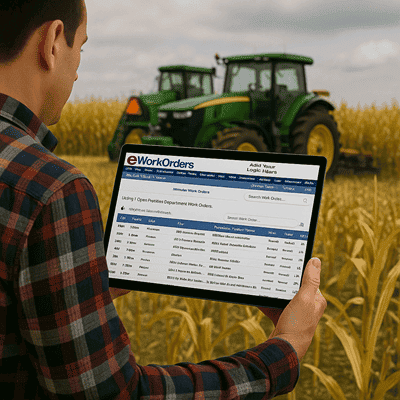
A CMMS for farming and agriculture is software that organizes and manages maintenance tasks for farm equipment, plants, and feed mills. It schedules preventive work, tracks repairs, manages spare parts, and records costs. The goal is simple: keep machines running, cut downtime, and improve efficiency across agricultural operations.
Why CMMS is Critical in Agriculture
Farming and agribusiness have unique challenges:
- Tight planting and harvest windows – downtime at the wrong time means lost crops.
- Harsh environments – dust, water, and chemicals accelerate wear.
- Distributed assets – equipment, irrigation systems, and feed mills are often spread across miles.
- Regulatory compliance – feed mills and processing plants must document sanitation and safety.
Without structured maintenance, these issues quickly lead to breakdowns, delays, and higher costs. A CMMS replaces paper logs and spreadsheets with an organized, centralized system.
Core Benefits of CMMS in Farming
| Benefit | Explanation | Impact on Farming Operations |
|---|---|---|
| Reduced Downtime | Preventive maintenance ensures tractors, harvesters, irrigation pumps, and other equipment are serviced before breakdowns. | Fewer emergency repairs, steady operations during planting/harvest, and less disruption in crop cycles. |
| Longer Equipment Life | Regular maintenance extends the life of machinery and keeps assets in better condition. | Higher resale value, delayed replacement costs, and better return on investment. |
| Cost Savings | CMMS tracks spare parts, schedules servicing, and prevents last-minute rush repairs or excess stock. | Lower maintenance costs, optimized inventory, and fewer unexpected financial hits. |
| Clear Accountability | Digital work orders record who completed the task, when it was done, and what materials were used. | Improved workforce transparency, reduced errors, and stronger team accountability. |
| Compliance Support | Automatically logs inspections, repairs, and servicing history for audits and warranty claims. | Easier proof of compliance with agricultural regulations, smoother audits, and faster warranty approvals. |
Key Features to Look For in Farm Equipment Maintenance Software
The right farm equipment maintenance software should help farmers reduce downtime, keep assets running longer, and simplify daily maintenance tasks. Below are the key features that make a CMMS effective for agricultural operations.
Work Order Management
- Task Assignment: Easily create and assign tasks to specific technicians or farmhands.
- Progress Tracking: Monitor work order status from “open” to “in progress” to “closed.”
- Documentation: Attach photos, notes, and technician signatures for proof of work and accountability.
Why It Matters: A clear work order management system reduces confusion, ensures tasks are completed properly, and keeps everyone accountable.
Preventive Maintenance (PM)
- Flexible Scheduling: Set PMs based on calendar dates, engine hours, mileage, or usage meters.
- Automatic Reminders: Receive alerts before equipment is due for servicing.
- Maintenance Templates: Use standard checklists for tractors, harvesters, or irrigation systems.
Why It Matters: Preventive maintenance minimizes surprise breakdowns and extends equipment life.
Inventory & Spare Parts Management
- Stock Control: Maintain optimal min/max levels to avoid overstocking or shortages.
- Reorder Alerts: Get notifications when parts are running low.
- Vendor Catalog Integration: Access supplier details, part numbers, and pricing directly from the system.
Why It Matters: Effective parts management cuts downtime by ensuring the right spares are always available.
Mobile Access
- Field Updates: Technicians can update work orders from barns, fields, or workshops on a phone or tablet.
- Photo & Note Capture: Document issues on the spot with images or voice notes.
Why It Matters: Farming operations span wide areas, and mobile CMMS access keeps maintenance running smoothly from anywhere.
Asset Tracking
- Comprehensive Records: Store serial numbers, warranty details, and manuals in one place.
- Hierarchy Management: Link attachments, like plows or sprayers, to parent tractors for complete tracking.
- Service History: Maintain a full log of all past maintenance activities.
Why It Matters: Accurate asset tracking helps farmers manage equipment lifecycles and resale value.
Reporting & KPIs
- Performance Metrics: Track downtime, PM compliance, Mean Time Between Failures (MTBF), and Mean Time to Repair (MTTR).
- Cost Analysis: Monitor cost per asset or per repair.
- Custom Dashboards: View key insights at a glance for better decision-making.
Why It Matters: Data-driven insights allow farmers to improve reliability and optimize costs.
Integration Capabilities
- Telematics & IoT: Connect with sensors that capture real-time equipment usage data.
- ERP & Accounting: Integrate with business systems for seamless financial tracking.
- Smart Automation: Trigger maintenance tasks automatically when IoT alerts flag unusual performance.
Why It Matters: Integration connects maintenance to the bigger picture of farm management, improving efficiency and control.
Best CMMS Software for Agriculture
Here’s a closer look at CMMS platforms used in agriculture. The entries below report what each vendor documents on its own website. No platform is ranked.
1. eWorkOrders
eWorkOrders is highly adaptable and easy to use. It offers preventive scheduling, inventory tracking, mobile work orders, and compliance-ready reports—all features that align with farming and feed mill operations.
Why It Stands Out
Unlike many CMMS platforms that require heavy customization, eWorkOrders comes with agriculture-ready workflows. Its preventive maintenance templates fit tractors, combines, irrigation pumps, feed mills, and plant facilities. The system balances usability with advanced features, making it ideal for both small family farms and multi-site agribusinesses.
Key Features
- Preventive maintenance schedules by hours, days, or seasons.
- Work order tracking with photos, comments, and mobile signatures.
- Inventory control with vendor management and purchase orders.
- Compliance-ready reports for audits and warranties.
- Scalable structure for multiple farms, plants, and feed mills.
Get started with eWorkOrders CMMS today and see how it can streamline your farm maintenance.
2. Fiix CMMS
Fiix, owned by Rockwell Automation, is a cloud-based platform with a reputation for analytics and scalability. It integrates well with larger enterprise systems, making it a fit for mid-sized and large agricultural businesses with complex needs.
Documented capabilities
- AI-powered maintenance forecasting to reduce breakdowns
- Cloud-based with robust mobile app
- Integration options with ERP and IoT sensors.
- Detailed dashboards and analytics for decision-making
3. Limble CMMS
Limble is designed to be mobile-first, with a user-friendly interface that helps farm operators and seasonal crews adopt it quickly.
Documented capabilities
- Mobile-friendly interface for field crews.
- Easy work order creation and updates.
- Asset hierarchy for organizing large fleets.
- Intuitive reporting for downtime and costs.
4. MaintainX
MaintainX combines CMMS with team communication. It’s especially useful for operations that rely heavily on seasonal labor or large crews. The built-in messaging keeps everyone aligned without switching between apps. Managers can assign, track, and verify tasks in real time, reducing delays and misunderstandings.
Documented capabilities
- Digital SOPs and safety procedures tied to work orders.
- Real-time messaging and communication inside the app.
- Mobile-first design for quick adoption.
- Easy to set up checklists for seasonal equipment prep.
5. Hippo CMMS
Hippo is a simple, visually oriented CMMS. It’s often chosen by smaller operations that want an easy-to-use platform without a steep learning curve. Its drag-and-drop interface makes scheduling and tracking tasks straightforward for non-technical users. The software also provides clear dashboards that help managers quickly see upcoming maintenance and overdue work.
Documented capabilities
- Visual dashboards and drag-and-drop scheduling.
- Affordable pricing tiers.
- Good entry point for farms moving from spreadsheets.
6. UpKeep
UpKeep is well-known for its mobile-first design. It’s popular among feed mills and farms that need technicians to manage work orders directly from the field. The app supports photo uploads and barcode scanning, making it practical for field use. It also offers analytics that help farm managers spot recurring issues and control maintenance costs.
Documented capabilities
- Easy mobile interface with photo/voice notes.
- Preventive scheduling for equipment.
- Good reporting on repair costs.
7. Tractian
Tractian is a hybrid of CMMS and IoT-based monitoring. It’s strong in industrial farming and feed mills where equipment reliability is critical. Sensors track vibration, temperature, and performance data in real time to predict failures before they happen. This predictive maintenance approach helps reduce costly downtime and extend the lifespan of high-value machinery.
Documented capabilities
- IoT sensors for vibration, temperature, and performance tracking.
- Predictive maintenance alerts tied directly to CMMS.
- Real-time dashboards for asset health.
Summary Table: Best CMMS Software for Agriculture
| Software | Documented capabilities |
|---|---|
| eWorkOrders | Preventive scheduling (hours/days/seasons), work orders with photos/comments, inventory control, mobile access, compliance reports, multi-site scalability |
| Fiix CMMS | AI-powered forecasting, ERP & IoT integration, cloud-based with mobile app, advanced dashboards & analytics |
| Limble CMMS | Mobile-first design, easy work order creation, asset hierarchies, downtime & cost reporting |
| MaintainX | CMMS + team messaging, digital SOPs, real-time task verification, mobile-first design, seasonal checklists |
| Hippo CMMS | Drag-and-drop scheduling, visual dashboards, affordable plans |
| UpKeep | Photo uploads, barcode scanning, preventive scheduling, cost analytics |
| Tractian | IoT sensors for vibration/temp tracking, predictive maintenance, real-time dashboards |
Future Trends in Farm CMMS
The next generation of CMMS platforms will not just track repairs and schedules but actively shape how farms prevent downtime, allocate resources, and integrate with other agricultural technologies. Below are the major trends shaping the future of farm CMMS.
Predictive Maintenance with IoT Sensors
- How It Works: IoT sensors installed on tractors, harvesters, irrigation pumps, and feed mill equipment collect real-time data such as vibration, temperature, and fuel efficiency
- Impact: Instead of waiting for scheduled servicing, the system predicts when a component is likely to fail and creates a maintenance task before it happens.
- Why It Matters: This reduces unplanned downtime, lowers repair costs, and extends the lifespan of high-value equipment.
AI-Driven Scheduling
- How It Works: Artificial intelligence analyzes farm activity, labor availability, and historical repair patterns to automatically assign maintenance tasks.
- Impact: Technicians are scheduled more efficiently, resources are allocated smarter, and seasonal labor can be managed with minimal confusion.
- Why It Matters: AI reduces human error in planning and ensures the right work is done at the right time, even during peak farming seasons.
Cloud-First Tools
- How It Works: CMMS platforms are moving away from on-premise systems to cloud-based software accessible from any device with an internet connection.
- Impact: Farmers and technicians can access maintenance records, work orders, and parts inventory from barns, fields, or remote offices.
- Why It Matters: With farms spread across large areas, cloud-first design ensures better collaboration, instant updates, and reduced reliance on paper-based systems.
Integration with Precision Agriculture
- How It Works: CMMS data connects with precision agriculture tools like GPS-guided tractors, field mapping systems, and irrigation control platforms.
- Impact: Maintenance schedules can be tied to actual field operations, such as adjusting servicing based on soil conditions, crop cycles, or machine usage intensity.
- Why It Matters: This integration ensures that maintenance is not just timely but also aligned with broader farm productivity goals, creating a more efficient and sustainable operation.
Final Word
A CMMS for farming and agriculture is more than software, as it’s a safeguard against costly downtime. For farms, mills, and plants, it means reliable equipment, controlled costs, and easier compliance. eWorkOrders combines preventive maintenance, mobile usability, and compliance support in one flexible package built for agricultural operations.
Get started with eWorkOrders CMMS today and see how it can streamline your farm maintenance.
Disclaimer: This guide does not rank or rate competing platforms. Capabilities attributed to any vendor are as documented on that vendor’s own website and are subject to change — verify features and pricing directly with each vendor before purchasing. eWorkOrders publishes this guide and offers maintenance software for agriculture.
FAQs
What are the two types of CMMS used in the industry?
The two main types of CMMS are on-premise systems and cloud-based systems. On-premise CMMS is installed locally on a company’s servers and offers full internal control but requires higher upfront investment and IT resources. Cloud-based CMMS runs online, offering easier updates, mobile access, and lower entry costs. For farming and agriculture, cloud-based CMMS is most common since it allows field technicians to access data remotely.
What is the most used machine in agriculture?
The tractor is the most widely used machine in agriculture worldwide. It is essential for plowing, planting, fertilizing, and transporting crops and materials. Modern tractors often support multiple attachments, making them versatile tools for both small and large farms. Their role as the backbone of mechanized farming makes them the single most important and frequently used machine in agriculture.
Which software is used in agriculture?
Agriculture uses a mix of farm management software and CMMS (Computerized Maintenance Management Systems). Farm management software helps track crops, labor, and field data, while CMMS solutions like eWorkOrders, Limble, and Fiix manage machinery and plant maintenance. Other tools include precision agriculture platforms, ERP systems for agribusiness, and feed mill management software. The right choice depends on whether the focus is crop management, equipment care, or both.
How can farm tools be prevented maintenance?
Farm tools can be kept in good condition through preventive maintenance. This includes regular cleaning after use, proper lubrication, timely replacement of worn parts, and safe storage to protect tools from rust or damage. Using a CMMS helps schedule these tasks and ensures they aren’t overlooked. Preventive care not only extends tool life but also improves efficiency during critical farming seasons.