Preventive Maintenance for Manufacturers: Reduce Downtime on the Production Floor
When a production line stops, you lose output, labor hours, and sometimes a delivery date. Deloitte estimates unplanned downtime costs industrial manufacturers about $50 billion a year.
Preventive maintenance moves that work onto your schedule instead of the machine’s. This guide covers which assets to put on PM first, how to schedule PM around production, and how a CMMS keeps the program running shift after shift.
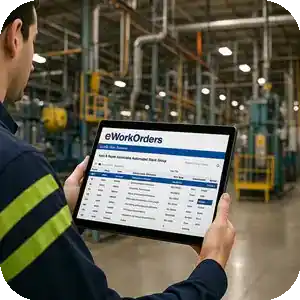
Why Manufacturing Maintenance Is Different
Preventive maintenance in manufacturing focuses on servicing production equipment before failures occur to maintain uptime and protect throughput. The fundamentals are the same as any preventive maintenance program. What changes on a production floor is the cost of getting it wrong.
- Every hour of downtime has a production cost. A stopped line idles operators, delays orders, and can scrap work in process.
- Maintenance windows are tight. PM has to fit into changeovers, planned stops, weekends, and shift gaps.
- Duty cycles vary. A machine running three shifts wears much faster than one running a single shift, so calendar-only schedules miss.
- Failures affect quality, not just uptime. Worn tooling, misalignment, and drifting calibration show up as defects before they show up as breakdowns.
The gap between reactive and planned plants is measurable. NIST found that the most reactive U.S. manufacturers had 3.3 times more downtime and 16 times more defects than the least reactive.
Critical Assets That Need PM First
Start with the equipment that stops production when it fails. In most plants, that list includes:
- CNC machines and machining centers: spindle and way lubrication, coolant condition, chip removal, and axis calibration.
- Conveyors: belt tension and tracking, roller and bearing checks, and drive inspection.
- Hydraulic and mechanical presses: fluid level and condition, hose and seal inspection, and safety guard checks.
- Air compressors: filter changes, drain checks, oil service, and leak inspection.
- Motors, pumps, and gearboxes: lubrication, vibration and temperature readings, and alignment.
- Industrial robots: cable and connector inspection, lubrication, and calibration checks.
- Electrical panels and motor control centers: visual and thermal inspection and connection checks.
- Dust collection and ventilation: filter changes and airflow checks.
Rank each asset by what a failure would cost you: lost production, safety risk, repair cost, and how long a replacement part takes to arrive. The top of that list gets PM first.
How to Schedule PM Around Production
A PM schedule that ignores the production plan gets skipped. Build it to fit.
Use the OEM interval as your starting point
Start with the manufacturer’s recommendations, then adjust using your own failure history. If a component keeps failing before its scheduled service, shorten the interval.
Trigger PM by usage where duty cycles vary
Set PM on operating hours, cycle counts, or parts produced instead of the calendar. That way a machine running three shifts gets serviced three times as often as one running a single shift.
Plan PM into planned stops
Line up PM with changeovers, scheduled downtime, and weekend shutdowns. Agree on those windows with production in advance, so maintenance is part of the plan instead of an interruption.
Stage parts before the window opens
A PM that waits on a filter or a belt runs into production time. Have parts pulled and ready before the machine comes down.
How a CMMS Supports Manufacturing PM
Spreadsheets and whiteboards work until you have dozens of machines, three shifts, and a team that changes every year. Preventive maintenance software keeps the schedule running without someone remembering every date.
- Scheduled PM work orders. eWorkOrders schedules preventive maintenance by date or meter-based usage, such as run hours. Once a PM schedule is set up, its work orders come due on that schedule.
- Checklists on PM work orders. A checklist with the steps, readings, and pass/fail criteria can be attached to PM-generated work orders, so every technician does the job the same way.
- Asset history in one place. eWorkOrders maintains each asset’s work order and maintenance history in the asset record in your asset management (EAM) system, which is the data you use to adjust intervals.
- Parts tied to the job. Spare parts link to the assets that use them, so you can see what is on hand before the window opens.
- Compliance and backlog reporting. Dashboards show which PMs are done, overdue, or coming due, by machine, line, or technician.
Every PM runs through the same work order management process as your repairs, so planned and unplanned work sit in one record. See how this works on the plant floor on our manufacturing maintenance software page.
Best Practices for Manufacturing PM
- Track PM compliance every week. SMRP best practices put the target at 90% or higher of PMs completed on time.
- Measure planned work, not just PM. SMRP’s target for planned maintenance percentage is 85% or higher. If most of your hours are still reactive, the schedule isn’t working yet.
- Watch OEE availability. PM shows up in the availability component of OEE first, because fewer unplanned stops mean more run time.
- Let your data move the intervals. Rising time between failures means the program is working. Falling time between failures means an interval is wrong.
- Close the work order the same shift. Readings, findings, and parts used are only useful if they’re recorded while the technician still remembers them.
The payoff is documented. The U.S. Department of Energy estimates a preventive maintenance program delivers 12–18% cost savings compared with reactive maintenance.
Keep Every Machine on Schedule
See how eWorkOrders helps your maintenance team schedule preventive maintenance, track inspections, and turn problems into work orders before small issues become costly downtime. See how it works in a free, personalized demo.
Frequently Asked Questions
How does preventive maintenance reduce manufacturing downtime?
Preventive maintenance finds wear, misalignment, leaks, and lubrication problems during planned inspections, before they stop the line. Because the work happens during scheduled windows such as changeovers or weekend stops, downtime is planned and short instead of sudden and long. NIST found the most reactive U.S. manufacturers had 3.3 times more downtime than the least reactive.
What equipment needs preventive maintenance in factories?
Start with equipment that stops production when it fails: CNC machines, conveyors, presses, air compressors, motors, pumps, gearboxes, industrial robots, electrical panels, and dust collection systems. Rank each asset by the cost of a failure and put the highest-risk equipment on PM first.
How often should manufacturing equipment get preventive maintenance?
Start with the manufacturer’s recommended interval, then adjust using your own failure history. For equipment with variable duty cycles, trigger PM by operating hours, cycle counts, or parts produced instead of calendar dates, so heavily used machines are serviced more often.
What should a manufacturing PM checklist include?
A manufacturing PM checklist should include the asset ID and location, lockout/tagout steps, required parts and tools, each inspection task with the reading to record and its acceptable range, lubrication and service tasks, and a sign-off with the technician’s name and the date.
Part of the eWorkOrders Learning Center
2. National Institute of Standards and Technology — Economics of Manufacturing Machinery Maintenance (NIST AMS 100-34), 2020
3. U.S. Department of Energy — Operations & Maintenance Best Practices Guide, Chapter 5
4. Society for Maintenance & Reliability Professionals (SMRP) — Best Practices, 6th Edition
Third-party figures: Statistics on this page come from the publishers listed above and reflect their own data, methods, and study populations. Deloitte’s estimate covers industrial manufacturers. NIST’s figures come from its 2020 survey of U.S. manufacturers. The DOE savings estimate compares preventive programs with reactive maintenance. Your results will depend on your equipment, operations, and starting point.


