LDAR: How Leak Detection and Repair Programs Work
Leak Detection and Repair is a required program at refineries, chemical plants, and gas processing facilities. Strip away the regulation, and what you have is a large recurring inspection route with a repair clock attached — and no room for missed paperwork. This guide covers what you tag, how technicians monitor it, what counts as a leak, how long you have to make repairs, and what inspectors will want to see.
What LDAR Is
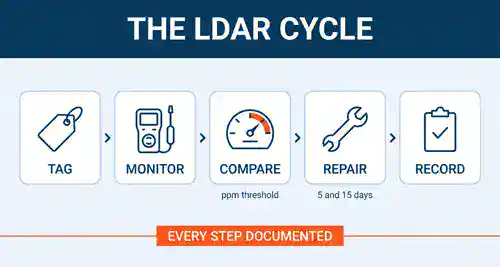
Leak Detection and Repair (LDAR) is a program for finding and fixing leaks from process equipment. A technician checks tagged components on a set schedule, measures what is leaking, and repairs anything over the allowed limit within the required timeframe.
The Environmental Protection Agency (EPA) requires these regulations under a list of air RULES (regulations that control what a facility can release into the air). The rules cover things like refineries, chemical plants, and other facilities where equipment can release regulated pollutants. EPA guidance lists 25 federal standards that can require a formal LDAR program, along with additional state and local requirements.
Why it exists
To begin with, leaking equipment adds up. The Environmental Protection Agency reports that a typical refinery or chemical plant can emit 600 to 700 tons a year of volatile organic compounds from leaking equipment. Valves alone account for an estimated 40,000 tons a year across petroleum refineries.
However, none of that comes from a single dramatic failure. It comes from thousands of small leaks at valve stems, pump seals, and threaded connections, most of which no one would notice without a meter.
Who it applies to
Petroleum refineries, chemical manufacturing plants, natural gas processing facilities, and some pharmaceutical and coatings operations. Whether a rule covers a specific unit depends on what it processes, when the plant built it, and which subpart applies. Your air permit is the document that answers it.
The rules are not uniform, and this article cannot tell you which apply to you. Leak thresholds, monitoring frequencies, and repair deadlines all change depending on which standard a unit falls under. The figures here are the common ones from the agency’s guidance. Your permit and your applicable subpart are what govern your site.
The Five Parts of an LDAR Program
The Environmental Protection Agency describes five basic elements. Every one of them is a maintenance management task before it is a compliance task.
1. Identifying components
Every regulated component gets an identification number and goes on a list. Valves, connectors, pumps, compressors, pressure-relief devices, open-ended lines, and sampling connections. A single unit can carry tens of thousands of tagged points.
In fact, this is where most programs fail first. Missing components from the inventory is the deficiency the Environmental Protection Agency lists at the top of its own problem list.
2. Leak definition
Above all, a leak is a number, not a judgment call. Each rule sets a concentration limit in parts per million, and a reading above that limit is a leak that starts the repair clock.
3. Monitoring components
A technician walks the route with a portable analyzer and takes a reading at each tagged point. The procedure is EPA Method 21, described in the agency’s guidance as a procedure used to detect volatile organic compound leaks from process equipment using a portable detecting instrument.
4. Repairing components
Then, once a technician finds a leak, the deadline starts. Repair as soon as practicable, and no later than the number of days the rule allows.
5. Recordkeeping
You document every step, and that documentation is what an inspector audits. The section below covers exactly what you need to keep.
Read that list again as a maintenance manager. A tagged asset register, a recurring inspection route, a measurement compared against a threshold, a corrective repair with a hard due date, and a complete closure record. That is a work order program. The regulation sets the numbers; the execution is maintenance.
What Counts as a Leak
There is no single number. The threshold depends on which rule the unit falls under, and the differences are large. These are the common ones from Environmental Protection Agency guidance.
| Rule type | Common leak definition |
|---|---|
| Most New Source Performance Standards | 10,000 parts per million |
| Many National Emission Standards for Hazardous Air Pollutants | 500 or 1,000 parts per million |
| Certain consent decrees | 250 parts per million for valves and connectors, 500 for pumps |
As a result, a twenty-fold difference between the loosest and tightest threshold changes everything downstream. It changes how many leaks you find, how much repair work the program generates, and how many technician hours you need. Confirm your own limit before planning around any of these numbers.
How often components get checked
Again, frequency varies by component type and by rule. The Environmental Protection Agency’s guidance describes the common pattern:
- Valves: generally monitored once a month
- Pumps: monthly monitoring, plus weekly visual inspections for signs of liquid leaking
- Agitators and compressors: weekly visual inspections for indications of liquids leaking
- Connectors: every 2, 4, or 8 years depending on the rule and performance
In addition, programs that demonstrate good performance over time may qualify to monitor less frequently, sometimes moving from monthly to quarterly. That cuts real labor. However, you earn it with clean records rather than by asking.
Do the arithmetic before you staff the program. Ten thousand valves monitored monthly is 120,000 readings a year. At a few minutes a reading, plus travel between points, that is a full-time route on its own before a single repair happens. The component count and the monitoring frequency together decide the headcount.
The Repair Clock
This is the part that separates LDAR from ordinary maintenance. When a reading crosses the threshold, a deadline starts. Moreover, the rule counts calendar days, not working days.
The Environmental Protection Agency describes the standard requirement this way: repair as soon as practicable, and no later than a specified number of calendar days after the leak is detected. Those days are usually 5 for a first attempt at repair and 15 for final repair.
| Day | What has to happen |
|---|---|
| Day 0 | Leak detected. Record the component identification number, the instrument and operator identification numbers, and the date. |
| By day 5 | Make the first repair attempt and document it, including the method you tried. |
| By day 15 | Final repair complete, with a follow-up reading confirming the component no longer leaks. |
When a repair cannot be made in time
Occasionally, a component cannot be fixed without shutting down the unit. Instead, those go on a delay of repair list, and the crew addresses them at the next scheduled shutdown.
However, that option is also one of the most commonly misused parts of the program. The Environmental Protection Agency lists improperly placing components or units on the delay of repair list among the problems it finds. Delay of repair is a documented technical justification, not a way to clear an overdue queue.
A missed LDAR deadline is not a backlog item. In ordinary maintenance an overdue work order is a scheduling problem you can catch up on. Here the rule fixes the date, the record shows when the technician found the leak, and anyone reading the file can see the gap. Overdue means non-compliant.
Where LDAR Programs Fail
The Environmental Protection Agency publishes the problems it finds most often. Worth reading as a checklist, because none of them are exotic.
Components missing from the inventory
Not identifying all regulated components in the inventory is first on the agency’s list. A component missing from the list never reaches a monitoring route, and nobody notices until an inspector counts. Typically, unit changes, tie-ins, and small piping modifications are how points go missing.
Components not actually monitored
Similarly, the agency flags unrealistic monitoring rates specifically. If the records show one technician reading more points per shift than is physically possible, that is what an inspector will ask about first.
Not holding the probe long enough
Insufficient time to identify a leak is on the list. The instrument needs time to respond. Moving too quickly through a route produces readings that look compliant and are not.
Probe held away from the interface
Holding the probe away from the component interface gives a low reading every time. Method 21 requires the probe at the interface, not near it.
Instruments not maintained or calibrated
Failing to properly maintain the monitoring instrument invalidates the readings it produced. Calibration records are part of the compliance file, not a side note.
Components wrongly marked unsafe or difficult
Improperly identifying components as unsafe or difficult to monitor removes them from the normal schedule. Those designations have criteria, and the agency checks whether you applied them honestly.
Delay of repair misused
Covered above, and worth repeating because it appears on the agency’s list of common problems.
Every one of these is a records problem before it is an emissions problem. The inventory, the route completion, the time on each point, the instrument calibration, the exemption justification, the repair dates. An inspector does not watch your technician work. They read what your system recorded.
What Records You Have to Keep
Environmental Protection Agency guidance sets out what a facility has to maintain. This is the part that decides whether an inspection goes well.
For the program overall
- A list of all identification numbers for equipment subject to an equipment leak regulation
- Detailed schematics, equipment design specifications, and piping and instrumentation diagrams
- Results of performance testing and leak detection monitoring
For every leak found
- The equipment identification number, the instrument identification number, and the operator identification number
- The date the leak was detected
- The date of each repair attempt, with an explanation of the repair method used
- Results confirming the repair was successful
What that means in practice
In practice, you must attach each of those fields to a specific tagged component and keep it retrievable years later. Notice what you must record: not just the technician, but the instrument. If a meter is later found out of calibration, you need to know which readings it produced.
Consequently, spreadsheets struggle here, not because the data is complicated, but because the volume is large and every entry has to tie back to a component identification number, a date, and a person.
Record the instrument, not just the technician. Instrument identification is a required field and it is the one most often left blank. When a calibration check fails, that field is what tells you which readings to re-take. Without it you may have to re-monitor everything that meter touched.
What a Well-Run Program Achieves
LDAR is a requirement, but the numbers behind it are real. Environmental Protection Agency guidance estimates the reduction available from a properly run program:
- Petroleum refineries: a 63% reduction in equipment leak emissions
- Chemical facilities: a 56% reduction
- Control effectiveness overall: 45% to 96%, depending on monitoring interval and leak definition
The agency’s own example facility reached an 89% reduction, cutting roughly 582 tons a year of emissions.
Notably, the spread from 45% to 96% is the interesting part. That range is not about technology. It is about how often you monitor and how tight your leak definition is. A program run at the minimum allowable frequency sits at the bottom of it.
The part that shows up in the maintenance budget
Vapor escaping a seal is product leaving the process. Beyond the compliance case, early finds tend to mean seal and packing repairs rather than pump rebuilds, and a component that is monitored monthly is one you are watching for other reasons too.
Reducing the work at the source
Alternatively, some facilities cut the monitored population instead of monitoring harder. Environmental Protection Agency guidance describes leakless equipment alternatives including bellows valves and diaphragm valves, along with diaphragm pumps, canned motor pumps, and magnetic drive pumps. Where a plant installs these, the component may drop out of the monitoring program entirely.
Admittedly, that is a capital decision rather than a maintenance one, but it belongs in the conversation when a component leaks repeatedly. For example, a valve the crew has repaired four times is a candidate for replacement with something that needs no monitoring.
Where eWorkOrders Fits in an LDAR Program
An LDAR program has two halves. One is the monitoring itself: the analyzer, the Method 21 procedure, the calibration, and the technician trained to use them. The other is everything around it, which is maintenance management.
eWorkOrders handles the second half. It does not perform Method 21 monitoring, optical gas imaging, or emissions calculations. It gives the maintenance team a place to manage the components, the routes, the readings, the repairs, and the records.
What the CMMS Handles
- The tagged component register. The system can carry every monitored valve, connector, pump, and compressor as an asset with its own identification number, location, and service. In most cases, components go missing from an inventory because the register was never the system of record.
- Recurring monitoring routes. The system can schedule monthly valve monitoring, weekly visual checks on pumps and compressors, and multi-year connector intervals to generate work automatically, so the route is issued whether or not someone remembers it.
- Readings recorded against the component. Measurement fields capture the value taken at each point, alongside who took it and when, so the reading lives with the component history instead of on a separate sheet.
- Repairs with a due date that is visible. A leak becomes a corrective work order with an assigned technician and a deadline. The system tracks first attempt and final repair as separate steps, because the rule treats them separately.
- The closure record. Repair date, method attempted, parts used, and the follow-up reading all close against the component, which is the file an inspector asks to see.
- History across years. Because every event attaches to the component, the record shows which points leak again and again, which is what tells you where a leakless alternative is worth the capital.
In short, the regulation sets the thresholds and the deadlines. Your monitoring provider or in-house technician takes the readings. The maintenance system is where all of it becomes scheduled work with a documented outcome.
Confirm your program against your own permit, not this article. Leak definitions, monitoring frequencies, and repair deadlines vary by rule, and a system configured to the wrong numbers will produce records that look complete and are not. Set the intervals and thresholds from your applicable subpart, with your environmental staff or consultant.
Manage the Work Behind Your LDAR Program
Tagged components, recurring monitoring routes, readings recorded against the asset, repairs with a visible deadline, and a closure record you can hand an inspector. eWorkOrders gives your maintenance team one place to run all of it, alongside the rest of your preventive maintenance and work order management. Rated 4.9 stars on Capterra and G2. Over 30 years serving maintenance teams.
Frequently Asked Questions
What does LDAR stand for?
LDAR stands for Leak Detection and Repair. It is a program required by the Environmental Protection Agency for finding and fixing leaks from process equipment at facilities such as petroleum refineries, chemical plants, and natural gas processing plants. Technicians monitor tagged components on a set schedule, and anything reading above a defined limit must be repaired within a fixed number of days.
What equipment is covered by an LDAR program?
Environmental Protection Agency guidance identifies valves, connectors, pumps, sampling connections, compressors, pressure-relief devices, and open-ended lines. A typical refinery or chemical plant can emit 600 to 700 tons a year of volatile organic compounds from leaking equipment of this kind. A single unit can carry tens of thousands of individually tagged points.
What is EPA Method 21?
Method 21 is the procedure used to detect volatile organic compound leaks from process equipment using a portable detecting instrument. A technician places the probe at the component interface and records the concentration in parts per million. Holding the probe away from the interface, or not allowing enough time for the instrument to respond, are two of the errors the Environmental Protection Agency identifies most often.
What counts as a leak under LDAR?
It depends on which rule the unit falls under. Most New Source Performance Standards use 10,000 parts per million. Many National Emission Standards for Hazardous Air Pollutants use 500 or 1,000 parts per million. Some consent decrees set 250 parts per million for valves and connectors and 500 for pumps. Confirm the threshold that applies to your unit from your permit and applicable subpart rather than from a general figure.
How long do you have to repair an LDAR leak?
Environmental Protection Agency guidance sets the clock in calendar days from the date the leak is detected. The usual deadlines are 5 days for a first repair attempt and 15 days for final repair. Components that cannot be fixed without a unit shutdown may go on a delay of repair list. The agency identifies misuse of that list as a common compliance problem.
How often do LDAR components have to be monitored?
Frequency depends on the component and the rule. Valves are generally monitored once a month. Pumps are monitored monthly, with weekly visual inspections for signs of liquid leaking, as are agitators and compressors. Connectors are typically monitored every 2, 4, or 8 years. Facilities that demonstrate good performance may qualify to monitor less frequently, for example moving from monthly to quarterly.
What records does an LDAR program require?
For the program: a list of identification numbers for all regulated equipment, detailed schematics and piping and instrumentation diagrams, and results of performance testing and monitoring. For each leak: the equipment identification number, the instrument and operator identification numbers, and the date it was detected. Then the date of each repair attempt, an explanation of the method used, and results confirming the repair worked.
Can a CMMS run an LDAR program?
A CMMS handles the maintenance-management side: the tagged component register, recurring monitoring routes, readings recorded against each component, repairs with an assigned owner and a due date, and the closure records an inspector reviews. It does not perform the monitoring itself. Trained personnel and dedicated equipment handle the Method 21 readings, optical gas imaging, instrument calibration, and emissions calculations. In eWorkOrders, your team schedules and closes monitoring routes and leak repairs as work orders against the specific component, so the history stays with the asset.
Sources
2. U.S. Environmental Protection Agency — Method 21: Determination of Volatile Organic Compound Leaks
Important Notes and Disclaimers
Regulatory scope: Leak definitions, monitoring frequencies, repair deadlines, and recordkeeping requirements vary by which standard a unit falls under, and by state and local requirements. The figures in this article are the common ones described in Environmental Protection Agency guidance and are provided for general education only. They are not a statement of what applies to your facility. Confirm your requirements from your air permit, your applicable subpart, and your environmental staff or consultant.
Not compliance advice: This is a general educational guide, not legal, regulatory, environmental, or engineering advice. Nothing here should be relied on to determine whether a facility is in compliance. Monitoring must be performed by appropriately trained personnel using properly calibrated instruments.
Third-party sources: Figures are cited to their publishers and may be revised. Citation does not imply endorsement in either direction.
About the Author
Janet Jaquis is a CMMS software specialist with over 8 years at eWorkOrders, where she develops educational content, technical guides, and implementation resources for maintenance management professionals. Her work covers preventive maintenance, work order management, asset reliability, inventory management, and CMMS implementation across manufacturing, healthcare, government, food and beverage, and facilities operations, grounded in customer case studies, industry research, and ongoing engagement with the eWorkOrders product team.


