OSHA Maintenance Regulations: The Standards That Apply to Your Team
There is no single OSHA standard called “maintenance.” Instead, maintenance work is governed by a set of standards covering hazardous energy, machine guarding, cranes, forklifts, electrical work, and confined spaces — each with its own inspection interval and its own documentation requirement.
Which OSHA Regulations Apply to Maintenance Work?
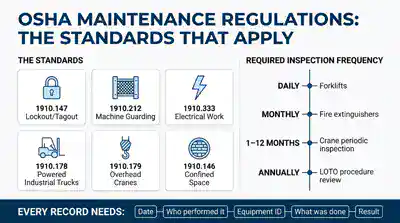
Maintenance work falls under 29 CFR Part 1910 for general industry. The standards most often triggered are lockout/tagout (1910.147), machine guarding (1910.212), electrical work practices (1910.333), powered industrial trucks (1910.178), overhead cranes (1910.179), permit-required confined spaces (1910.146), portable fire extinguishers (1910.157), and process safety management (1910.119).
Underneath all of them sits the General Duty Clause. Section 5(a)(1) of the Occupational Safety and Health Act of 1970 states that each employer “shall furnish to each of his employees employment and a place of employment which are free from recognized hazards that are causing or are likely to cause death or serious physical harm to his employees.” Section 5(a)(2) adds that employers “shall comply with occupational safety and health standards promulgated under this Act.”
That first clause matters because it applies where no specific standard does. If a recognized hazard exists in your maintenance operation and OSHA has not written a rule about it, the General Duty Clause is the citation.
This article is general information, not legal advice. Requirements vary by industry, jurisdiction, and the specific equipment in your facility. There are 29 OSHA-approved State Plans — 22 covering private sector plus state and local government workers, and seven covering state and local government workers only. State Plans must be at least as effective as federal OSHA and are sometimes stricter. Verify against the current CFR text and your own counsel before acting. The full disclaimer is at the end of this article.
Where Maintenance Shows Up in OSHA’s Most-Cited List
OSHA publishes the standards it cites most often each fiscal year. Three of the top ten for FY 2025 sit squarely in maintenance territory.
| Rank | Standard | Subject |
|---|---|---|
| 2 | 1910.1200 | Hazard Communication |
| 4 | 1910.147 | Control of Hazardous Energy (lockout/tagout) |
| 5 | 1910.134 | Respiratory Protection |
| 8 | 1910.178 | Powered Industrial Trucks |
| 10 | 1910.212 | Machine Guarding |
Lockout/tagout at number four is the one worth pausing on. It is not a hazard that arises during production — it arises during servicing and maintenance. Every citation in that column came from work your department does.
OSHA Inspection Frequencies Maintenance Teams Must Meet
Several OSHA standards specify how often equipment must be inspected. Lockout/tagout procedures require a periodic inspection at least annually. Powered industrial trucks must be examined at least daily. Fire extinguishers need a monthly visual inspection and an annual maintenance check. Overhead cranes require frequent inspections at daily to monthly intervals and periodic inspections at one to twelve month intervals.
The Intervals, by Standard
| Standard | What | How often |
|---|---|---|
| 1910.147(c)(6)(i) | Periodic inspection of energy control procedures | At least annually |
| 1910.178(q)(7) | Examination of powered industrial trucks | At least daily, or after each shift if run around the clock |
| 1910.157(e)(2) | Visual inspection of portable fire extinguishers | Monthly |
| 1910.157(e)(3) | Extinguisher maintenance check | Annually, record kept one year |
| 1910.157(f)(2) | Extinguisher hydrostatic testing | 5 to 12 years, per Table L-1 by type |
| 1910.179(j)(1)(ii) | Crane “frequent” inspection | Daily to monthly |
| 1910.179(j)(1)(ii) | Crane “periodic” inspection | 1 to 12 months |
| 1910.119(j)(4)(iii) | PSM process equipment inspection and testing | Per manufacturer recommendations and good engineering practice |
Note what the last row does not say. Process safety management sets no fixed calendar. Under 1910.119(j)(4)(iii), frequency must be “consistent with applicable manufacturers’ recommendations and good engineering practices, and more frequently if determined to be necessary by prior operating experience.” You set the interval, and you have to be able to defend how you set it.
Lockout/Tagout: The Standard Written for Maintenance
Among all the standards here, 1910.147 is the one aimed directly at servicing and maintenance activities. Three requirements carry most of the citations.
A Written Energy Control Procedure
Under 1910.147(c)(4)(i), “Procedures shall be developed, documented and utilized for the control of potentially hazardous energy when employees are engaged in the activities covered by this section.” Paragraph (c)(4)(ii) requires those procedures to spell out scope, purpose, authorization, rules, techniques for controlling hazardous energy, and how compliance will be enforced.
A generic one-page policy does not satisfy this. Procedures are expected to be equipment-specific, because the isolation points differ from machine to machine.
An Annual Periodic Inspection
Paragraph (c)(6)(i) requires that “The employer shall conduct a periodic inspection of the energy control procedure at least annually to ensure that the procedure and the requirements of this standard are being followed.” An authorized employee other than the one using the procedure performs it, and the inspection is a review of practice, not paperwork.
Training
Under (c)(7)(i), training must ensure employees understand the purpose and function of the energy control program and have acquired the knowledge and skills for safe application, usage, and removal of energy controls.
Electrical work adds a parallel obligation. Standard 1910.333(a)(1) requires that live parts be de-energized before employees work on or near them, unless the employer can demonstrate that de-energizing introduces greater hazards or is infeasible.
What OSHA Expects You to Have Documented
Several standards specify not only that an inspection happen, but what the record must contain. Missing records are treated as a missing inspection.
- Crane hook and chain inspections — 1910.179(j)(2). Monthly inspection with a certification record showing the inspection date, the inspector’s signature, and an identifier for the hook or chain. Records are kept on file where readily available to appointed personnel.
- Fire extinguisher maintenance — 1910.157(e)(3). Record the annual maintenance date and retain it for one year after the last entry, or the life of the shell, whichever is less.
- Extinguisher hydrostatic testing — 1910.157(f)(16). Evidence must include the test date, the signature of the person who performed it, and the serial number or other identifier.
- PSM equipment — 1910.119(j)(4)(iv). Each inspection and test must be documented with the date, the name of the person who performed it, the equipment identifier, a description of what was performed, and the results.
- Confined space entry — 1910.146(e)(1). “Before entry is authorized, the employer shall document the completion of measures required by paragraph (d)(3) of this section by preparing an entry permit.” A written permit space program is required under (c)(4).
The pattern is consistent. Date, who performed it, which asset, what was done, what was found. Four of the five standards above ask for a signature or a name. A checkbox on a shared spreadsheet with no attribution satisfies none of them.
What a Citation Costs
For violations assessed after January 15, 2026, OSHA’s maximum penalty is $16,550 per violation for serious, other-than-serious, and posting violations, and $165,514 per violation for willful or repeated violations. Failure to abate carries $16,550 per day beyond the abatement date.
Penalty amounts are subject to annual inflation adjustment, so verify the current figure on OSHA’s penalties page before quoting it in a budget request.
Two details are worth understanding. Failure to abate accrues daily, which means an unresolved citation compounds while the paperwork moves. And a repeat violation is priced at ten times a serious one — so the same finding at a second site, or the same finding twice at one site, is a categorically different event.
Where a CMMS Fits
Software does not make an organization compliant. Compliance comes from doing the work, training people properly, and correcting hazards. What a CMMS does is make the inspections happen on schedule and produce the records that prove they did.
Look again at what those standards ask for: a fixed interval, a named person, an equipment identifier, a description, a result, and a retained record. That list describes a work order.
What eWorkOrders Covers
- Recurring PM scheduling. Annual LOTO procedure reviews, monthly extinguisher checks, and crane inspection cycles scheduled as recurring work orders rather than reminders in someone’s calendar. See preventive maintenance.
- Work order records with attribution. Date, technician, asset, checklist results, and digital signature captured when the work is done. See work order management.
- Asset history. A permanent per-asset record, so an inspector asking for two years of crane inspections gets one search rather than a filing-cabinet hunt. See asset management.
- Meter-based triggers. Schedule from runtime or cycles where the manufacturer specifies usage-based intervals. See meter readings.
- Document management. Equipment-specific LOTO procedures and permit forms attached to the asset they belong to. See document management.
- LOTO program management. Procedure libraries, periodic inspections, and 1910.147 documentation. See lockout tagout software.
Whether an inspection actually happened is a management question. Whether you can prove it happened is a records question, and records are what a CMMS is for.
Make Your Inspection Records Audit-Ready
Recurring PM schedules, signed work order records, and searchable asset history — so when an inspector asks for two years of documentation, you can produce it. Rated 4.9 stars on Capterra and G2. Over 30 years serving maintenance teams.
Frequently Asked Questions
Is there one OSHA standard for maintenance?
No. Maintenance work is covered by several standards in 29 CFR Part 1910, including lockout/tagout (1910.147), machine guarding (1910.212), electrical safety-related work practices (1910.333), powered industrial trucks (1910.178), overhead and gantry cranes (1910.179), permit-required confined spaces (1910.146), and portable fire extinguishers (1910.157). Where no specific standard addresses a recognized hazard, the General Duty Clause in Section 5(a)(1) of the OSH Act applies.
How often does OSHA require a lockout/tagout inspection?
At least annually. Standard 1910.147(c)(6)(i) requires the employer to conduct a periodic inspection of the energy control procedure at least annually to ensure the procedure and the requirements of the standard are being followed.
How often must forklifts be inspected under OSHA?
At least daily. Under 1910.178(q)(7), industrial trucks must be examined before being placed in service and shall not be placed in service if the examination shows any condition adversely affecting safety. Where trucks run around the clock, they must be examined after each shift.
What maintenance records does OSHA require?
Requirements vary by standard, but the pattern is consistent: the date, the person who performed the work, an identifier for the equipment, a description of what was performed, and the result. Standard 1910.119(j)(4)(iv) states all five explicitly for process equipment. Crane certification records under 1910.179(j)(2) and extinguisher testing records under 1910.157(f)(16) require a signature and an equipment identifier.
What is the General Duty Clause?
Section 5(a)(1) of the Occupational Safety and Health Act of 1970 requires each employer to furnish employment and a place of employment free from recognized hazards that are causing or are likely to cause death or serious physical harm. It allows OSHA to cite a recognized hazard even when no specific standard covers it.
How much is an OSHA fine?
For violations assessed after January 15, 2026, the maximum is $16,550 per violation for serious, other-than-serious, and posting violations, and $165,514 per violation for willful or repeated violations. Failure to abate carries $16,550 per day beyond the abatement date. OSHA penalty amounts are subject to annual inflation adjustment, so confirm the current figures on OSHA’s penalties page.
Does a CMMS make us OSHA compliant?
No software makes an organization compliant. Compliance comes from performing the work, training employees, and correcting hazards. A CMMS schedules required inspections so they are not missed, and captures the date, technician, asset, and result that most standards require as documentation. It supports compliance rather than delivering it.
Sources
2. 29 CFR 1910.147 — Control of hazardous energy (lockout/tagout) ·
3. Powered industrial trucks — 29 CFR 1910.178 ·
4. Overhead and gantry cranes — 29 CFR 1910.179 ·
5. Portable fire extinguishers — 29 CFR 1910.157 ·
6. Process safety management — 29 CFR 1910.119 ·
7. Permit-required confined spaces — 29 CFR 1910.146 ·
8. Electrical safety-related work practices — 29 CFR 1910.333 ·
9. Machine guarding, general requirements — 29 CFR 1910.212 ·
10. Top 10 most frequently cited standards, FY 2025 — OSHA ·
11. Penalties — OSHA ·
12. State Plans — OSHA
Important Legal Notice
Not legal advice. This article is general educational information about federal OSHA standards as published on osha.gov. It is not legal advice, regulatory guidance, or a compliance opinion, and reading it creates no advisory relationship. eWorkOrders is a software provider, not a law firm, consultancy, or certifying body, and does not represent that following this article will achieve or maintain compliance with any regulation.
Verify the current text. Regulations, paragraph numbering, and penalty amounts change. Quoted requirements reflect the CFR text and OSHA pages as published at the time of writing, and penalty figures reflect the adjustment effective after January 15, 2026. Always confirm against the current official text at osha.gov and the Electronic Code of Federal Regulations before acting.
State plans and scope. OSHA has approved 29 State Plans — 22 covering both the private sector and state and local government workers, and seven covering state and local government workers only. State Plans must be at least as effective as federal OSHA and may impose additional or stricter requirements. Coverage also differs by industry — construction (29 CFR Part 1926), maritime, and agriculture are governed by separate parts not addressed here. Determine which requirements apply to your facility, jurisdiction, and equipment with qualified safety and legal professionals.
About the Author
Janet Jaquis is a CMMS software specialist with over 8 years at eWorkOrders, where she develops educational content, technical guides, and implementation resources for maintenance management professionals. Her work covers preventive maintenance, work order management, asset reliability, inventory management, and CMMS implementation across manufacturing, healthcare, government, food and beverage, and facilities operations, grounded in customer case studies, industry research, and ongoing engagement with the eWorkOrders product team.


