How Maintenance Has Kept American Industry Running for 250 Years
As the United States marks 250 years of independence, the inventions get the headlines — but it’s maintenance that made them last. This is the story of the work that has quietly kept America running — and the people who do it.
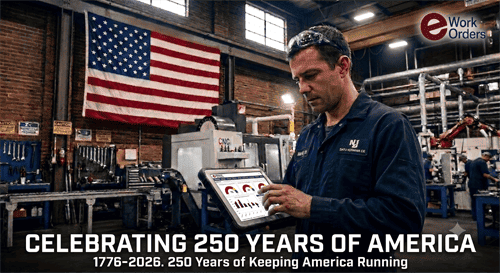
On July 4, 2026, the United States marks 250 years of independence — a quarter of a millennium of invention, grit, and growth. We usually tell that story through inventors and breakthroughs: the cotton gin, the assembly line, the power grid, the microchip.
But there’s a quieter story running underneath all of it. Every machine America ever built had to be kept running — repaired, inspected, maintained — or it ground to a halt. Maintenance has been there in every era of American industry, usually without credit. This Independence Day, that’s the story we want to tell — 250 years of keeping America running — because at eWorkOrders, it’s the work we think about every day.
250 Years of Keeping America Running
Maintenance is as old as American industry itself. When Samuel Slater built the first water-powered cotton-spinning mill in Pawtucket, Rhode Island, in 1793, he didn’t just start the American factory system — he created the country’s first machines that someone had to keep running. From that moment on, every mill in America needed a person who could hear a bearing going bad and fix it before the line stopped.
A few years later, Eli Whitney’s push for interchangeable parts changed maintenance forever. Once components were uniform, a broken part could be swapped out instead of the whole machine rebuilt by hand. That single idea — replace the worn part, restore the machine — is still the foundation of how maintenance works today, more than two centuries later.
As the country industrialized, the stakes of not maintaining kept rising. The railroads that tied the nation together after 1869 ran on rails and locomotives that had to be inspected and repaired across thousands of miles — the first time reliability became a matter of national safety. When Henry Ford’s moving assembly line arrived in 1913 and cut the build time of a Model T from over twelve hours to about ninety minutes, a line that productive simply could not be allowed to stop — so keeping it running became a competitive weapon. And during World War II, as American factories became the “Arsenal of Democracy,” they ran around the clock, and the maintenance crews who kept them from faltering were as essential to the war effort as anyone on the floor.
Through every one of those eras, the machines and the milestones got the headlines. But it was maintenance — steady, skilled, mostly invisible — that made them last.
From the Wrench to the Work Order
For most of those 250 years, the work itself was reactive: something broke, and a skilled worker fixed it. The knowledge lived in people’s heads and hands, and the records lived on paper — logbooks, index cards, work-order slips on clipboards, binders of equipment manuals. It worked, but history got lost and scheduling lived mostly in someone’s memory.
Then maintenance matured from a craft into a discipline. The idea took hold that you could prevent failures on a schedule rather than just react to them. Japanese manufacturers built maintenance into everyone’s job through Total Productive Maintenance in the 1970s. The U.S. aviation industry produced Reliability-Centered Maintenance, which proved that more maintenance isn’t always better — the goal is the right maintenance at the right time.
The tools followed the thinking. The first computerized maintenance management systems appeared in the 1960s on mainframes fed by punch cards, affordable only to the largest companies. They moved to desktop computers in the 1980s and 90s, to the cloud in the 2000s, and into technicians’ pockets in the 2010s — paired with sensors that can now predict a failure before it happens. The paper logbook became a single searchable system you can reach from the plant floor.
That’s what a modern CMMS — a Computerized Maintenance Management System — does for a facility today:
- Reduces unplanned downtime by scheduling preventive maintenance before equipment fails.
- Extends the life of expensive assets through consistent, documented upkeep.
- Keeps technicians productive with clear, prioritized work orders on their phones or tablets.
- Keeps facilities compliant and audit-ready with a complete, time-stamped history.
- Controls costs by tracking labor, parts, and inventory in one place.
It’s the same goal that drove that mill worker in 1793 — keep the operation running — with tools the mill worker who started it all could never have imagined.
The People Who Keep America Running
As the country enters its next 250 years, the things that keep it going are more complex than ever — advanced manufacturing, energy and water systems, hospitals, schools, transit, and facilities of every kind. All of it depends on equipment that has to work. And all of it depends on people.
The maintenance technicians, plant managers, and facilities teams who do this work rarely make the headlines. There’s no monument to the person who caught the failing bearing or kept the line moving through a long night shift. But they are the direct continuation of a 250-year-old American tradition: the people who make things, fix things, and keep things running.
That’s the legacy worth celebrating this Independence Day — not just what America has built, but everyone who has kept it working.
A Note From eWorkOrders
We’re proud to play a small part in that story. Our CMMS software helps American businesses — across manufacturing, facilities, fleet, government, and more — maintain the operations that keep this country moving forward. Here’s to 250 years of American industry, and to everyone who keeps it running. 🇺🇸
Frequently Asked Questions
What is the history of maintenance?
Maintenance is as old as industry itself. In the first American mills of the 1790s it was reactive — a skilled worker repaired equipment when it broke. Over the next two centuries it matured into a discipline: scheduled preventive maintenance, then reliability-centered and predictive maintenance, supported by computerized systems that replaced paper logbooks. Its core purpose has never changed: keep equipment running reliably and safely.
When did preventive maintenance begin?
Preventive maintenance — servicing equipment on a schedule before it fails rather than fixing it afterward — took hold through the industrial era of the 20th century. It was formalized further by Total Productive Maintenance in the 1970s and by Reliability-Centered Maintenance, set out in a 1978 report for the U.S. Department of Defense.
How was maintenance tracked before computers?
For most of industrial history, maintenance was recorded on paper — logbooks, index cards, work-order slips on clipboards, and binders of equipment manuals. Schedules depended largely on memory, and records were easily lost. The first computerized systems in the 1960s began replacing paper with punch cards fed into mainframe computers.
When was the first maintenance software (CMMS) created?
The first computerized maintenance management systems (CMMS) appeared in the 1960s, when large manufacturers recorded work-order data on punch cards read by mainframe computers. The technology moved to minicomputers in the 1980s, PCs in the 1990s, the web and cloud in the 2000s, and mobile devices with IoT sensors in the 2010s.


