Maintenance management has evolved far beyond fixing equipment after it fails. Today, it directly impacts uptime, operational costs, safety compliance, and asset lifecycle performance.
As production demands increase and skilled labor becomes more constrained, organizations must adopt smarter maintenance strategies supported by modern CMMS software.
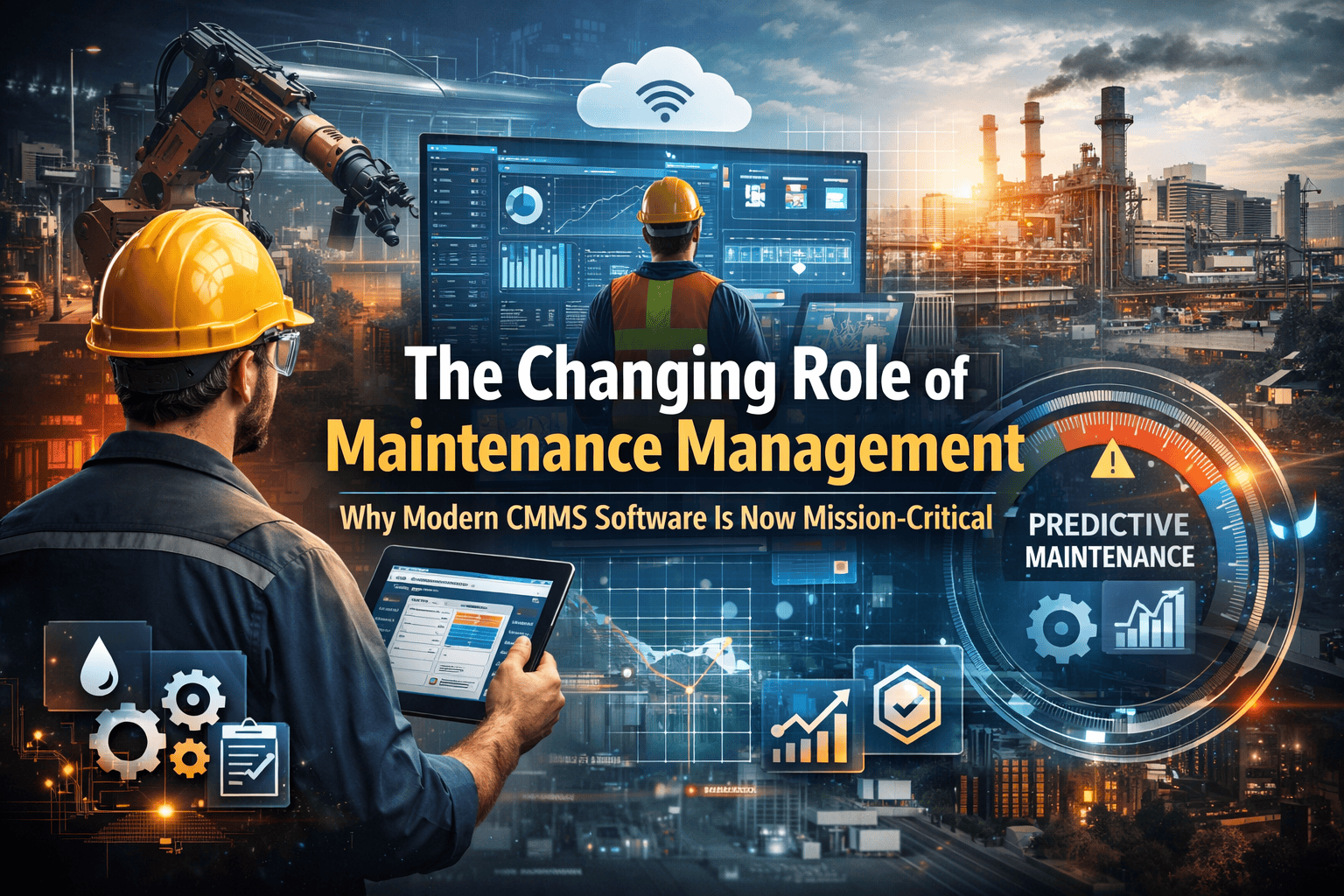
Why CMMS Software Plays a Strategic Role in Maintenance Management
Maintenance leaders are increasingly expected to demonstrate measurable business value through improved availability, cost control, and compliance.
Modern CMMS software enables organizations to:
- Transition from reactive to preventive and predictive maintenance
- Improve work order management and task prioritization
- Optimize asset lifecycle management and capital planning
- Provide technicians with mobile CMMS access
- Gain real-time visibility into labor, inventory, and maintenance costs
- Maintain audit-ready maintenance documentation
Operational Challenges Driving CMMS Adoption
Organizations adopt CMMS software to address persistent maintenance challenges:
- Unplanned equipment failures and downtime
- Manual, paper-based maintenance processes
- Limited asset condition visibility
- Inefficient labor scheduling and forecasting
- Communication gaps across teams
Disconnected tools cannot scale to meet modern maintenance demands.
CMMS as the Central Hub for Maintenance Operations
A modern CMMS serves as a single source of truth for maintenance operations.
- Corrective, preventive, and predictive work orders
- Asset hierarchies and service histories
- Labor tracking and contractor management
- Spare parts inventory and purchasing
- Maintenance KPIs and reporting dashboards
Predictive Maintenance: Moving Beyond Scheduled Maintenance
Predictive maintenance uses real-time data to detect early warning signs of failure.
- Reduce unplanned downtime
- Improve maintenance scheduling accuracy
- Extend asset service life
- Optimize spare parts inventory
- Lower maintenance costs
Maintenance Automation Improves Productivity and Accuracy
- Automatic work order creation
- Preventive maintenance scheduling
- Automated alerts and notifications
- Labor and materials tracking
- Audit-ready documentation
Mobile CMMS Software Is Now Essential
- Real-time access to work orders and assets
- Barcode and QR code scanning
- Photo and video documentation
- Offline functionality
- Instant updates and notifications
Scalable CMMS Software Supports Long-Term Growth
- Single-site and multi-site operations
- Modular feature expansion
- Role-based access control
- Fast onboarding and configuration
Evaluating CMMS Software by Total Cost of Ownership
- Implementation and deployment effort
- Training and adoption
- Scalability and flexibility
- Ongoing support
Conclusion: Turning Modern Maintenance Strategy into Action
Maintenance management is becoming more proactive, data-driven, and strategically aligned with organizational goals.
Modern CMMS platforms enable reliability, cost control, and long-term maintenance excellence.
Frequently Asked Questions (FAQs)
What is CMMS software?
CMMS software is a computerized maintenance management system used to manage work orders, assets, labor, and inventory.
How does CMMS software reduce downtime?
It enables preventive and predictive maintenance and improves asset visibility.
Why is mobile CMMS important?
Mobile CMMS allows technicians to work efficiently in the field with real-time access to data.


