When a $2.4 Million Reporting Gap Forced a Facilities Director to Rethink Deferred Maintenance Strategy.
Keep reading to find out how one audit reshaped a university’s approach to deferred maintenance.
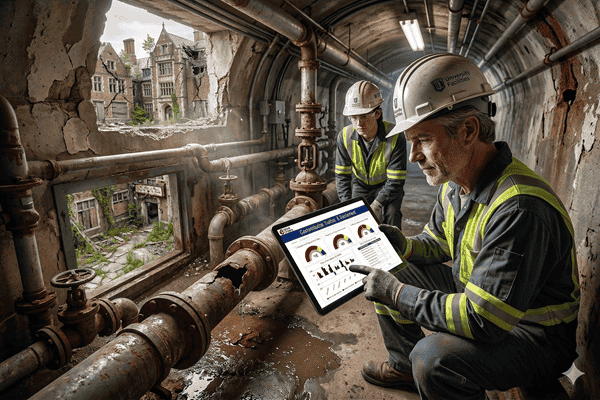
Across higher education, aging infrastructure and limited capital budgets make deferred maintenance an unavoidable operational reality. Universities manage complex physical assets that require continuous oversight, documentation, and lifecycle planning.
Industry Perspective
The Association of Physical Plant Administrators (APPA) has consistently identified deferred maintenance as one of the most significant long-term challenges facing colleges and universities. Effective asset lifecycle planning and preventive maintenance programs help institutions improve facility reliability, prioritize capital investments, and support long-term campus sustainability.
Sid oversees facilities operations for a multi-building public university campus. With the annual board review approaching, he prepares to present the institution’s infrastructure position. His biggest concern is ensuring that the deferred maintenance backlog he reports reflects accurate and defensible data.
His core challenge is clear: he must validate his campus maintenance numbers before they are reviewed at the highest level.
Continue reading to understand what happened next.
The Deferred Maintenance Reporting Framework Under Review
Sid manages a campus portfolio that includes academic halls, residence facilities, laboratories, and central mechanical systems. Some buildings are newly renovated, while others operate with decades-old infrastructure. His team coordinates preventive schedules, reactive repairs, and long-term maintenance management planning.
Each year, department heads submit condition reports. These are consolidated into spreadsheets and summarized for leadership review. The process has worked for years, even if it requires manual reconciliation.
For this year’s board meeting, the reported deferred maintenance backlog stands at $38 million. The documentation appears organized.
Historical comparisons look stable. Nothing suggests imminent concern. Yet beneath the surface, asset histories are fragmented across departments, and lifecycle data is not consistently centralized.
The $2.4 Million Deferred Maintenance Gap That Stalled Funding
The tension begins during a capital planning review tied to state funding eligibility. As part of the process, the university undergoes an external facilities audit using formal building-condition assessments and asset lifecycle modeling.
The recalculated number changes everything. The university’s true deferred maintenance exposure turns out to be $40.4 million, $2.4 million higher than originally reported.
Several HVAC systems and air-handling units had exceeded expected service life. Without centralized lifecycle tracking or integrated management documentation, deterioration trends were not fully captured in spreadsheet summaries.
The discrepancy triggers immediate scrutiny. Board members question oversight controls. Finance leaders reassess capital forecasting assumptions. The funding application process is temporarily paused pending revised documentation. What appeared to be a stable reporting exercise now becomes a governance concern.
Guidance from the U.S. Government Accountability Office (GAO) has repeatedly emphasized the importance of reliable facilities data and long-term infrastructure planning to support effective capital investment decisions within public institutions.
Sid attempts to reconcile the variance manually. He gathers updated spreadsheets, requests revised departmental data, and revalidates inspection records. The process reveals deeper issues:
- No centralized CMMS connecting work orders to asset history
- Preventive maintenance records stored in separate systems
- Limited visibility into condition trends across facilities
- Capital planning models not linked to real-time lifecycle data
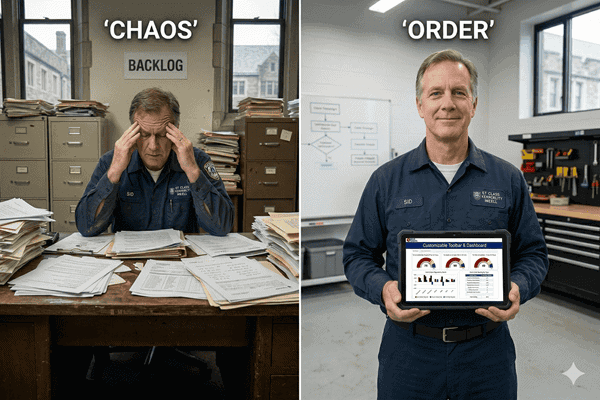
The stakes are significant. Inaccurate deferred maintenance reporting risks delayed funding, weakened board confidence, and long-term financial exposure. The audit forces Sid to rethink the institution’s entire approach to maintenance management.
Discover how structured maintenance management can eliminate uncertainty. → Learn more.
How eWorkOrders’ CMMS Reestablished Visibility Across Deferred Maintenance
The discovery of the true backlog amount serves as a wake-up call for Sid and his team. Sid recognizes that sustainable backlog maintenance control requires structured maintenance management powered by a modern CMMS. His research leads him to eWorkOrders, a cloud-based solution purpose-built for complex institutional environments.
As workloads grew, Ben spent more time tracking status than preventing issues. The operation still functioned, but the margin for error was shrinking across his industrial maintenance environment.
Unlike the spreadsheet process he had relied on for years, eWorkOrders connects every work order directly to specific equipment. HVAC systems, chillers, and air-handling units are no longer summarized in departmental reports. Their runtime data, maintenance history, capital cost, and condition records are continuously updated and accessible in real time.
The system’s configurable workflows ensure that preventive maintenance is scheduled, tracked, and verified consistently across departments, eliminating the reporting inconsistencies that led to the audit gap. Sid decides to implement eWorkOrders.

With eWorkOrder’s customizable toolbar and dashboard improves preventive maintenance with automated monitoring and scheduling.
Within weeks, preventive maintenance compliance improves because tasks are automatically scheduled and monitored. Asset histories that were once fragmented across spreadsheets become centralized and searchable. Reporting dashboards provide immediate visibility into asset condition trends and backlog projections. Deferred maintenance calculations are now supported by documented lifecycle data rather than manual assumptions.
By the next capital planning review, the university presents figures that are traceable to individual asset records within the CMMS. Funding discussions resume with confidence. Deferred maintenance shifts from a reactive estimate to a controlled metric embedded within structured maintenance processes. The audit variance that once exposed vulnerability becomes the catalyst for institutional clarity and long-term infrastructure control.
A Future Secured: The Power of CMMS Solutions
The $2.4 million discrepancy ultimately strengthens the university’s governance framework. By implementing eWorkOrders, Sid replaces fragmented processes with a secure, configurable CMMS designed for higher education complexity.
Unlike heavy enterprise systems, eWorkOrders deploys quickly while supporting sophisticated workflows and asset-level tracking. Its centralized maintenance management capabilities ensure deferred maintenance reporting is accurate, audit-ready, and aligned with long-term capital strategy.
For universities navigating aging infrastructure and increasing financial scrutiny, structured systems are no longer optional. They are foundational to institutional stability.
Discover how eWorkOrders can modernize your maintenance management strategy.
FAQs
Schools can track deferred maintenance more effectively with a centralized CMMS. By connecting work orders, asset histories, and inspection records in one platform, facilities teams get a clear view of equipment condition, overdue repairs, and backlog growth. This makes it easier to prioritize tasks and schedule preventive maintenance across all campus buildings.
Using a CMMS allows maintenance teams to automate preventive maintenance schedules, centralize asset records, and monitor equipment condition in real time. This reduces reactive repairs, helps allocate staff efficiently, and ensures limited resources are focused on the most critical maintenance needs.
Key features include:
1. Centralized work order tracking and asset history.
2. Automated preventive maintenance scheduling.
3. Condition monitoring dashboards to identify high-risk equipment.
4. Reporting tools for compliance and audit-ready documentation.
These features help schools stay organized, reduce deferred maintenance, and maintain campus facilities proactively.
Turning Campus Risk into Measurable Control with eWorkOrders
When deferred maintenance reporting lacks asset-level visibility, financial exposure grows silently. Structured maintenance management systems transform uncertainty into measurable control.
- Centralized CMMS links work orders to asset lifecycle history
- Automated preventive maintenance reduces reactive backlog growth
- Accurate deferred maintenance forecasting supports capital planning
- Audit-ready documentation strengthens governance confidence
- Funding eligibility is protected through defensible reporting
Transform deferred maintenance into measurable outcomes with eWorkOrders built for higher education
References
- Association of Physical Plant Administrators (APPA)
- U.S. Government Accountability Office (GAO)
- National Association of College and University Business Officers (NACUBO)


