Managing facilities has become increasingly complex. Operational costs are rising, equipment is more sophisticated, and the pressure to minimize downtime has never been greater. For decades, maintenance teams have relied on calendar-based schedules and reactive repairs, an approach that often leads to inefficient labor allocation and unexpected failures. The shift toward data-driven strategy is no longer a luxury; it’s essential for maintaining a competitive edge. This is where AI facility maintenance emerges as a practical, ROI-focused solution.
Artificial intelligence moves beyond simple automation by analyzing vast amounts of operational data to find patterns and predict outcomes. Instead of guessing when a critical HVAC unit might fail, AI provides the foresight to act proactively. This transformation allows organizations to optimize asset longevity, reduce capital expenditures, and ensure resources are directed where they will have the most impact. A robust CMMS facilities management software serves as the foundation for this strategy, capturing the clean, structured data AI needs to function. This article will explore five tangible ways AI is making maintenance smarter and more cost-effective.
Why AI is a Strategic Imperative for Facility Maintenance
Adopting AI is a strategic business decision that directly impacts the bottom line. It transforms maintenance from a cost center into a source of operational intelligence and competitive advantage. By leveraging AI, facility managers can move from a reactive stance—fixing things as they break—to a predictive one, preventing failures before they disrupt operations. This shift significantly reduces costs associated with emergency repairs, lost productivity, and premature equipment replacement. AI provides the actionable insights needed to optimize budgets, extend asset lifecycles, and allocate skilled technicians with precision.
The ROI of AI in Maintenance: By the Numbers
The financial and operational benefits of integrating AI into maintenance workflows are measurable. By leveraging data, organizations can achieve significant improvements in efficiency, asset health, and cost control. Here are a few key statistics that illustrate the impact:
- AI-powered predictive maintenance can improve asset uptime by up to 20% compared to preventive maintenance alone.
- Implementing a modern CMMS, which serves as the foundation for AI, can reduce unscheduled equipment downtime by 25%.
- Smart building systems that leverage AI can reduce utility costs by 15-30% through real-time energy optimization.
Criteria for High-Impact AI Applications
Not all AI solutions deliver the same value. To be truly transformative for facility maintenance, an application must meet several practical criteria. These benchmarks separate hype from high-impact technology, ensuring any investment delivers tangible returns.
- Tangible ROI: The solution must directly reduce operational costs, prevent revenue loss from downtime, or improve asset longevity.
- Integration Capability: It needs to work seamlessly with existing systems, especially a CMMS that acts as the central data repository for work orders, assets, and inventory.
- Scalability: The technology should be effective whether applied to a single critical asset, an entire facility, or a portfolio of properties.
- Actionability: It must provide clear, straightforward recommendations that managers and technicians can understand and execute without needing a data science degree.
5 Practical Applications of AI in Facility Maintenance
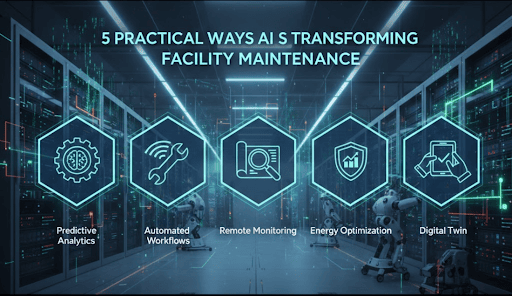
Artificial intelligence is already delivering measurable results across various aspects of facility management. From predicting equipment failures to optimizing energy consumption, these applications turn data into a powerful tool for efficiency and cost savings. Below are five core examples of AI in action.
1. Predictive Maintenance for Critical Assets
Predictive maintenance uses AI algorithms to analyze real-time data from sensors on critical equipment, monitoring factors like vibration, temperature, and performance. This use of predictive analytics allows the system to identify subtle signs of degradation and forecast potential failures with a high degree of accuracy. Unlike preventive maintenance, which operates on a fixed schedule, this approach enables teams to schedule repairs at the most opportune time—before a catastrophic failure occurs but without performing unnecessary service. This minimizes operational disruption, reduces repair costs, and extends the useful life of valuable assets.
2. Automated Work Order Triage and Assignment
Facility managers are often inundated with maintenance requests from various sources. AI can automate the entire intake process by categorizing new work orders, assessing their urgency based on predefined rules and historical data, and assigning them to the technician with the right skills and availability. These smart maintenance systems reduce the manual administrative burden on managers, prevent critical issues from getting overlooked, and ensure a faster, more efficient response. The system learns over time, becoming even better at prioritizing tasks that pose the greatest risk to safety or operations.
3. Intelligent Energy Management
Energy is one of the largest operational expenses for any facility. AI-powered building management systems (BMS) continuously optimize HVAC and lighting based on real-time conditions. The system analyzes data from occupancy sensors, weather forecasts, and utility rate schedules to make constant, incremental adjustments that reduce consumption without impacting comfort or safety. This goes far beyond simple timers, creating a dynamic energy strategy that directly lowers utility bills and helps organizations achieve their corporate sustainability goals.
4. AI-Powered Spare Parts Inventory Optimization
Managing spare parts inventory is a delicate balance. Too little stock leads to extended downtime while waiting for a delivery, while too much ties up capital in depreciating assets. AI analyzes historical work order data, asset failure predictions, and supplier lead times to recommend optimal inventory levels for every component. It can automatically trigger reorder points and even identify trends in parts consumption, ensuring that technicians have what they need for both planned and unplanned repairs without carrying costly excess stock.
5. Enhanced Safety and Compliance Monitoring
Maintaining a safe and compliant environment is a top priority. AI-powered computer vision can analyze security camera feeds to automatically detect safety hazards in real time, such as liquid spills, blocked fire exits, or personnel not wearing required PPE. The system can issue immediate alerts to managers for intervention. Furthermore, AI can automate compliance checks and generate meticulous documentation for regulatory audits, reducing administrative workload and minimizing the risk of costly fines or legal issues.
How to Get Started with eWorkOrders
Our process is designed to help you quickly understand how a modern CMMS can streamline your operations. We focus on providing a solution tailored to your specific maintenance challenges.
- Tell us about your maintenance management needs (quick online form or call).
- Get a live demo of eWorkOrders CMMS/EAM software to see how it can simplify your maintenance operations.
- Receive a customized plan to streamline your workflows—from work orders and preventive maintenance to asset tracking and inventory control.
- Start using an award-winning CMMS trusted by thousands of businesses across industries including manufacturing, healthcare, food & beverage, and facilities management.
- Work with our expert support team with 30+ years of experience delivering top-rated service, training, and implementation.
Why Choose eWorkOrders?

We provide a proven, powerful, and user-friendly platform backed by decades of industry expertise. Our focus is on delivering tangible value and exceptional support to every client.
- Award-winning CMMS and EAM software trusted by thousands of organizations across manufacturing, healthcare, food & beverage, utilities, and facilities management.
- Over 30 years of experience delivering proven maintenance management solutions and exceptional customer support.
- Cloud-based platform with real-time visibility into work orders, assets, preventive maintenance, and inventory control.
- Flexible configuration, mobile access, and API integration to fit any organization’s maintenance workflows and compliance needs.
- Recognized by G2, Capterra, and Software Advice for Best Value, Ease of Use, and Customer Support.
Conclusion
From predictive maintenance and inventory optimization to intelligent energy management, AI is fundamentally reshaping facility operations for the better. These technologies are no longer theoretical concepts but practical tools that deliver significant returns by reducing downtime, cutting costs, and improving safety. The essential foundation for harnessing this power is a robust, modern CMMS capable of capturing clean and structured data from across your operations. By implementing a powerful data management system, you prepare your organization to leverage these advancements and stay ahead of the curve. Investing in a strong foundation for AI facility maintenance is the first step toward a more efficient and resilient future. Book a demo today!
Frequently Asked Questions About AI in Maintenance
Do I need a team of data scientists to use AI facility maintenance?
No. Modern CMMS platforms are designed to integrate AI-powered features with user-friendly dashboards. The system handles the complex analysis, presenting you with actionable insights and automated workflows, not raw data.
Is AI maintenance only suitable for large, new buildings?
Not at all. Scalable, cloud-based smart maintenance systems can be implemented in facilities of any age or size. The key is to start by capturing quality data on your critical assets, which can be done with simple sensors and a modern CMMS.
How does AI work with a CMMS?
A CMMS serves as the central nervous system, collecting data from work orders, asset histories, and inventory. AI acts as the brain, analyzing that data to identify patterns, predict future needs, and automate routine decisions, making your entire maintenance operation more intelligent.
What is the typical ROI for implementing AI maintenance solutions?
The ROI varies based on facility size and asset complexity, but it’s typically significant. Reductions in equipment downtime, lower energy bills, and optimized inventory directly contribute to cost savings. Most organizations see a return through the prevention of a single major asset failure.


