Selecting the right Computerized Maintenance Management System (CMMS) is a critical decision for any asset-intensive organization. While most platforms offer core features like work order management and preventive maintenance scheduling, a generic, one-size-fits-all solution often fails to address the specific operational and regulatory challenges unique to your sector. The modern CMMS industry has evolved beyond basic functionality, offering specialized systems designed to meet the distinct needs of different environments, from manufacturing floors to offshore oil rigs.
An effective CMMS is not just a digital logbook; it’s a strategic tool for optimizing asset performance, ensuring compliance, and driving down operational costs. Choosing a system built with your industry’s nuances in mind—whether it’s managing FDA regulations with food and beverage management software or tracking complex components in aerospace—is the most direct path to achieving a significant return on investment. This guide compares leading CMMS solutions by their industry specializations to help you identify a platform that aligns directly with your business objectives and workflows.
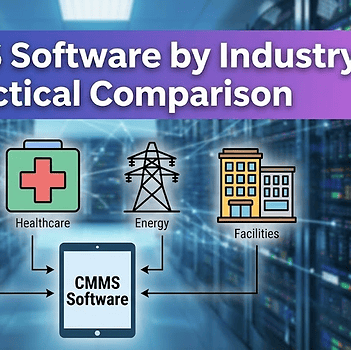
Why an Industry-Specific CMMS Delivers Better ROI
Opting for a CMMS tailored to your industry provides tangible advantages over a general-purpose system. These platforms are designed with your specific challenges in mind, which translates to faster implementation, higher user adoption, and more impactful business outcomes. They go beyond basic maintenance tracking to become an integral part of your operational and compliance strategy.
- Regulatory Compliance: Industry-specific CMMS solutions often include pre-built checklists and reporting templates for standards like FDA (food), ISO 9001 (manufacturing), or ISM Code (maritime). This simplifies audit preparation and reduces the risk of non-compliance penalties.
- Asset Management Nuances: A CMMS for the oil and gas industry is built to handle high-value, complex assets in harsh environments, while a system for fleet management focuses on telematics and mobile assets. Specialization ensures the software speaks your operational language.
- Targeted KPIs and Reporting: Specialized platforms provide industry-relevant dashboards and reports out of the box. This allows leadership to immediately track the metrics that matter most for their sector’s performance, such as Overall Equipment Effectiveness (OEE) in manufacturing or asset uptime in utilities.
- Optimized Workflows: From managing linear assets in utilities to tracking batch-specific clean-in-place (CIP) procedures in the food industry, a specialized CMMS aligns with existing processes. This reduces the need for costly customization and shortens the learning curve for your team.
Our Evaluation Methodology
To provide a practical comparison, we selected and evaluated these CMMS platforms based on criteria that directly impact their value in a real-world operational setting. Our focus was on identifying solutions that have demonstrated a clear commitment to serving the specific needs of their target industries.
- Industry-Specific Features: We prioritized solutions with a proven track record and features explicitly designed for one or more target industries, such as automotive, food and beverage, or maritime.
- Scalability and Integration: The list includes platforms capable of scaling with business growth and integrating with other essential systems like ERP, SCADA, and financial software.
- User Experience & Mobility: We considered the ease of use for both managers and technicians, especially the quality and functionality of mobile applications for fieldwork.
- Customer Support and Reputation: Selection was informed by market reputation, customer reviews, and the quality of implementation support and training provided.
10 Leading CMMS Solutions by Industry Specialization
The following platforms are recognized for their ability to address the unique maintenance and asset management challenges of specific industries. We’ve analyzed their core strengths and ideal use cases to help you find the right fit for your operations.
eWorkOrders

Role: Flexible CMMS for Multi-Industry Compliance
Snapshot: eWorkOrders is a highly configurable, cloud-based CMMS/EAM platform known for its robust feature set and exceptional customer support. Serving thousands of clients across manufacturing, healthcare, facilities, and government, it excels at adapting to complex workflows and stringent regulatory requirements. The system provides comprehensive modules for work orders, preventive maintenance, asset management, inventory control, and detailed reporting. Its flexibility allows organizations to tailor the software to their exact processes without requiring expensive custom development, ensuring a solution that grows with the business and meets evolving compliance demands.
Core Strength: Deep configurability for workflows, compliance reporting, and asset management across multiple sites.
Best For: Organizations in manufacturing, facilities management, and food & beverage needing a scalable and customizable maintenance solution.
Pro Tip: Use the custom reporting module to create dashboards that track industry-specific compliance metrics for audits.
Fiix CMMS
Role: Manufacturing & Industrial CMMS
Snapshot: As part of the Rockwell Automation family, Fiix offers a powerful, user-friendly CMMS that excels in manufacturing environments. Its key advantage is the ability to connect maintenance teams with real-time operations data from the factory floor. This integration helps bridge the gap between maintenance activities and production outcomes, enabling teams to make data-driven decisions that directly impact metrics like Overall Equipment Effectiveness (OEE). The platform is designed to help manufacturers move from reactive to proactive maintenance by providing the tools and insights needed to predict failures and optimize performance.
Core Strength: Native integration with Rockwell Automation’s FactoryTalk suite and other industrial systems.
Best For: Manufacturing plants that want to integrate maintenance data directly with production systems.
Pro Tip: Connect Fiix to your PLCs and sensors to automate work order creation based on machine conditions.
UpKeep
Role: Mobile-First Asset Operations Management
Snapshot: Recognized as a G2 Leader, UpKeep provides a mobile-centric platform that simplifies maintenance for technicians on the go. Its intuitive design focuses on empowering field teams with all the information they need, including asset histories, manuals, and work order details, directly on their mobile devices. The platform is particularly effective for organizations with distributed assets, such as in fleet or property management. By streamlining communication and data entry from the field, UpKeep reduces administrative burden and increases wrench time, making maintenance operations more efficient and responsive across the board.
Core Strength: Intuitive mobile interface and strong asset and work order management capabilities for distributed teams.
Best For: Fleet management, property management, and manufacturing companies prioritizing mobile accessibility.
Pro Tip: Use the QR code feature to allow any team member to scan an asset and submit a work request.
Helm Connect
Role: Maritime Maintenance & Compliance Software
Snapshot: Helm Connect is purpose-built for the unique demands of the maritime and offshore industry. It goes beyond standard maintenance to integrate compliance, personnel management, and vessel operations into a single platform. The software helps operators meet strict regulatory standards like the US Coast Guard’s Subchapter M and the ISM Code by streamlining safety documentation, drills, and audits. Its focus on vessel-specific workflows, from engine room maintenance logs to crew scheduling and certifications, makes it an indispensable tool for ensuring both operational reliability and regulatory adherence in a high-stakes environment.
Core Strength: Deep focus on maritime-specific workflows, including vessel maintenance, safety documentation, and crew scheduling.
Best For: Tugboat, ferry, and offshore support vessel operators needing an all-in-one compliance and maintenance solution.
Pro Tip: Set up recurring compliance forms and checklists to automate documentation for inspections and audits.
eMaint CMMS
Role: Industrial & Automotive Manufacturing CMMS
Snapshot: As a Fluke-owned company, eMaint offers a comprehensive CMMS that excels at connecting maintenance teams with asset reliability data. Its strength lies in facilitating predictive maintenance (PdM) strategies. By integrating directly with Fluke’s advanced diagnostic tools and sensors, eMaint allows teams to monitor asset health in real time and trigger maintenance based on actual condition rather than fixed schedules. This capability is highly valuable in the CMMS software for automotive industry and other industrial settings where unplanned downtime is extremely costly, helping to maximize asset uptime and extend equipment life.
Core Strength: Strong predictive maintenance (PdM) capabilities and integration with Fluke reliability tools.
Best For: Automotive manufacturing and industrial facilities focused on maximizing asset reliability and uptime.
Pro Tip: Integrate vibration or thermal sensors with eMaint to automate work orders based on condition alerts.
MaintainX
Role: Workflow & Procedure Management
Snapshot: MaintainX is a modern, communication-focused platform that blends work orders with checklists, team messaging, and standard operating procedures (SOPs). This unique approach makes it highly effective in regulated industries like food and beverage or hospitality, where procedural adherence is critical for safety and quality. The mobile-first design ensures that technicians can easily access and complete digital checklists for tasks like sanitation or safety inspections, providing a clear audit trail. By centralizing communication and procedure management, MaintainX helps teams ensure that work is done correctly and consistently every time.
Core Strength: Excellent for standardizing procedures (SOPs) and ensuring they are followed correctly via its mobile app.
Best For: Food & beverage, hospitality, and manufacturing companies focused on operational procedure adherence.
Pro Tip: Digitize your recurring safety and quality checklists to create an instant, paperless audit trail.
IBM Maximo Application Suite
Role: Enterprise Asset Management (EAM) for Heavy Industry
Snapshot: IBM Maximo is a market-leading Enterprise Asset Management (EAM) solution designed for large-scale, complex operations in sectors like oil and gas, utilities, and transportation. It leverages AI, IoT data, and advanced analytics to manage the entire asset lifecycle, from procurement to decommissioning. Maximo’s powerful predictive maintenance capabilities, powered by IBM Watson, help organizations anticipate asset failures and optimize maintenance strategies across vast portfolios of critical equipment. It is a comprehensive, enterprise-grade system for organizations that require deep analytical insight and control over their capital-intensive assets.
Core Strength: Advanced analytics, AI-powered predictive maintenance, and comprehensive asset lifecycle management.
Best For: Large enterprises in the oil and gas, utilities, and transportation industries with complex asset portfolios.
Pro Tip: Utilize its AI-driven insights to optimize MRO inventory levels and reduce carrying costs.
Hippo CMMS
Role: User-Friendly CMMS for Facilities
Snapshot: Hippo CMMS stands out for its visually intuitive interface that simplifies maintenance management, particularly for non-technical users. It is a strong fit for facilities-based industries like healthcare, education, and hospitality. A key feature is its use of interactive floor plans and site maps, which allow users to pinpoint the location of an issue when submitting a work request and help technicians quickly find assets. This user-friendly approach lowers the barrier to entry for adopting a CMMS, encourages broad user adoption, and ensures that maintenance operations are managed efficiently without a steep learning curve.
Core Strength: Interactive floor plans and a simple, user-friendly interface for managing work orders and assets.
Best For: Hospitals, schools, and hotels looking for an easy-to-implement and easy-to-use maintenance system.
Pro Tip: Upload your facility floor plans to allow users to drop a pin to report issues visually.
Limble CMMS
Role: Fast-Implementation Manufacturing CMMS
Snapshot: Limble is known for its quick setup and exceptionally user-friendly design, which helps maintenance teams get organized and proactive with minimal training. The platform is designed to deliver a fast return on investment by making it simple to digitize assets, build preventive maintenance schedules, and manage work orders. Its straightforward approach is ideal for small to mid-sized manufacturing and facilities teams that need a powerful system without the complexity and long implementation timelines of larger enterprise solutions. Limble empowers teams to quickly transition from reactive firefighting to organized, proactive maintenance.
Core Strength: Ease of use and rapid implementation, allowing teams to see ROI quickly.
Best For: Small to mid-sized manufacturing and facilities teams needing a powerful but straightforward CMMS.
Pro Tip: Use the drag-and-drop PM builder to quickly set up maintenance schedules for your critical assets.
SSG Insight (Agility)
Role: CMMS/EAM for Complex Operations
Snapshot: Agility by SSG Insight is a robust and highly customizable solution designed to support complex maintenance, asset, and workforce management in demanding industries. It is well-suited for sectors like logistics, aerospace, and heavy manufacturing that have intricate operational requirements and stringent safety protocols. The system provides deep functionality for managing complex asset hierarchies, permit-to-work systems, and detailed audit trails for safety-critical maintenance processes. Its customizability allows organizations to build a system that precisely mirrors their unique workflows, ensuring control and visibility over every aspect of their maintenance operations.
Core Strength: Highly customizable system for managing complex assets and safety-critical maintenance processes.
Best For: Logistics, aerospace, and heavy manufacturing sectors with intricate operational requirements.
Pro Tip: Configure the system’s safety modules to manage permits-to-work for high-risk maintenance tasks.
Getting Started with eWorkOrders
Our process is designed to be straightforward, ensuring we understand your needs and can deliver a solution that provides immediate value.
- Tell us about your maintenance management needs (quick online form or call).
- Get a live demo of eWorkOrders CMMS/EAM software to see how it can simplify your maintenance operations.
- Start using an award-winning CMMS trusted by thousands of businesses across industries including manufacturing, healthcare, food & beverage, and facilities management.
- Work with our expert support team with 30+ years of experience delivering top-rated service, training, and implementation.
Why Choose eWorkOrders?
We combine decades of experience with a flexible, powerful platform to deliver maintenance solutions that drive real results.
- Proven Across Industries: We are an award-winning CMMS and EAM software trusted by thousands of organizations across manufacturing, healthcare, food & beverage, utilities, and facilities management.
- Decades of Expertise: With over 30 years of experience, we deliver proven maintenance management solutions and exceptional customer support.
- Real-Time Visibility: Our cloud-based platform provides instant insight into work orders, assets, preventive maintenance, and inventory control from any device.
- Unmatched Flexibility: Benefit from flexible configuration, mobile access, and API integration to fit your organization’s unique maintenance workflows and compliance needs.
- Recognized for Excellence: We are consistently recognized by G2, Capterra, and Software Advice for Best Value, Ease of Use, and Customer Support.
Find the Right CMMS for Your Industry
Choosing from the broad CMMS market can be overwhelming, but a generic tool rarely delivers optimal results for specialized operations. Selecting a platform tailored to your industry’s specific compliance demands, asset types, and workflows is the most direct path to improving efficiency, reducing operational costs, and maximizing equipment uptime. The right software acts as a strategic partner, providing the targeted functionality needed to turn maintenance from a cost center into a value driver. By focusing on a solution designed for your world, you ensure faster adoption and a more significant impact on your bottom line. To see how a flexible, industry-proven platform can be configured for your exact needs within the CMMS industry, explore a tailored solution. Book a demo today! https://eworkorders.com/schedule-a-free-demo-or-contact-us/
Frequently Asked Questions (FAQ)
What is the main difference between CMMS and EAM software?
A CMMS (Computerized Maintenance Management System) focuses on managing maintenance activities once an asset is operational. EAM (Enterprise Asset Management) covers the entire asset lifecycle, from planning and procurement to operation, maintenance, and disposal. Many modern CMMS platforms, like eWorkOrders, include robust EAM capabilities.
How does a CMMS help with compliance in the food and beverage industry?
A CMMS designed for the food industry helps by automating documentation for audits (e.g., FDA, SQF), scheduling and tracking sanitation tasks, and managing calibration records for equipment. This ensures that food safety standards are consistently met and that a complete, verifiable history is always available for inspectors.
Can a CMMS integrate with our company’s existing ERP system?
Yes, most leading CMMS solutions offer API integrations to connect with ERPs (like SAP or Oracle), accounting software, and other business systems. This allows for seamless data flow, such as sharing inventory data or maintenance costs, creating a single source of truth for your operations.
What is a typical implementation timeline for a new CMMS?
Implementation times vary based on complexity. A straightforward, cloud-based CMMS for a single site can be up and running in a few weeks. A multi-site enterprise implementation with extensive data migration and custom integrations may take several months, where a phased approach is often recommended.


