Workplace safety is of utmost importance in every organization. Employers are responsible for providing a safe and secure work environment for their employees. However, workplace accidents can occur despite best efforts to mitigate risks. Lockout/tagout, commonly known as LOTO, is a crucial program designed to protect workers from hazardous energy sources during maintenance, servicing, or repair of equipment. This article covers what a lockout/tagout program must contain, how to write energy-control procedures for your equipment, and what OSHA expects you to be able to prove.
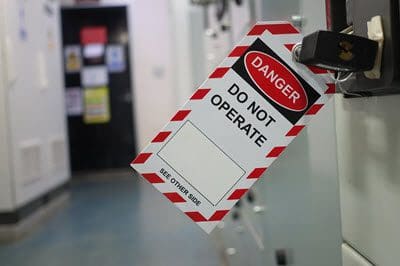
A lockout/tagout program is the written system an employer uses to control hazardous energy. It contains machine-specific energy-control procedures, trained and documented authorized employees, standardized locks and tags, and a certified inspection of every procedure at least once a year.
What Is A Lockout/Tagout Program?
Lockout and tagout, commonly referred to as LOTO, is a crucial OSHA standard that regulates the control of hazardous energy. Its primary objective is to protect employees by establishing necessary measures for disabling machinery or equipment that could release hazardous energy or start unexpectedly, potentially causing severe harm or even death to workers during machinery maintenance or work.
Lockouts and tagouts entail specific practices and procedures designed to isolate machinery energy hazards by de-energizing and locking out the equipment’s ability to power on.
Failure to adhere to lockout/tagout regulations is one of OSHA’s top 10 most common violations. Non-compliance with regulations not only results in fines, but also creates hazardous situations for employees and everyone in the work environment.
OSHA estimates that compliance with the lockout/tagout standard prevents an estimated 120 fatalities and 50,000 injuries each year. Workers injured by exposure to hazardous energy lose an average of 24 workdays to recuperation. Source: OSHA Fact Sheet, Lockout/Tagout
It’s crucial to take lockout/tagout procedures seriously. Failure to follow the prescribed procedures and requirements can lead to grave injuries or fatalities caused by machinery and equipment.
If you are looking for the basics instead — what the term means, the types of hazardous energy, the devices involved, and the step-by-step procedure — start with our complete lockout tagout guide. This page is about building and running the program itself.
What Your Written Energy-Control Procedure Must Contain
This is where most programs fall short. OSHA does not accept a single generic policy covering every machine in the plant. Each piece of equipment with hazardous energy needs its own documented procedure, and that document has to be specific enough that a trained employee could follow it without asking anyone.
Energy-control procedures should include:
- How to use the procedure — scope, purpose, and who it applies to
- Steps to shut down, isolate, block, and secure the machine
- Steps to place and remove lockout/tagout devices
- How responsibility for lockout/tagout devices is identified
- A process for testing the machine to verify that lockout devices and other energy-control measures are effective
Vague or one-size-fits-all instructions do not satisfy the standard, and they are the first thing an inspector asks to see.
Energy-Control Procedure Template
Use this structure for each machine. Fill in everything in brackets for each asset.
Procedure: [Equipment name and asset ID]
Location: [Building / line / area]
Written by: [Name] | Date: [Date] | Last reviewed: [Date]
1. Energy sources — list every source, its type, its magnitude, and its isolation point.
Example: Electrical, 480V, disconnect DS-14 on north wall. Pneumatic, 90 psi, ball valve BV-3.
2. Shutdown sequence — the exact order of operations to stop the machine safely.
3. Isolation — which energy-isolating device to operate for each source, and in what order.
4. Lockout/tagout application — where each lock and tag goes, and how many the job needs.
5. Stored energy — what residual energy remains and exactly how to release, block, or dissipate it.
6. Verification — the specific test that proves isolation worked, and what a safe result looks like.
7. Restoration — the order for removing devices and returning the machine to service.
Examples by Equipment Type
The procedure changes with the machine. These illustrate how specific the isolation section needs to be.
| Equipment | Energy Sources to Address | Commonly Missed |
|---|---|---|
| Conveyor | Electrical drive motor; pneumatic diverters; gravity on inclined sections | Product load on an incline that can roll back when the drive is released |
| Hydraulic press | Electrical supply; hydraulic pressure; accumulator; ram at height | Accumulator pressure remaining after the pump is locked out; the ram needs blocking |
| Electrical panel | Line side of the disconnect; control circuits; capacitors; backfeed from UPS or generator | Backfeed from a secondary source; stored charge in capacitors |
| Pump or compressor | Electrical supply; line pressure; thermal energy; rotating inertia | Pressure trapped between closed valves; a flywheel still spinning down |
OSHA Requirements for a Compliant Program
The OSHA standards for The Control of Hazardous Energy (Lockout/Tagout), Title 29 Code of Federal Regulations (CFR) Part 1910.147 and 1910.333, establish guidelines for disabling machinery during maintenance work and protecting workers from electrical circuits or equipment.
To comply with the standards, you must implement a lockout or tagout program that takes the equipment offline, locks it into an “off” position, and tags it with the name of the authorized person who will remove the lock.
These are the basic requirements outlined in the standards. They are guidelines rather than a comprehensive list, and specific requirements vary by equipment type and industry — check the OSHA standard and your state regulations.
- Employers must develop, implement, and enforce an energy control program and procedures.
- Use lockout devices to disable machinery from releasing hazardous energy whenever possible. Where that is not possible, tagout devices may serve instead, provided they give protection equal to a lockout program.
- Lockout/tagout devices must be protective, substantial, and authorized for the machinery.
- All new, refurbished, or overhauled equipment must accept a lock.
- Identify every user of lockout/tagout devices, and let only the employee who applied a lock remove it.
- Provide effective training on hazardous energy control procedures, workplace energy control plans, and OSHA lockout/tagout requirements to everyone who works on, around, and with heavy machinery and equipment.
- Repeat training as required, and inspect every procedure at least annually.
- Inspect energy control procedures regularly, then certify each inspection.
Employers are responsible for implementing a safe and effective lockout/tagout system to protect their employees from workplace accidents caused by hazardous energy.
Who Runs the Program
Lockout/tagout systems involve two categories of workers: authorized personnel and affected individuals. An authorized worker possesses the required knowledge, training, and experience to carry out hazardous energy control procedures. Therefore, before any repair or maintenance work begins, the authorized person must tell all affected employees that the team will apply lockout/tagout procedures.
The authorized worker places the locks and tags, manages the keys, and alone may remove them once the work finishes. Meanwhile, any worker whose job depends on that equipment — but who does not perform the lockout or the maintenance — counts as an affected person.
Your program has to name these people, not just describe the categories. Training records must name each person, the topic, and the date. Our guide covers the full breakdown of authorized, affected, and other employees.
What Your Procedure Must Specify at Each Step
Each company tailors its documented program to its own policies and equipment. So when you write a procedure, these are the decisions the document must make for the technician, rather than leaving them to judgment on the floor.
Notification
The procedure must name who notifies affected employees, and what they hear: which equipment is going down, why, how long it will stay out of service, and who to contact for more information.
Hazard Identification
For each energy source, the document records the energy type (electrical, mechanical, hydraulic, thermal, pneumatic, chemical), the magnitude (volts, temperature, psi), the specific hazard, and the method used to control it. Magnitude matters — “electrical” is not a procedure, “480V at disconnect DS-14” is.
Shutdown Sequence
Stopping a machine out of order can create hazards of its own. The procedure lists the exact sequence: affected personnel clear the area, then the authorized person shuts down using normal stopping means — a STOP button, a switch to OFF, closing a valve. The order is not optional.
Isolation Points
The procedure names the energy-isolating device for each source: circuit breaker, valve, switch, blank flange, restraining device. Note carefully: ON/OFF and STOP buttons do not qualify as energy-isolating devices. An isolating device physically prevents the transmission of energy; an operating control merely tells the machine to stop.
Device Application
A lockout device holds the isolating device in the safe or off position, and a safety padlock prevents its removal. The procedure states how many locks the job needs and where each one goes — line valves, circuit breakers and electrical disconnects, safety blocks on movable parts, blank flanges on pipelines. The tag names the employee who applied it and why, so anyone with a question knows who to ask.
Stored Energy Release
Locking the isolation point is not the end. The procedure lists every place residual energy can hide — springs, capacitors, elevated machine members, hydraulic systems, rotating flywheels, air, gas, steam, or water pressure — and states how to relieve pressure, bleed liquids, vent gases, and release tension until the energy is gone.
Verification
This step saves lives, and it is the one most often skipped under time pressure. The procedure must state the specific test: confirm no one stands exposed, attempt to operate the equipment using the normal controls, check the gauges, then return the control to OFF. Document what a safe result looks like.
Restoration
The procedure closes the loop: reassemble the equipment with guards and safety devices reinstalled and access panels closed, confirm no tools remain, survey the area so all personnel are clear, set controls to neutral, have each person remove their own lock and tag, then notify affected personnel that the equipment is back in service.
Training, Inspection, and Keeping Procedures Current
To stay compliant, you must train employees who work with machines and equipment so they know their LOTO duties and understand the OSHA standard. Training is not a one-time event. Repeat it when job assignments change, when machines or processes change, when a new hazard appears, or when an inspection catches someone deviating from the procedure.
Procedures also drift. Over time, someone modifies the equipment, adds an energy source, and the document on the wall stops matching the machine. Whenever a procedure changes, update the affected employees and confirm they understand the change, even a minor one. Review and revise your procedures at least annually as part of the energy control program — that review is both an OSHA requirement and the practical moment to refine wording and improve the procedure.
Finally, the inspection needs certification, not just completion. The certification records the machine, the date, the employees involved, and who performed the inspection. An uncertified inspection is, from an auditor’s point of view, an inspection that did not happen.
Lockout/Tagout and Maintenance Safety
Lockout/tagout procedures are crucial for meeting regulatory requirements and ensuring the safety of maintenance technicians and others. With eWorkOrders’ CMMS software, maintenance organizations can track LOTO procedures and keep the documentation that industry standards require.
The CMMS stores all LOTO documentation where maintenance employees can reach it. You can also attach LOTO instructions to work orders, so technicians see the procedure the moment they open the job rather than hunting for a binder. In addition, you can schedule annual procedure inspections as recurring tasks so they trigger on time. Then, during a maintenance audit, the system proves the team followed the procedures — per machine, per event, without a file search.
Conclusion
No one should disregard lockout/tagout procedures or treat them lightly. Failure to de-energize, lock, and tag a machine before working on it can cause severe injury or death if someone restarts that machine while a worker is still inside it. A program is what turns that intention into something repeatable: written procedures per machine, named and trained people, standardized devices, certified annual inspections, and records you can produce on demand.
Therefore, make sure everyone in your organization trains on the lockout/tagout procedures for their own work areas, because their lives and limbs depend on it. Book a demo to see how LOTO documentation looks inside a work-order system.
FAQs
What is a lockout tagout program?
A lockout/tagout program is the written system an employer uses to control hazardous energy. It includes machine-specific energy-control procedures, identified and trained authorized employees, standardized locks and tags, and a certified inspection of each procedure at least annually.
What must a written energy-control procedure include?
Scope and purpose, the steps to shut down, isolate, block, and secure the machine, the steps to apply and remove lockout/tagout devices, how responsibility for those devices is assigned, and the test used to verify that the isolation worked. List each energy source with its type, magnitude, and isolation point.
Does every machine need its own lockout tagout procedure?
Generally yes. OSHA does not accept a single generic policy covering all equipment where machines have multiple energy sources. A narrow exception exists for simple machines with a single energy source that is fully controlled by the person servicing it, but most industrial equipment requires its own documented procedure.
What is the difference between OSHA 1910.147 and 1910.333?
1910.147 is the general standard for the control of hazardous energy during servicing and maintenance. 1910.333 covers safety-related work practices for electrical hazards, including selecting safe work practices when working on or near energized parts. Programs involving electrical work usually need to satisfy both.
Who is responsible for a company’s LOTO program?
The employer is responsible for developing, implementing, and enforcing the program. Day to day, an authorized employee applies locks and tags and is the only person permitted to remove their own. Your program should name the people in each role rather than only describing the categories.
How do you prove LOTO compliance during an audit?
By producing, per machine, the written energy-control procedure, the certification of its most recent annual inspection, and the training records for the employees who performed the work. Programs that keep these in separate binders and spreadsheets struggle here; keeping them attached to the asset and the work order makes the record retrievable on demand.
Disclaimer: This article provides general information only. It does not constitute legal, professional, or compliance advice. Requirements under 29 CFR 1910.147 and 1910.333 depend on your specific equipment, operations, and jurisdiction, and no software makes an organization compliant on its own. We encourage readers to consult the OSHA standards and relevant experts for guidance on their own programs.


