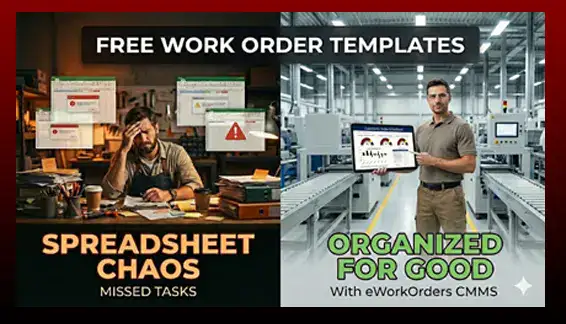
Looking for a free work order template Excel file you can start using right away? A work order is an official document that authorizes, assigns, and tracks a maintenance task from start to finish. It captures the asset, location, problem description, assigned technician, parts needed, priority level, and completion sign-off — creating a complete audit trail for every job your team performs. Without a standardized work order process, maintenance tasks get missed, costs go untracked, and compliance documentation falls apart.
Each free work order template Excel file is designed to help maintenance teams create, track, and manage work orders without complex software.
Start with Excel, Scale with CMMS Stay organized and streamline your maintenance tasks with our free work order templates Excel downloads. Perfect for maintenance teams of any size, these free work order templates Excel files make it simple to create, track, and manage work orders efficiently. Start with Excel to get your team on the same page—and when you’re ready to automate scheduling, mobile access, and reporting, eWorkOrders CMMS is here to help you scale your maintenance operations.
3
Essential Templates
100%
Free Forever
10 min
Setup Time
12,000+
Downloads
Download Your Free Work Order Templates in Excel
Get your free work order template that fits your maintenance process perfectly. Each template is fully customizable in Excel and designed for real-world maintenance operations across facilities management, manufacturing, property management, healthcare, hospitality, government, and education.
Whether you’re managing equipment repairs, preventive maintenance schedules, service requests, or asset history, these work order templates help you standardize maintenance tasks, track work efficiently, and document activity for compliance and reporting.
Easily implement these templates to improve work order organization, streamline maintenance processes, and enhance operational efficiency—ideal for maintenance teams, facility managers, and service departments.
Download now to simplify your maintenance workflow and start organizing work orders like a pro.
General Work Order Template
Perfect for everyday maintenance tasks across any facility or equipment.
Templates work great for small teams. When you’re ready to automate scheduling, tracking, and reporting, upgrade to a full CMMS system.
The Hidden Challenges of Managing Work Orders in Spreadsheets
Spreadsheets are familiar and free—which is why most maintenance teams start there. But as your team and workload grow, Excel can create problems that cost you more time and money than any software subscription ever would.
88%
of spreadsheets contain at least one error
$50B
lost annually to unplanned downtime
3-5x
more costly to fix than to prevent
80%
of unplanned downtime caused by human error
Sources: University of Hawaii, Deloitte, Aberdeen Group
Why Can’t Technicians Access Work Orders in the Field?
Technicians can’t access or update work orders from the field. Everything requires going back to a desktop—slowing down every job.
What Happens When Multiple People Edit the Same Spreadsheet?
Multiple people editing the same file creates conflicting versions. Nobody knows which spreadsheet is current—and critical updates get lost.
Why Do Work Orders Sit Unnoticed in Spreadsheets?
Work orders sit unnoticed. Nobody is alerted when tasks are assigned, overdue, or completed. Managers spend hours chasing status updates.
Why Does Preventive Maintenance Get Missed in Spreadsheets?
Preventive maintenance depends on someone remembering to check the schedule and manually create work orders. Busy weeks mean skipped PMs and avoidable breakdowns.
How Do You Find Past Work Order History Across Hundreds of Files?
Finding a past work order means opening file after file. Asset history, recurring issues, and cost trends are nearly impossible to analyze across hundreds of spreadsheets.
How Long Does It Take to Generate a Maintenance Report from Spreadsheets?
Generating a maintenance report means manually copying data from dozens of files. By the time it’s done, the data is already outdated—and the process starts again next month.
⏱️ What This Really Costs You
Maintenance teams managing work orders in spreadsheets typically spend 10-15 hours per week on administrative tasks—creating work orders manually, chasing status updates, compiling reports, and searching for historical data. At an average labor rate of $35/hour, that’s $18,000–$27,000 per year in pure administrative overhead. eWorkOrders automates all of it.
What Does eWorkOrders CMMS Do That Excel Can’t?
Templates are a great start, but eWorkOrders CMMS automates everything and scales with your team.
Can Technicians Access Work Orders on Mobile?
Technicians access work orders, update statuses, attach photos, and close tasks directly from their iOS or Android devices — without returning to the office.
How Does eWorkOrders Notify Your Team Automatically?
Instant alerts when work orders are created, assigned, or completed. No more chasing people down for updates or status checks.
How Does eWorkOrders Automate Preventive Maintenance Scheduling?
Set schedules once and eWorkOrders automatically creates preventive maintenance work orders based on calendar dates or meter readings.
How Quickly Can You Search Work Order History in eWorkOrders?
Search across thousands of work orders instantly. View complete asset maintenance history, track recurring issues, and identify trends.
How Does eWorkOrders Connect Work Orders to Parts Inventory?
Link work orders directly to parts inventory. See stock levels, auto-deduct parts used, set reorder points, and track costs in real-time.
What Maintenance Reports Does eWorkOrders Generate Automatically?
Live dashboards show work order metrics, cost tracking, technician productivity, and asset performance—no manual data entry required.
When Should You Switch from Templates to CMMS Software?
See what happens when you automate your work orders with eWorkOrders CMMS
Work Order Templates vs. CMMS Software: Which Is Right for Your Team?
Excel templates are a great starting point — but growing maintenance teams need more.eWorkOrders CMMS automates work order management, preventive maintenance scheduling, parts tracking, and compliance reporting so your team can focus on maintenance, not paperwork.
📊 Side-by-Side Comparison
Feature
❌ Excel Templates
✅ eWorkOrders CMMS
Getting Started
Free & easy
Free Demo, Quick Setup
Mobile Access
Office only
iOS, Android, web
Auto Notifications
Manual only
Instant alerts
PM Automation
Manual creation
Auto-generated
Search History
Open each file
Instant search
Parts Integration
Separate tracking
Fully integrated
Asset History
Manual compile
Auto tracking
Team Collaboration
Version conflicts
Real-time updates
Reporting
Manual entry
Auto dashboards
Best For
Small teams
Scaling & growth
💡 When Should You Switch to CMMS?
You’ve outgrown templates if you’re experiencing:
⚠️ Managing 20+ work orders per month
⚠️ Multiple technicians need access at once
⚠️ Preventive maintenance getting missed
⚠️ Hours spent searching for historical data
⚠️ Need mobile access in the field
✅ If 2+ apply — it’s time for eWorkOrders
Most teams see ROI within 2–3 months of switching from spreadsheets to CMMS software — through reduced downtime, fewer missed PMs, and hours saved on admin work every week.
Frequently Asked Questions About Work Order Templates
Find answers to common questions about work order management systems.
Can I customize these templates for my industry?
Yes. All templates are fully editable in Excel. Add fields, rename columns, insert your logo, and restructure for manufacturing, healthcare, facilities, hospitality, government, or any other industry.
What’s the difference between a work order and a service request?
A service request is an informal notification that something needs attention. A work order is the approved action plan—with assigned technician, parts, timeline, and official sign-off. Work orders create accountability.
Can these templates handle preventive maintenance?
Our PM template tracks schedules, frequency, last completed, and next due dates. However, you must manually create each work order when due. eWorkOrders CMMS auto-generates PM work orders so nothing gets missed.
How long should I keep completed work orders?
Best practice is to keep work orders for the operational life of the asset—typically 5-30 years. This history supports warranty claims, compliance audits, and repair-vs-replace decisions. eWorkOrders stores everything digitally with instant search.
Can I use these templates in Google Sheets?
Yes! Simply upload the .xlsx file to Google Drive and open it with Google Sheets. All formulas and formatting carry over automatically.
How do I migrate from Excel to eWorkOrders?
eWorkOrders provides free implementation support including data migration. We import your asset lists, work order history, and PM schedules. Most teams are fully operational within 1-2 weeks—and your data comes with you.
Maintenance Center
Explore our maintenance management resource center to learn how to improve work order processes, optimize preventive maintenance programs, and choose the right CMMS software for your organization. These guides are designed for maintenance managers, facility directors, and operations teams looking to improve efficiency and reduce downtime.
Work Order Management: The Definitive Guide
Your ultimate collection of articles about work order management with eWorkOrders CMMS.
Work Order Guide
Coming Soon
What Is a Work Order?
A deep dive into what a work order is and why it matters for your maintenance team.
Coming Soon
Coming Soon
More Work Order Management Insights on the Way – Stay Tuned for Tips to Streamline Your Maintenance Workflow.
Coming Soon
Take Control of Your Work Order Management Today
Join the world’s most efficient maintenance teams. Experience the speed and accuracy of eWorkOrders Work Order Management software.